

More news on this day
More than 100 Qatar Airways flights to and from Doha’s Hamad International Airport have been cancelled in recent days, leaving thousands of passengers stranded and triggering widespread disruption across major long-haul routes linking Melbourne, London, Dubai, Hong Kong, Singapore and other global hubs.
Get the latest news straight to your inbox!
Mass Cancellations Grip Qatar Airways’ Global Network
The large wave of cancellations stems from an abrupt shutdown of regular commercial operations at Hamad International, Qatar Airways’ primary hub, after regional security concerns forced the airline to ground a significant portion of its schedule. With Doha sitting at the heart of the carrier’s connecting model, the impact has rippled rapidly across its worldwide network.
Operational data shared by industry and passenger channels indicates that well over 100 Qatar Airways flights have been scrubbed over several days, affecting departures and arrivals in Europe, Asia, the Middle East and Australia. Long-haul services to and from cities such as Melbourne, London Heathrow, Dubai, Hong Kong and Singapore have been especially hard hit as aircraft and crews remain out of position.
The airline has mounted a limited program of repatriation flights out of Doha to clear a mounting backlog of transit passengers, focusing first on those already stranded in the terminal. However, the bulk of its regular schedule remains suspended, and capacity on the special flights has fallen far short of total demand.
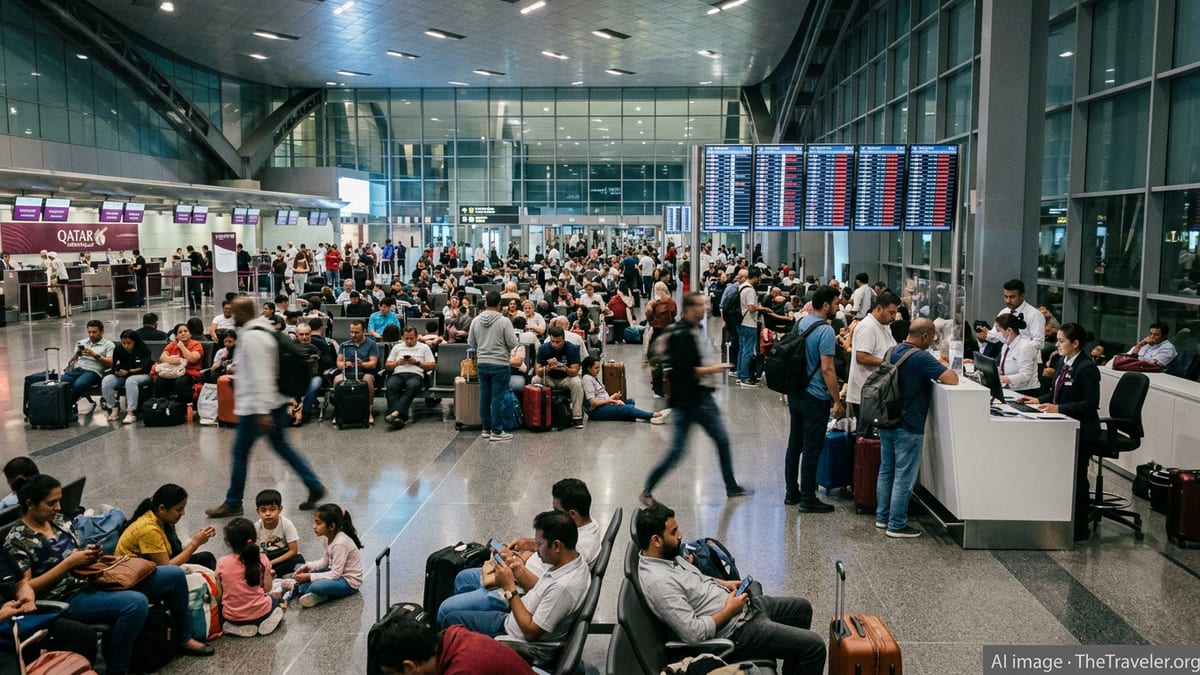
Hamad International, normally one of the Middle East’s busiest transfer hubs, has effectively shifted from routine hub operations to crisis management, with its concourses crowded by travellers sleeping in chairs, on the floor and in makeshift rest areas as they wait for news of onward travel.
Stranded Passengers Describe Days of Uncertainty
Accounts from travellers stuck in Doha paint a picture of prolonged uncertainty and frayed tempers. Many passengers report spending multiple nights inside Hamad International, with repeated cancellations wiping out rebooked itineraries and leaving them unsure when they will get home.
Families with young children and elderly passengers have described struggling to secure hotel rooms or meal vouchers during the disruption, particularly when cancellations were confirmed late at night or in the early hours of the morning. Some have turned to social media and online forums to coordinate information, share advice and chronicle their attempts to rebook flights.
On the ground, queues at Qatar Airways customer service desks have stretched through terminal corridors whenever new updates are posted to departure boards. Travellers report difficulty reaching call centres, while many overseas stations appear to have limited authority to confirm alternative routings or endorse tickets on partner airlines.
Despite these challenges, a gradual trickle of passengers has begun to leave Doha on the special repatriation services. These flights have prioritised stranded transfer customers, people with urgent medical or compassionate travel needs and those who have already been waiting several days inside the airport.
Global Hubs From Melbourne to London Feel the Shock
The disruption radiating out from Doha has quickly reached other major aviation hubs. In Melbourne, travellers booked on Qatar Airways’ popular one-stop services to Europe have reported last-minute cancellations and difficulty rebooking as alternative options with other carriers sell out or surge in price.
In London, one of Qatar Airways’ busiest European gateways, cancellations from Doha have caused a cascade of missed connections and abandoned itineraries, particularly for passengers heading onwards to destinations in Africa and Asia. Some travellers have resorted to purchasing entirely new tickets home on different airlines when refund timelines and limited availability made rebooking impractical.
Airports in Dubai, Hong Kong and Singapore, all heavily integrated into global connecting networks, are also seeing knock-on effects. Passengers who began their journeys in these cities with plans to connect through Doha have found themselves turned back at origin, delayed for days, or rerouted through alternative hubs such as Istanbul or European capitals where partner capacity is still available.
Travel agents in several markets report a spike in last-minute itinerary changes as clients attempt to avoid routings via Doha, at least in the short term. Inbound tourism operators are also bracing for cancellations and no-shows from travellers who can no longer reach their destinations on schedule.
Qatar Airways’ Recovery Effort and Rebooking Policies
Qatar Airways has announced a series of measures aimed at stabilising operations and assisting affected passengers, including expanded rebooking flexibility, fare waivers and the use of partner airlines to help clear the backlog. Industry notices indicate that customers whose flights are cancelled may, in certain cases, be rebooked onto other carriers or alternative routings without additional fare collection.
The airline is also operating a rolling schedule of repatriation flights from Doha to key cities such as London, Paris, Frankfurt, Madrid and Rome, with capacity allocated first to passengers already stranded in transit at Hamad International. Seats are being assigned directly by Qatar Airways, often at short notice, based on length of delay and individual travel needs.
However, the scale of the disruption means that recovery is expected to take several days at minimum, and potentially longer for those originating in cities with fewer daily frequencies. Travellers holding future bookings have been urged to monitor flight status closely and consider adjusting their plans if their travel is not time-sensitive.
Consumer advocates are reminding passengers that, depending on their point of origin and ticket conditions, they may be entitled to refunds when flights are cancelled, even if they ultimately choose to arrange their own transportation using different airlines or routes.
What Travellers Should Do Now
For passengers still stuck at Hamad International, the immediate priority remains securing a confirmed seat on one of the limited outbound services. Airport authorities advise checking departure boards frequently, staying close to Qatar Airways service counters and ensuring that contact details in reservations are correct so that last-minute notifications can be received.
Those yet to begin their journeys but booked to fly with Qatar Airways in the coming days are being encouraged to verify their flight status repeatedly in the 24 hours before departure. Where cancellations appear likely or have been officially posted, travellers may be able to shift dates, reroute through a different hub or request a refund, depending on the ticket type and local regulations.
Travel experts say the episode underscores the importance of flexible bookings, comprehensive travel insurance and maintaining some buffer time for long-haul connections. For now, they add, anyone planning complex itineraries across multiple regions should factor in the possibility of sudden airspace restrictions or airline schedule changes when choosing routes.
As Qatar Airways works to restore normal operations from Doha, attention will remain fixed on Hamad International’s departure boards, where thousands of stranded passengers are waiting for their long-delayed journeys to finally resume.