

More news on this day
Qatar Airways has suspended its flights at San Francisco International Airport as Qatari airspace remains largely closed due to the escalating conflict centered on Iran, disrupting one of the Bay Area’s key links to the Gulf and forcing travelers and airlines to rapidly redraw long-haul routes.
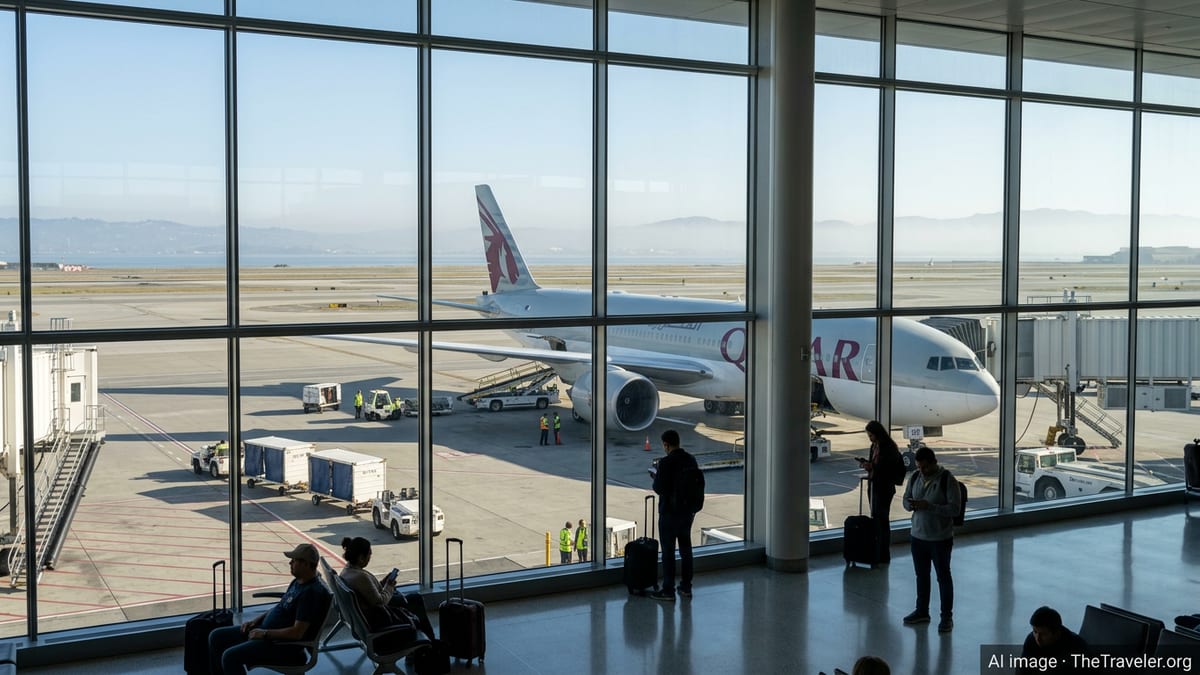
San Francisco Service Quietly Paused Amid Wider Qatar Shutdown
The halt to Qatar Airways’ San Francisco operations is part of a broader suspension of the carrier’s global scheduled network after Qatari authorities restricted airspace in late February, following missile strikes and rising regional tensions. While the airline has issued generic service bulletins about stopping almost all regular passenger flights, the effects are now clearly visible at major U.S. gateways, including San Francisco International Airport, where the Doha service has disappeared from departure boards.
In recent days, aviation advisories and airline statements have confirmed that Qatar Airways’ scheduled passenger flights remain on hold, with only limited relief and repatriation services operating from Doha to a handful of cities. Industry trackers report dozens of the airline’s widebody jets parked at foreign airports, underscoring how quickly a hub-and-spoke network can be frozen when a home country’s airspace is constrained.
San Francisco had been one of Qatar Airways’ flagship West Coast destinations, offering a one-stop link to South Asia, Africa and the Middle East via Doha. The suspension effectively cuts that corridor for now, pushing Bay Area travelers toward alternative hubs in Europe and Asia or to competing Gulf carriers that have secured more flexible routings around the conflict zone.
Airport officials in San Francisco have so far deferred to airline communications, pointing passengers to carrier channels for real-time updates. On the ground, the impact is immediately visible in quieter international check-in areas and a reshuffled mix of long-haul operators serving the transpacific and transatlantic markets.
What the Suspension Means for Current and Future Travelers
For travelers booked on Qatar Airways to or from San Francisco through mid-March, the practical effect is that their original itineraries are highly unlikely to operate as scheduled. Across the network, the carrier has been offering complimentary date changes within a limited window or refunds for unused tickets on flights that fall within the suspension period, while advising passengers not to go to the airport without a new, confirmed booking.
In many cases, customers are being rebooked on partner or competitor airlines using other hubs, including European and Asian gateways, to bypass the Gulf bottleneck. Recent reports from passengers show reroutings that replace a single Doha connection with more complex journeys via London, Frankfurt, Singapore or New Delhi, often adding hours to total travel time and increasing the risk of missed onward connections.
Travel agents and corporate travel managers say the uncertainty is particularly acute for those with trips scheduled later in March. Official guidance from Qatar Airways and regional regulators has generally extended the suspension in short increments, making it difficult for travelers to know whether to wait for a possible resumption or proactively shift to alternative carriers.
At San Francisco International Airport, airlines such as Air India, United Airlines and European carriers are seeing increased inquiries from passengers seeking last-minute options to South Asia, the Middle East and East Africa. Fare data from major booking platforms suggest that prices on key alternative routes have risen as inventory tightens, especially in premium cabins that had relied on Qatar Airways’ capacity.
Ripple Effects Across Global Aviation Networks
The grounding of most Qatar Airways operations reverberates far beyond San Francisco. As one of the world’s largest long-haul carriers by international destinations, its sudden partial shutdown removes a critical piece of capacity from already stressed global networks. Aviation analytics firms estimate tens of thousands of flights have been disrupted across the Middle East and connecting regions since the latest phase of the conflict began.
Other Gulf and regional airlines, including Emirates and Etihad, have experimented with limited resumptions of service using rerouted paths that skirt closed airspace, often flying longer tracks over the Arabian Sea or northern corridors. These detours can add several hours to typical flight times, raising fuel burn by double-digit percentages and complicating crew scheduling. For airlines, that translates into higher operating costs and reduced flexibility to deploy aircraft where demand is strongest.
Airports from Europe to Asia are feeling the knock-on effects in the form of irregular arrival waves, altered night curfews and pressure on ground operations. Hub airports that previously shared traffic with Doha are now absorbing stranded or rerouted passengers, putting extra strain on security, baggage handling and immigration services during peak periods.
For cargo and logistics, the disruption is equally severe. Qatar Airways had been a major player in belly cargo on passenger jets as well as dedicated freighter services. With that capacity curtailed, shippers are hunting for space on alternative carriers, and freight forwarders are warning of delays and higher rates on lanes that once relied on Doha’s central position between Asia, Europe and the Americas.
Safety, Geopolitics and the New Risk Map for Long-Haul Flying
The Qatar Airways suspension highlights how quickly geopolitical risk can redraw the map of long-haul aviation. Regulators and airlines are required to avoid conflict zones that pose a credible threat to civilian aircraft, and route planners must constantly recalculate safe corridors as military activity and air defense systems shift.
The current crisis follows a pattern seen in past regional conflicts, where airspace closures over parts of the Middle East push traffic into narrower corridors to the north and south. That concentration increases congestion and complexity for air traffic controllers and can create bottlenecks in neighboring countries that suddenly see their skies become the primary overflight option.
For Qatar Airways, whose business model depends almost entirely on funneling global traffic through its Doha hub, the loss of normal operations strikes at the core of its strategy. Analysts note that even a temporary shutdown can have enduring effects, from weakening corporate contracts and code-share relationships to encouraging high-value customers to trial competing airlines and loyalty programs.
At the same time, safety experts emphasize that the conservative approach to suspending flights reflects lessons learned from earlier aviation tragedies in conflict zones. In this environment, any perceived delay in grounding or rerouting flights can carry immense reputational and legal consequences if a civilian aircraft were to be caught in hostilities.
What Travelers Should Watch in the Days Ahead
For passengers in the Bay Area and beyond, the next key signals will come from Qatari regulators and Qatar Airways’ own operational updates. Authorities will need to confirm that airspace is secure before authorizing a broader return to regular schedules, and the airline will then face the logistical challenge of repositioning aircraft and crews scattered around the world.
Industry observers expect a phased restart once conditions allow, with priority given to high-demand trunk routes and essential connectivity to major partner hubs. Secondary destinations, including some North American gateways, may return more slowly as the airline assesses demand, available fleet and crew resources, and the stability of the security situation.
In the meantime, experts urge travelers to treat any near-term itinerary involving Qatar Airways, especially via Doha or to and from San Francisco, as subject to change. Keeping contact details up to date with the airline or booking agent, monitoring flight status closely, and considering refundable or flexible fares on alternative carriers are all advised strategies in such a fluid environment.
For the global aviation industry, the episode is another reminder that complex, highly optimized long-haul networks are vulnerable to sudden geopolitical shocks. How quickly Qatar Airways and its competitors can restore reliable service after this disruption will shape not only individual travel plans, but also the competitive landscape for international air travel in the months to come.