

More news on this day
Qatar Airways is sharply reducing passenger services between Australia and Doha as the Middle East conflict keeps Qatari airspace constrained, triggering waves of cancellations, complex rerouting and rising uncertainty for travelers with long-haul itineraries to Europe, Africa and the Middle East.
Get the latest news straight to your inbox!
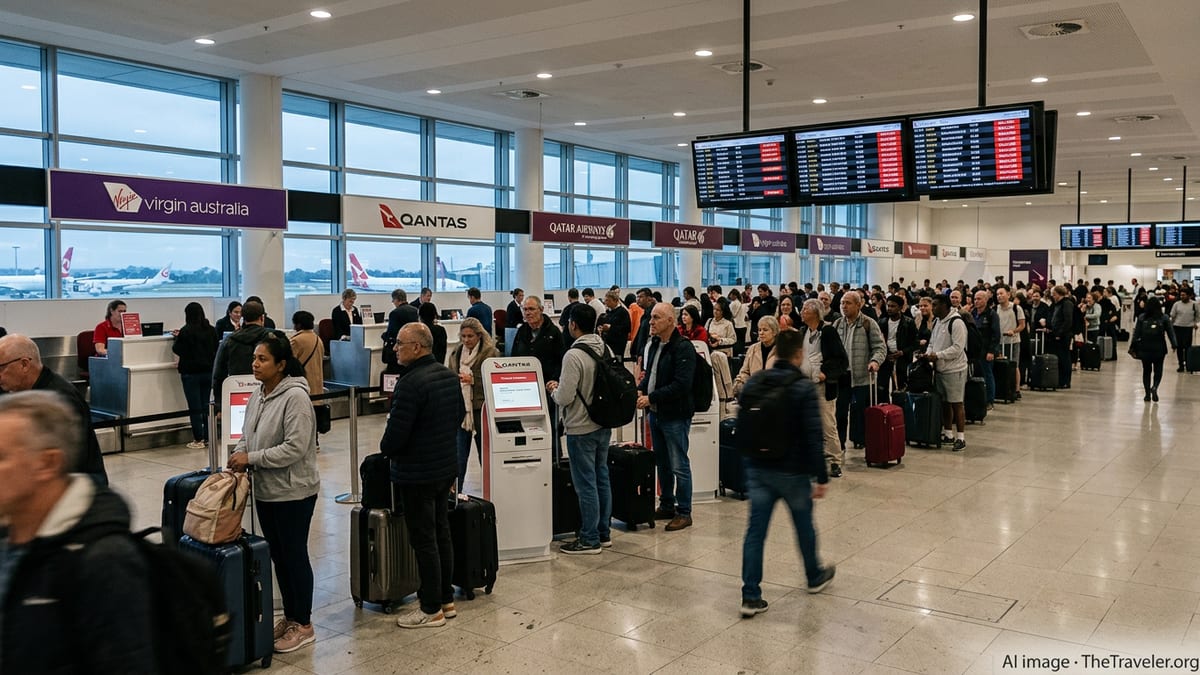
Middle East Crisis Chokes Qatari Airspace and Australian Links
The latest escalation of the regional conflict involving Iran has left Qatari airspace subject to rolling closures and tight restrictions since late February 2026. Publicly available operational updates describe a near-total suspension of standard commercial flights in and out of Doha in early March, followed by a gradual reintroduction of limited services as emergency corridors reopened.
Australia has been hit particularly hard. Qatar Airways and its partner Virgin Australia had been building an extensive network linking Sydney, Melbourne, Brisbane, Perth and Adelaide to Doha and on to more than 100 destinations. In recent weeks, however, timetables show most non-essential long-haul services pared back, with Australia–Doha rotations among the first to be pulled when schedules are trimmed.
Industry data services tracking global disruption estimate that more than ten thousand flights across the wider region have been cancelled since the conflict began, with Doha named alongside Dubai and Abu Dhabi as heavily affected hubs. Capacity between Australia and Europe has tightened markedly as a result, with analysts warning that fares are likely to remain elevated while Middle East routings are constrained.
Reports from aviation analytics firms and travel trade publications indicate that Qatar Airways is now prioritising shorter-haul regional links and essential long-range routes while it rebuilds its operations. That means fewer seats for Australian travellers looking to connect via Doha, even as a limited number of long-haul flights restart.
Which Australia–Doha Routes Are Most Affected
Flight-status screens and airline communication to customers over the last fortnight point to repeated cancellations on services from Melbourne and Perth to Doha, with many days showing no Qatar Airways-operated departures at all. Passengers report that some flights briefly reappeared in the schedule only to be withdrawn again as operational conditions shifted.
Virgin Australia’s planned long-haul services to Doha, operated in cooperation with Qatar Airways, have effectively been placed on hold for now. Travel advisory sites note that these codeshare flights are cancelled until further notice, removing an additional layer of capacity that had been expected to ramp up through 2025 and 2026.
Sydney and Brisbane connections have also seen significant disruption, although schedules suggest that limited services may resume earlier on these higher-demand routes as airspace restrictions ease. Some travelers have received rebookings to later April or May dates, but many of those replacement flights remain flagged as “subject to change” in booking systems.
Adelaide, which only recently regained a direct Qatar Airways link, appears especially vulnerable. Aviation forums and route analyses suggest that secondary Australian gateways are more likely to see prolonged suspensions, as airlines concentrate scarce aircraft and crew on trunk routes where demand is strongest.
How Qatar Airways Is Rebuilding Its Network From Doha
Despite the sharp pullback, travel alerts and airline communications show that Qatar Airways is now operating a growing number of daily departures from Doha under a revised schedule. Some reports put the figure at around 80 passenger flights departing Doha on certain days in early April, compared with a near standstill just weeks earlier.
The rebuilt network is highly selective. European capitals such as London, Paris, Madrid, Rome and Frankfurt feature prominently in early phases of the restart, reflecting their importance for repatriation and high-yield traffic. Destinations in Asia, including key Southeast Asian hubs, are also being restored, offering alternative one-stop options for Australians able to reposition via Asia instead of flying directly to Doha.
Australia, however, is returning more slowly to the timetable. While advance schedules still show a robust program of services linking Doha with Sydney, Melbourne, Brisbane and Perth later in 2026, recent operational updates emphasise that all such flights remain contingent on stable airspace, aircraft availability and crew constraints. In practice, that means near-term departures are at higher risk of last-minute cancellation than flights on shorter regional sectors.
Australian travellers should therefore treat any confirmed Qatar Airways booking in the coming weeks as provisional. Even once departures resume from major cities, schedules may change repeatedly as the airline adapts to fuel, route and security considerations tied to the evolving conflict.
Rebooking, Refunds and What Travelers Can Expect
Qatar Airways has rolled out a series of flexible policies for customers affected by the crisis. Travel sites that summarise airline rules for the Australian market report that passengers with tickets booked on or before the end of April for travel between late February and late April can typically request a full refund, convert their booking to flight credit, or move their trip to a later date, often into June or beyond, without change fees.
More recent updates show that these waivers have been extended on a rolling basis as the disruption drags on. In some cases, travelers have been offered complimentary date changes as far ahead as October 2026 when rebooking onto Qatar Airways-operated flights, subject to seat availability in the same cabin. However, conditions vary by fare type, route and point of sale, meaning passengers need to carefully check the specific rules attached to their ticket.
One notable shift in recent days is a tightening of rerouting options on other airlines. Whereas some customers early in the crisis were rebooked on competitors to bypass Doha altogether, frequent-flyer forums now highlight updated guidance stating that rebooking solely onto other carriers is no longer routinely permitted. Instead, most changes are being handled within Qatar Airways’ own network or through limited interline arrangements.
This policy evolution is particularly significant for Australians, many of whom would otherwise seek to reroute via Asia or another Gulf hub. Without broad access to alternative airlines at Qatar Airways’ expense, affected passengers may face a choice between waiting for a workable new routing within the same ticket, or pursuing a refund and starting again with a fresh booking on a different carrier.
Planning Alternatives From Australia to Europe and Beyond
With Qatar Airways and Doha no longer a reliably available corridor for now, Australian travelers heading to Europe, North Africa or the Middle East are increasingly looking to alternative routings. Industry reports show that Qantas and European partners are ramping up nonstop or one-stop services to continental hubs such as London, Rome and Paris, often via Singapore rather than traditional Gulf connections.
Other Asian and Middle Eastern airlines that are not as constrained by the Qatari airspace closure are also capturing displaced demand. Carriers based in hubs such as Singapore, Hong Kong and, where safe routing is possible, parts of the United Arab Emirates are adjusting schedules to meet higher demand from Australia, although the availability of award seats and lower fares has shrunk rapidly.
Travel analysts caution that, with a significant share of Asia–Europe capacity removed from the market, price-sensitive passengers may struggle to find affordable options in the short term. Many recommend flexibility on dates, willingness to accept longer routings, and early booking where possible to secure remaining inventory during peak travel periods.
For those who choose to keep their Qatar Airways itineraries, close monitoring will be essential. Passengers are being advised by consumer advocates and travel agents to check their booking status regularly, keep contact details updated in airline profiles, and be prepared with backup plans in case their Australia–Doha leg is cancelled at short notice as the Middle East crisis continues to unfold.