

Raiatea does not shout for attention the way Bora Bora or Moorea might. It speaks in quieter tones: in the chant of elders, in the basalt stones of an ancient temple, in the scent of a flower that blooms in only one place on Earth.
Often called the sacred island of the Pacific, Raiatea is both a cradle of Polynesian civilization and an emerging destination for travelers who are more interested in meaning than in marquee names. This guide unpacks the island’s deep cultural roots, its landscapes and lagoons, and the practical details you need to explore it with respect.
Understanding Raiatea’s Sacred Reputation
Raiatea sits in the Society Islands of French Polynesia, sharing a lagoon with smaller, vanilla-scented Taha’a. To local Maohi people, it is far more than an administrative hub. Traditional narratives describe Raiatea as a departure point for voyages that settled distant corners of the Polynesian Triangle, from Hawaii to Aotearoa New Zealand and Rapa Nui. Its name translates loosely as “faraway heaven” or “bright sky,” a poetic hint at its role in origin stories.
The sacred status of Raiatea is anchored in Taputapuatea, a monumental marae complex on the island’s eastern shore. Recognized as a World Heritage cultural landscape, this coastal ceremonial center once drew chiefs and navigators from across the Pacific to affirm alliances and consult the gods. The idea of Raiatea as a spiritual hub spread along these canoe routes, so that far-flung communities traced their genealogies and rituals back to this single island.
For contemporary travelers, Raiatea’s sacredness is not a museum piece but a living identity. Ceremonies, traditional navigation projects and cultural festivals continue to link local life with a wider Polynesian world. Visiting with open curiosity and humility gives you access to an island where cosmology and geography still overlap, from sea passages considered tapu to mountain plateaus reserved for chiefs and now carefully protected.
Understanding this background changes how you see the landscape. A stretch of reef is not only a snorkel site but a spiritual threshold. A platform of weathered stones is not just a ruin but a place where negotiations shaped the politics of islands scattered over thousands of miles. To experience Raiatea fully, it helps to view it not only as a destination but as a homeland of ideas, rituals and voyaging knowledge.
Taputapuatea Marae: Heart of the Polynesian Triangle
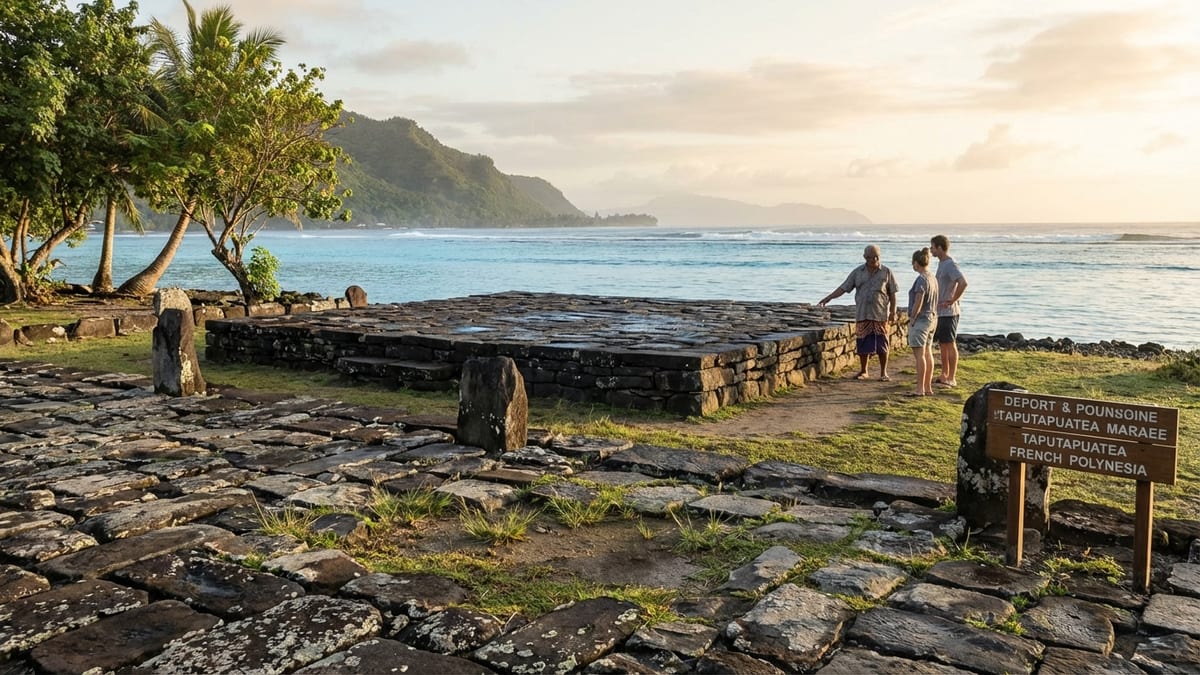
Taputapuatea is the single most important place to grasp why Raiatea is called the sacred island. Set on a tongue of land projecting into the lagoon at Opoa, the complex gathers several marae into a stony amphitheater between forested valleys and the sea. At its core is a large paved courtyard edged by an ahu, the raised stone platform where rituals unfolded. In its heyday, this was the religious and political center for a vast alliance of islands, a meeting ground for priests, navigators and chiefly families.
The marae is dedicated to the god Oro and is understood as a point where Te Ao, the world of the living, intersected with Te Po, the realm of gods and ancestors. Stone alignments and sightlines knit together sacred mountains inland with the reef pass offshore, through which voyaging canoes once arrived to present offerings. Ceremonies here once included the investiture of chiefs with the red feather girdle that signaled supreme authority, binding earthly power to divine sanction.
Visiting Taputapuatea today is as much about listening as looking. Interpretive signs and guides can explain the layout, but the experience deepens when you pause to hear waves on the outer reef and the wind in the ironwood trees. Restoration in recent decades has stabilized stonework and cleared invasive vegetation, yet the site still feels raw and elemental rather than over-sanitized. Local cultural associations play a central role in its care, reviving ceremonies and strengthening ties with communities across the Pacific that trace ancestral links to this shoreline.
Respectful behavior is essential. Many visitors choose to join guided tours, which typically include protocol such as a simple greeting or chant before stepping onto the marae. Walking around instead of across key platforms, avoiding loud conversation and dress that feels at odds with the setting, and refraining from climbing or sitting on sacred stones all help maintain the mana of the place. In doing so, you participate, however briefly, in a long tradition of approaching Taputapuatea with reverence.
Island Geography, Landscapes and Seasons
Raiatea’s physical form reinforces its layered identity. The island rises steeply from the sea, its volcanic ridges draped in rainforest and cloud. Deep valleys cut into the interior, carrying rivers down to a wide fringing lagoon. Across that lagoon lie barrier reefs broken by narrow passes, the same channels that once guided double-hulled canoes and that now admit yachts and dive boats.
Unlike Bora Bora, Raiatea has no sweeping ring of motu encircling its entire lagoon, but the shared lagoon with neighboring Taha’a creates an impression of a single maritime world. Mangroves, pandanus thickets and coastal hibiscus fringe the shore. Inland, slopes are cloaked in ferns and native hardwoods, with pockets of introduced fruit trees and plantations. The island’s highest peaks, often veiled in mist, remain lightly trafficked and hold stories only gradually shared with visitors through guided hikes.
Climate follows the broad patterns of French Polynesia, with a warmer, wetter season roughly from November to April and a slightly cooler, drier period from May to October. Showers can fall at any time, especially on windward slopes, feeding waterfalls and keeping the interior intensely green. Cyclones are rare but possible in the wet season, which travelers should take into account when planning sailing trips or ambitious treks into the backcountry.
For many visitors, the most comfortable months to travel are June through September, when humidity is modest, trade winds blow steadily and seas are typically calmer. Yet traveling outside peak months can reward you with fewer crowds and more availability for small guesthouses and charter boats. On a sacred island where so much revolves around the relationship between people, land and ocean, paying attention to seasons and weather is part of traveling responsibly.
Culture, Language and Local Life
Raiatea’s sacred reputation grows out of Maohi culture, not in spite of it. French and Tahitian are both widely spoken, with English understood in many tourism-facing businesses, but the nuance of place names and stories lives most strongly in the local Polynesian language. Even a few Tahitian phrases used sincerely can open conversations about heritage and identity that you might otherwise miss.
Daily life on the island revolves around schools, small administrative offices, the main harbor at Uturoa and a constellation of family-run businesses. Fishing, small-scale agriculture and increasingly, yachting and eco-tourism support the local economy. Markets offer a mix of staples and local specialties, from taro and breadfruit to fish cooked in coconut milk. On certain days, you might find artisans selling wood carvings, tapa cloth or traditional quilts known as tifaifai.
Religious practice blends Christianity with enduring Polynesian spirituality. Churches are prominent in villages, and Sunday services often resound with powerful choral singing. At the same time, respect for sacred sites, burial grounds and ancestral stones runs deep. Community groups continue to revitalize hula-like dance, oratory and navigation skills, often staging performances or workshops for both residents and visitors.
As a traveler, you are entering a small, tightly knit society. Dress codes tend toward modesty away from beaches, and greetings are important. Simple gestures, such as asking before photographing people, removing hats inside certain spaces and acknowledging property boundaries, show that you recognize Raiatea as someone’s home rather than just your vacation stage set. Approaching the island as a cultural encounter as much as a scenic one yields richer experiences and fewer misunderstandings.
Experiences on Land: Hiking, Flora and Sacred Peaks
Raiatea’s interior remains one of the least known parts of the Society Islands for many visitors, yet for those drawn to hiking and botany it is a highlight. Trails range from gentle river walks to more strenuous climbs along ridgelines that demand fitness and a head for heights. Because many paths cross private or community land and enter sensitive ecosystems, hiring a local guide is strongly recommended and in some cases required.
The most storied landscape feature is the Temehani plateau, sometimes described as two distinct areas known for endemic plants and sweeping views. Here grows the tiare apetahi, a delicate white flower that has become a symbol of Raiatea. The bloom opens with a faint cracking sound in the early morning, and its entire natural range is confined to this plateau. Decades of over-collecting and habitat disturbance drastically reduced its numbers, prompting protection measures, restoration projects and strict guidance on how visitors may approach.
Current practice asks hikers to stay on marked paths, avoid touching or trampling vegetation, keep group sizes small near the rare flowers and obtain permissions or use professional guides who know where it is appropriate to walk. Seeing the tiare apetahi in its natural environment is a privilege that carries responsibility: respecting distance, not taking seeds or cuttings and understanding that conservation takes precedence over photography.
Beyond Temehani, other hikes lead to waterfalls, river gorges and panoramic lookouts over the lagoon and Taha’a. Trails can become slippery after rain, and stream crossings may swell quickly. Good footwear, sufficient water, sun and insect protection and a conservative approach to weather are essential. Many guides enrich the journey with explanations of medicinal plants, ancient agricultural terraces and place names that encode stories of gods, warriors and navigators.
On the Water: Lagoon, Sailing and Underwater Life
For all its mountains and valleys, Raiatea reveals much of its character from the water. The island is a major base for sailing in French Polynesia, with charter companies offering bareboat and crewed yachts that explore the shared lagoon with Taha’a and, for longer trips, the arcs of Huahine and Bora Bora. Even if you are not a sailor, day cruises and small-boat excursions let you experience the reef passes and enclosed turquoise pools that once guided and sheltered voyaging canoes.
Snorkeling and diving in Raiatea’s lagoon are gentler in feel than some better-known sites, but they reward patient observation. Coral gardens, bommies and drop-offs harbor reef fish, turtles and occasionally reef sharks. Certain passes offer drift dives where currents carry you past schools of jacks and barracuda, yet conditions can change quickly, so reputable operators and local knowledge are important. Protecting the lagoon’s health means basic reef etiquette: avoiding contact with coral, using reef-safe sunscreen and never feeding fish.
Kayaking and stand-up paddleboarding are excellent ways to explore coastal sections of lagoon at a slower pace. Mangrove channels, uninhabited motu and river mouths can be reached quietly, allowing for birdwatching and glimpses of daily life along the shore. Some tours combine paddling with cultural visits, such as stops at archaeological sites or small vanilla plots, weaving together ecology and heritage.
Harbors and marinas give Raiatea a cosmopolitan edge compared with some outlying islands, with yachts from multiple continents moored side by side. Yet even here, a sense of scale remains human. Respecting mooring guidelines, waste disposal rules and speed limits within the lagoon helps keep this maritime environment in balance. On a sacred island, the lagoon is not just a playground but a pathway whose spiritual and historical roles remain vivid for many residents.
Practicalities: Getting There, Getting Around and Where to Stay
Reaching Raiatea typically involves a domestic flight from Tahiti’s Faa’a International Airport, with regular services connecting Papeete to Uturoa, the main town on Raiatea. Flights are relatively short, crossing the open ocean and dropping down over the shared lagoon with Taha’a. Seats can fill quickly in high season and around school holidays, so advance booking is wise if your schedule is tight or you are connecting with a sailing charter.
Ferries also operate between Raiatea and neighboring islands such as Huahine, Taha’a and Bora Bora. These services provide a slower but often scenic alternative, useful for travelers who want to island-hop with more flexibility. Schedules can be subject to weather and operational changes, so it is prudent to check times locally and build some margin into your plans, especially if you need to catch onward flights.
Once on Raiatea, rental cars, scooters, bicycles and taxis offer options for getting around the coastal road that encircles much of the island. Distances are modest, but road conditions vary, and night driving can be tricky because of rain, unlit stretches and animals on the road. Organized tours remain the simplest way to visit Taputapuatea, remote valleys and certain viewpoints, particularly if you prefer to combine logistics with cultural interpretation.
Accommodation ranges from small guesthouses and family-run pensions to a handful of larger hotels, with additional stays available on sister island Taha’a accessed by boat. Many properties emphasize lagoon access, gardens and views rather than urban amenities. Booking ahead is especially important during the peak dry-season months and around major local events. Staying in locally owned lodgings helps ensure your spending supports the communities that maintain the very traditions and landscapes you came to experience.
Travel Responsibly on a Sacred Island
Raiatea invites visitors into spaces that hold immense emotional and spiritual value for local people. Travel here carries an implicit responsibility to minimize impact and honor that significance. This begins with learning about basic cultural etiquette and natural protections before you arrive, so that you do not unintentionally treat a burial ground as a picnic site or a fragile plateau as an off-trail playground.
Supporting guides and operators committed to cultural continuity and environmental care is one of the most effective choices you can make. Many local associations and small businesses focus on restoring native vegetation, transmitting navigation skills or reviving traditional arts. Choosing their excursions or products not only enriches your stay but also channels income to projects that safeguard Raiatea’s heritage.
Simple behavior changes make a cumulative difference. Carrying reusable water bottles and shopping bags reduces plastic waste; obeying signs around sensitive habitats protects endangered species; keeping noise levels low at sacred sites respects both the living community and the memory of ancestors. When in doubt, asking a local host or guide how best to behave in a given place shows humility and opens constructive conversations.
Above all, remember that Raiatea’s sacredness is not a performance staged for visitors. It is the lived reality of people whose identity is entwined with the stones of Taputapuatea, the reefs that shield the lagoon and the mountains that catch the first light of day. Approaching the island as a guest in someone else’s spiritual homeland, rather than as a consumer of experiences, is the foundation of truly responsible travel here.
The Takeaway
Raiatea stands apart in the Pacific because it fuses visible beauty with invisible depth. Its calm lagoon, green heights and low-key villages might at first glance resemble others in the Society Islands, but the stories embedded in its stones and place names quickly set it apart. This is the island many Polynesians look to as a cradle of culture, navigation and leadership, a role inscribed in both oral tradition and international recognition.
For travelers, that sacred identity is not a barrier but an invitation. Visiting Taputapuatea with a knowledgeable guide, hiking respectfully on Temehani to glimpse the tiare apetahi in its only natural home, drifting over coral gardens while hearing about the star paths that once emanated from this lagoon: these are experiences that leave you with more than photographs. They foster a sense of connection to a wider Pacific story.
Approach Raiatea with curiosity, patience and care, and the island reveals itself gradually. It is not a place to rush, nor one to tick off a list. Whether you arrive on a small plane banking over the reef, a ferry threading through a pass, or a yacht following in the wake of ancient canoes, you step into a landscape where time feels layered, not linear. The ultimate reward of a journey here is the realization that the sacred Pacific is not an abstract idea, but a real, inhabited place, and that for a brief moment, you were part of its unfolding story.
FAQ
Q1. Why is Raiatea called the sacred island of the Pacific?
Raiatea is known as the sacred island because it hosts Taputapuatea, a major ancestral marae complex that once served as a political and religious center for much of Eastern Polynesia. From here, voyaging networks spread people, gods and rituals across the Pacific, giving the island a founding role in many communities’ origin stories.
Q2. Do I need a guide to visit Taputapuatea marae?
You can physically reach Taputapuatea on your own by road, but traveling with a local guide is strongly recommended. A guide helps you understand the site’s significance, observe appropriate protocol and avoid behavior that might inadvertently disrespect sacred areas or damage fragile stone structures.
Q3. When is the best time of year to visit Raiatea?
The most popular period is the cooler, drier season from roughly May to October, when humidity is lower and trade winds bring more stable weather. However, the island is a year-round destination, and traveling in the shoulder months outside peak season can mean fewer visitors and more flexibility, provided you are comfortable with occasional tropical showers.
Q4. Is Raiatea suitable for first-time visitors to French Polynesia?
Yes, Raiatea works well for first-time visitors who value culture and nature over nightlife and large resorts. It offers good infrastructure, domestic flight connections and a range of excursions, yet remains quieter and less commercial than some neighboring islands, making it ideal if you seek a more grounded experience.
Q5. Can I see the tiare apetahi flower, and are there any restrictions?
The tiare apetahi grows naturally only on Raiatea’s Temehani plateau and is considered highly endangered. Access to its habitat is regulated, and visitors are expected to stay on designated paths, keep a respectful distance and never pick or touch the plants. Joining a guided hike arranged with conservation in mind is the best way to see it responsibly.
Q6. What kinds of activities are available on the lagoon?
On the lagoon you can sail, kayak, snorkel, dive and join day cruises that explore coral gardens, motu and reef passes. Many excursions combine water activities with cultural visits to archaeological sites or vanilla plots, offering a balanced view of Raiatea’s marine environment and human history.
Q7. How do I travel between Raiatea and neighboring islands like Taha’a or Bora Bora?
Short domestic flights link Raiatea with Bora Bora and other Society Islands, while ferries provide an alternative for those who prefer surface travel. Small boats shuttle frequently between Raiatea and nearby Taha’a across the shared lagoon, often arranged through accommodations or tour operators.
Q8. What should I wear when visiting sacred sites and villages?
Modest, comfortable clothing is appropriate. Covering shoulders and wearing shorts or skirts that reach mid-thigh or longer shows respect, particularly at marae and in villages. Beachwear should be reserved for the shore and boats, and removing hats at certain cultural sites or during ceremonies is often appreciated.
Q9. Is Raiatea a good base for sailing charters?
Raiatea is one of the main sailing hubs in French Polynesia, with several charter companies offering bareboat and crewed options. Its central location and shared lagoon with Taha’a make it an ideal starting point for itineraries that also include Huahine and Bora Bora, combining accessible navigation with varied anchorages.
Q10. How can I ensure my visit benefits local communities?
You can support local communities by choosing family-owned pensions and restaurants, hiring local guides, buying directly from artisans and selecting tour operators who prioritize cultural integrity and environmental care. Listening to residents’ perspectives and following their guidance at sacred and sensitive sites further reinforces that your presence contributes positively to Raiatea’s future.