


More news on this day
Rail passengers planning cross border journeys in Europe over the coming months are being urged to prepare for tighter checks and possible delays as a mix of new digital systems and renewed internal Schengen controls reshape how trains move across key routes.
Get the latest news straight to your inbox!
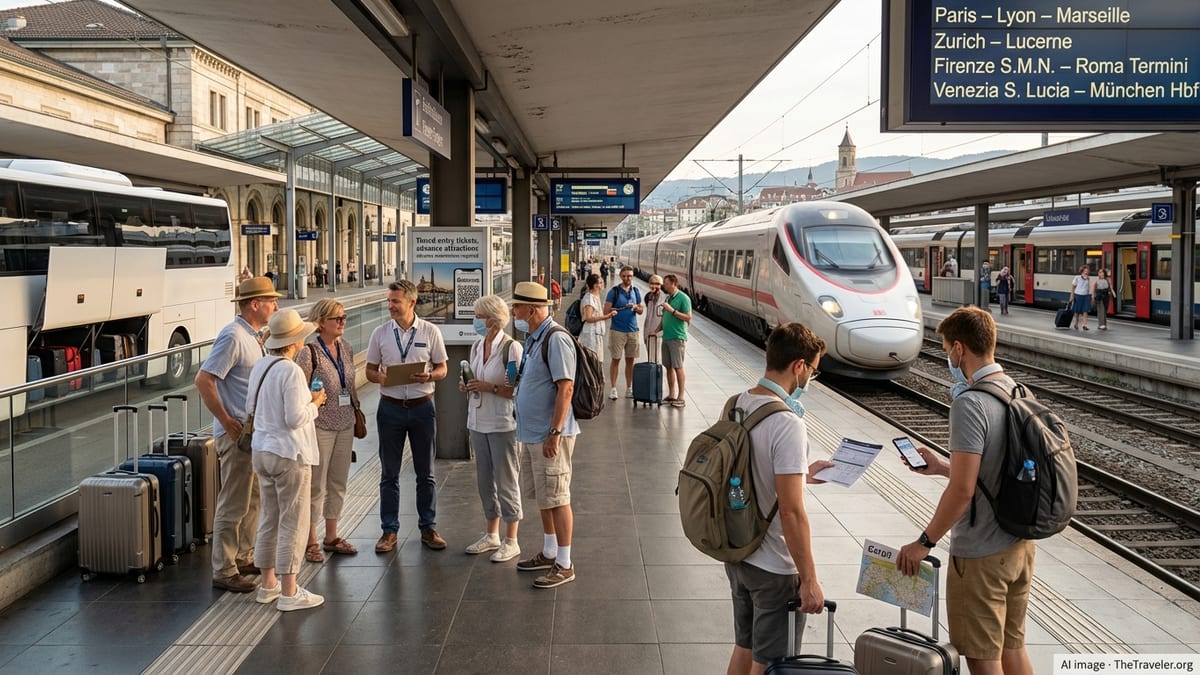
Fresh Internal Controls on Key Cross Border Rail Corridors
Schengen travel has long been associated with the ability to cross many European borders without routine checks, particularly by train. That experience is changing on several important corridors as a number of countries make renewed use of provisions in the Schengen Borders Code that allow temporary internal controls in response to security or migration pressures.
According to publicly available European Commission documentation from June 2026, countries including Austria, Denmark, France, Germany, Italy, the Netherlands, Norway, Slovenia and Sweden have all notified some form of internal border control in recent months. These measures typically focus on major road and rail crossings, meaning international trains are among the services most exposed to on the spot checks and border guard presence.
On routes linking Germany with neighbours such as Poland, Czechia, Switzerland and Austria, travellers have already reported increased inspections on board and at selected stations. Earlier decisions by Berlin and Warsaw to reintroduce checks along parts of their shared frontier, followed by a short period in 2025 when Poland itself reinstated controls toward Germany and Lithuania, illustrate how quickly rail journeys that once felt routine can again involve formal border scrutiny.
Although the European Union continues to present internal checks as a last resort, recent State of Schengen reporting acknowledges that several member states now use this tool repeatedly. For rail passengers, that can translate into spot passport inspections, targeted identity checks and unplanned stops, even when timetables do not formally list a border control halt.
Digital Entry Exit System Brings Stricter External Checks
At the same time as some internal controls return, the EU’s external frontier is undergoing its largest procedural change in decades. The new Entry Exit System, a bloc wide database intended to record the movements of non EU nationals on short stays, completed its phased roll out in April 2026 and is now in operation at all Schengen border checkpoints on land, sea and air routes.
The system, managed by the EU agency eu LISA, replaces manual passport stamps with digital records that store data from a traveller’s document alongside biometric identifiers such as facial images and fingerprints. Official material from the European Commission and Council indicates that the project entered service in October 2025 at selected crossings before becoming fully operational on 10 April 2026 across 29 participating countries.
For rail travellers, the impact is most visible at Schengen’s external rail gateways, including services connecting the bloc with the United Kingdom, the Western Balkans and other neighbouring states. Operators running international trains are required to ensure that non EU nationals subject to the system are properly enrolled and checked, which can involve the installation of new kiosks, longer boarding processes and additional pre departure verification.
The new digital regime is presented as a way to improve security and reduce long term delays by automating checks, but in the short term, travel industry coverage has warned of queues at busy border points as passengers complete one off biometric registrations. On some rail routes, companies have begun advising non EU citizens to arrive earlier than usual to allow time for the new procedures.
High Impact Routes: Germany Neighbours and Channel Connections
Not all rail lines are equally affected by the combination of temporary internal controls and stricter external borders. Long distance services that cross the frontiers of states currently applying Schengen derogations or that connect directly with non Schengen countries face the greatest scrutiny.
Central European corridors that funnel traffic between Germany and Austria, Czechia, Poland and Switzerland have seen repeated waves of checks linked to migration pressures. Public parliamentary questions and Commission responses from 2025 and 2026 refer to Germany’s use of targeted controls on several land borders, while neighbouring countries have periodically responded with their own measures. For passengers on trains between cities such as Vienna, Prague, Warsaw and Munich, that can mean identity inspections onboard, special police teams boarding at the border, or more visible controls in frontier stations.
The situation is also evolving on links between the Schengen Area and the United Kingdom. Cross Channel services, particularly those using the Channel Tunnel, already operate with juxtaposed controls in which outbound passengers are processed before boarding. With the Entry Exit System now live, published rail and port guidance anticipates additional kiosks and data capture for non EU travellers heading toward or returning from the continent, including those using high speed rail.
Industry reporting on preparations at major hubs notes that space constraints at some stations have forced creative layouts for new equipment, occasionally requiring passengers to disembark coaches or move through temporary facilities. While this planning is intended to keep rail services running close to schedule, travellers should be prepared for longer queues, particularly at peak times and during holiday periods.
What Rail Travellers Should Expect at the Border
For most passengers, the practical experience of these changes will centre on three elements: more frequent identity checks on internal Schengen routes where controls have been reintroduced, biometric registration at external borders for non EU nationals, and more visible police or border personnel at certain stations and onboard international trains.
Within the Schengen Area, travellers on affected routes may notice that officers now move through carriages near the border asking to see passports or identity cards, even if there is no physical barrier or dedicated checkpoint. These operations can be sporadic or continuous depending on national decisions, but in either case they mark a departure from the almost invisible borders that many rail passengers had grown used to over the past decade.
At external frontiers, non EU nationals entering or exiting the Schengen zone can expect to have their travel documents scanned and their biometric data captured on first use of the Entry Exit System. Once recorded, subsequent crossings should be faster, but rail operators and border services alike acknowledge a transition period during which queues are likely as large numbers of travellers are registered for the first time.
Travel information portals and national rail operators increasingly recommend that international passengers carry a valid passport rather than relying solely on national identity cards, even on routes where ID cards are technically accepted. This guidance reflects the greater reliance on automated systems and machine readable documents, which tend to process passports more quickly than older forms of identification.
Balancing Security Concerns and Seamless Rail Mobility
The current patchwork of renewed internal checks and high tech external controls highlights the tension between the EU’s goal of maintaining seamless movement inside Schengen and the political drive in several capitals to respond visibly to migration, security and irregular border crossing concerns. The updated Schengen Borders Code adopted in recent years expressly aims to keep internal checks as a measure of last resort, yet notifications compiled by the European Commission show that several member states have repeatedly renewed such controls.
Rail travel sits at the centre of this debate because cross border passenger trains are both symbols of European integration and practical channels for movement that are difficult to monitor without intrusive measures. When controls are reinstated on a land frontier, trains are among the first services affected, even if checks are selective rather than systematic.
For now, there is no suggestion that the principle of border free travel inside Schengen is being abandoned. However, the combination of more frequent temporary checks and the roll out of the Entry Exit System means that rail passengers can no longer assume that international journeys will always feel like domestic ones. Those planning trips that cross EU internal borders or connect with non Schengen countries are being advised by rail operators and travel advisers to monitor the latest national notices and to allow extra time for identity and biometric procedures at the start and end of their journey.