

More news on this day
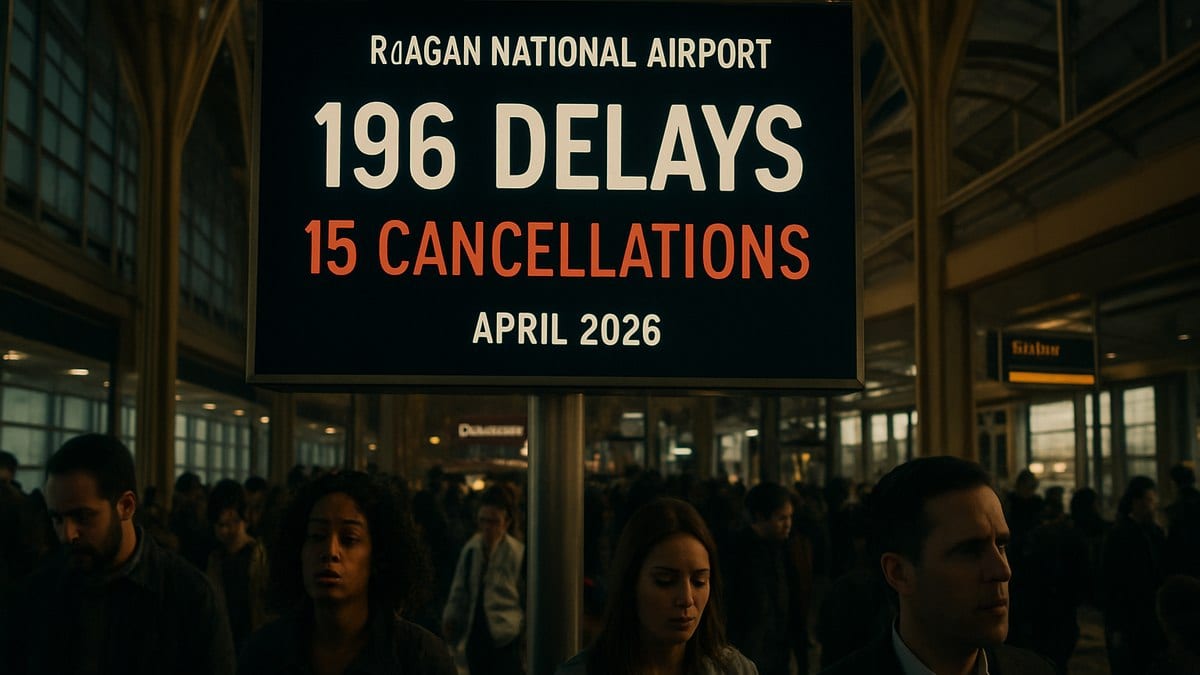
Ronald Reagan Washington National Airport recorded 196 flight delays and 15 cancellations in early April 2026, underscoring how vulnerable the compact, high-traffic hub remains to spring weather and air-traffic strains across the Mid-Atlantic.
Get the latest news straight to your inbox!
Disruptions Cap a Turbulent Spring for Washington-Area Air Travel
The disruption at Reagan National unfolded against a broader backdrop of springtime volatility for Washington-area airports. Publicly available aviation dashboards and media coverage show that March and early April brought repeated ground stops and flow-control programs affecting Reagan National, Dulles International and Baltimore/Washington International, often simultaneously.
In several of those events, operations at Reagan National were constrained not only by local conditions but also by issues at regional air-traffic facilities. A widely reported incident in late March involved a strong odor at an air-traffic facility serving the region, prompting a temporary halt to departures and arrivals across multiple Washington-area airports and triggering subsequent waves of delays.
The April tally of 196 delayed flights and 15 cancellations at Reagan National reflects the lingering impact of that tumultuous period. Industry analysts note that when a compact airport experiences even a brief ground stop or extended arrival spacing, it can take many hours for schedules to recover, particularly at hubs with dense short-haul and shuttle traffic.
Travel commentary and first-hand accounts posted in recent weeks describe evenings where departure boards at Reagan National showed long strings of delayed flights and scattered cancellations. Those anecdotal reports align with the numerical picture of a facility operating near capacity and highly sensitive to any disruption in the wider airspace system.
Weather Systems and Network Ripple Effects Drive Delay Counts
The 196 delays linked to early April at Reagan National coincided with a broader pattern of storm-driven disruption across the eastern United States. National coverage of airline performance this spring has highlighted severe weather in the Midwest and Mid-Atlantic, including strong frontal systems that produced high winds, thunderstorms and turbulent conditions along key flight corridors.
When those systems move through, Reagan National’s location along the Potomac River and its constrained runway layout can magnify the impact. Traffic-management initiatives that slow arrival rates into the Washington area, or into major upstream hubs, tend to cascade quickly into late departures on short-haul routes feeding and departing DCA.
Sector-wide analysis from travel outlets indicates that similar patterns of delay have been visible at other congested airports during the same period, including Boston Logan, Chicago Midway, Atlanta and San Francisco International. In that national context, the 196 delays at Reagan National reflect how even a relatively small airport by land area can contribute disproportionately to overall delay minutes when weather and congestion collide.
Because many of Reagan National’s routes are under two hours, even short interruptions can snowball. An aircraft that arrives late from the Southeast may then operate multiple subsequent legs that each depart behind schedule, adding to the day’s total delay count even after the original weather trigger has passed.
Staffing Pressures and Infrastructure Constraints Add to Strain
Operational data and policy documents published over the past year have repeatedly cited staffing challenges in air-traffic control as a factor in delays along the East Coast. Reagan National sits in one of the most complex and heavily trafficked airspace regions in the country, sharing skies with Dulles, Baltimore/Washington and a series of military and general-aviation facilities.
Transportation analyses and congressional reports have also drawn attention to the airport’s structural limitations. Reagan National relies heavily on a single main runway that is among the busiest in the United States by movements, even as surrounding communities have raised concerns about noise, safety and any further expansion of flight operations.
Past federal briefings on slot controls and runway capacity have warned that adding flights at Reagan National could sharply increase total daily delay minutes. The April 2026 figures, with 196 delays recorded in a relatively short window, appear consistent with those earlier projections that showed how quickly congestion can build when adverse conditions occur.
While staffing patterns and equipment performance at regional air-traffic facilities are not fully visible in public data, the clustering of delays around known outage and ground-stop events suggests that workforce availability and system reliability remain important pieces of the puzzle for passengers flying through Reagan National.
Impact on Passengers and Airline Operations
For travelers, the headline numbers of 196 delays and 15 cancellations translated into longer-than-expected hours in terminals, crowded gate areas and compressed connection windows. Travel-focused outlets describe scenes of rolling departure-time revisions on airport screens, with some evening services departing after midnight and others scrubbed entirely.
Airlines operating at Reagan National must juggle aircraft and crew assignments carefully when disruption hits. Because most carriers use the airport as a spoke rather than a full-scale hub, spare aircraft and standby crews are limited. When a line of storms or a flow-control program affects multiple airports along the East Coast, carriers may prioritize maintaining schedule integrity at their largest hubs, leaving secondary but critical nodes like Reagan National to absorb more variability.
The 15 cancellations recorded during the April disruption represented a small fraction of total operations but had outsized consequences for affected passengers. Industry guidance notes that travelers whose flights are canceled and who decide not to travel are generally entitled to refunds on the unused portion of their tickets, but rebooking options can be constrained when nearby departures are already full due to prior delays.
As delays mounted, some passengers based on public forum posts and travel reports opted to reroute through Dulles, Baltimore/Washington or even take rail alternatives for short regional trips. That kind of mode-shifting is one reason transportation planners closely monitor reliability metrics at Reagan National, which serves as a vital link for business and government travel within the Northeast and Mid-Atlantic corridors.
What Travelers Can Expect Through the Rest of April
Looking ahead through the remainder of April 2026, public forecasts and aviation commentary suggest that conditions at Reagan National will likely remain sensitive to weather and national airspace constraints. Spring cold fronts, early-season thunderstorms and lingering staffing adjustments at air-traffic facilities all have potential to trigger further pockets of disruption.
Travel experts quoted in recent coverage recommend that passengers using delay-prone airports build additional buffer time into itineraries, particularly when connecting to long-haul flights or time-sensitive events. For Reagan National, that may mean targeting earlier departures, considering flights to or from nearby airports when feasible, and closely monitoring airline apps for schedule changes.
Airline performance dashboards also underscore the value of flexibility. Accepting a rebooking through a different hub, or shifting to a slightly earlier or later departure, can sometimes reduce exposure to the peak of a delay wave that sweeps across multiple East Coast airports.
For now, the early April total of 196 delays and 15 cancellations at Reagan National stands as a snapshot of how quickly schedules can unravel at one of the country’s most capacity-constrained airports. As the busy summer travel season approaches, regulators, airlines and travelers alike will be watching closely to see whether operational adjustments can keep similar disruption from becoming a regular feature of flying in and out of Washington’s closest-in commercial airport.