

More news on this day
Severe flight disruptions at Ronald Reagan Washington National Airport are rippling across the U.S. East Coast today, with 195 flights delayed and 126 cancelled, snarling travel for thousands of passengers and straining operations at major hubs from Washington, D.C. to New York, Charlotte and Atlanta.
Storm Fallout and System Strain Converge on Washington Hub
Ronald Reagan Washington National Airport, a critical gateway for domestic travel and government business, is at the center of one of the most disruptive travel days of the winter. The combined total of 321 delayed and cancelled flights is hitting morning and afternoon bank departures hardest, amplifying the impact on shuttle-style routes that connect the capital to New York, Boston and other political and financial centers along the corridor.
Airline and federal officials say the disruption is tied to lingering effects of the powerful winter storm system that has hammered the Northeast in recent days, coupled with ongoing congestion in the national airspace. Airlines are still repositioning aircraft and crews after widespread cancellations earlier in the week, leaving little margin to absorb fresh weather- and congestion-related delays around Washington, D.C.
Because Reagan National operates inside some of the most controlled and capacity-constrained airspace in the United States, even modest schedule pressure can cascade quickly. Today’s volume of delayed departures and arrivals has triggered wider spacing between aircraft, longer taxi times and knock-on disruptions at connecting airports that depend on DCA for high-frequency shuttle traffic.
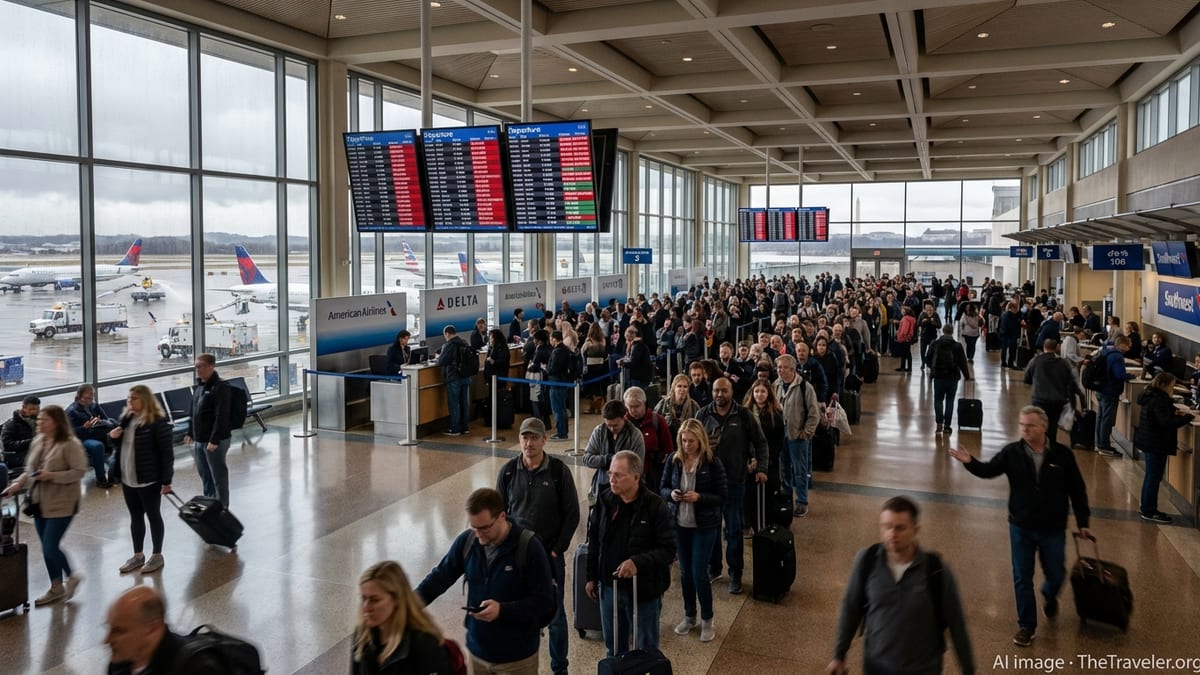
By midday, terminal departure boards at Reagan National were dominated by yellow and red status markers, with frequent gate changes and rolling departure times complicating efforts by airlines to maintain predictable schedules for business travelers and commuters.
Major U.S. Carriers Hit as East Coast Network Backs Up
The operational turbulence is affecting all of the largest U.S. carriers serving Reagan National. American Airlines, which maintains a substantial presence at the airport, has been forced to consolidate frequencies on popular East Coast routes and prioritize flights with the highest concentrations of connecting passengers. Delta Air Lines and United Airlines are also reporting a wave of delays, particularly on shuttle-style segments into New York and on connections flowing through their hubs in Atlanta and Newark.
Southwest Airlines, which has a smaller footprint at Reagan National but extensive operations at Baltimore/Washington International and other East Coast airports, is contending with schedule knock-ons as aircraft and crews fall out of position. Regional affiliates operating under the American and United brands, including carriers such as PSA Airlines, Republic and GoJet, have cancelled multiple short-haul flights, further tightening capacity on already crowded corridors.
New York’s congested airspace is compounding the problem. Disruptions at Reagan National are interacting with residual delays and cancellations at John F. Kennedy International, LaGuardia and Newark Liberty, where airlines are still recovering from earlier storm-related ground stops and runway closures. Routes linking Washington with New York, Boston and other Northeast destinations are among the most heavily affected, forcing some travelers to shift to rail or last-minute rental cars.
Farther south, flight banks into Charlotte and Atlanta are seeing growing inbound delays as aircraft depart Washington behind schedule. Those delays then spill into onward connections from the Southeast to Florida, Texas and Midwest cities, creating a network effect that reaches far beyond the Mid-Atlantic.
Passengers Face Long Lines, Frayed Plans and Limited Options
Inside Reagan National’s terminals, the human toll of the disruption is clear. Security lines have lengthened as passengers arrive early in hopes of beating rolling delays, only to find departure times repeatedly pushed back. Customer service counters and gate podiums are crowded with travelers seeking rebooking options, hotel vouchers or standby seats on the few flights departing close to schedule.
Families returning from school breaks, government staff commuting between Washington and regional offices and business travelers on day trips to New York or Boston are among those most acutely affected. Many passengers have seen tightly scheduled meetings, court appearances and connecting itineraries unravel with little warning as cancellations mount through the day.
Airline apps and text alerts have become essential tools for navigating the chaos, yet frequent schedule updates are also leading to confusion. Some travelers arriving hours early for a delayed flight have watched previously cancelled services reinstated or retimed, forcing them to make quick decisions at crowded gates with limited staff available to assist.
With hotel inventory near central Washington and in airport-adjacent neighborhoods tightening, stranded passengers are being advised to secure accommodation early where possible. Others are opting to shift to Amtrak services along the Northeast Corridor or to delay nonessential trips until flight operations stabilize.
Operational Recovery May Stretch Beyond a Single Day
Airline operations teams caution that clearing today’s backlog will likely require more than one full operational cycle. Aircraft that start the morning out of position because of earlier storm-related cancellations cannot be instantly rebalanced, particularly in a constrained airport like Reagan National where takeoff and landing slots are tightly regulated.
Carriers are focusing on restoring backbone routes first, including Washington connections to New York, Boston, Chicago, Charlotte and Atlanta, in order to rebuild predictable connection banks. This often means cancelling lower-demand frequencies, late-evening departures or select regional spokes so that limited crews and aircraft can be concentrated on flights with the greatest passenger impact.
Industry analysts note that Reagan National has seen some of the highest cancellation rates among major U.S. airports over the past year, reflecting both its crowded schedule and the complexity of operating in the National Capital Region. With broader staffing pressures on air traffic control and ground operations still present nationwide, they warn that similar shockwaves are likely whenever severe weather intersects with peak travel periods.
Travelers booked to fly in or out of Reagan National over the next 24 to 48 hours are being urged to treat schedules as fluid, closely monitor airline communications and be prepared for further rolling changes as airlines work through aircraft rotations.
What Travelers Should Do if Flying Through Reagan National
For passengers with flights scheduled today or in the coming days, aviation and consumer advocates recommend confirming flight status repeatedly, rather than relying on a single morning check. Airlines are updating departure times and gate assignments frequently as they juggle aircraft routings, crew duty limits and evolving weather patterns across the East Coast.
Arriving at the airport earlier than usual can help, particularly for those checking bags or traveling with families, but officials caution against heading to the terminal if a flight is already showing as cancelled without first securing an alternative itinerary. In many cases, airlines are waiving change fees or offering flexible rebooking windows, allowing passengers to move trips by a day or more without penalty when seats are available.
Travelers are also encouraged to consider nearby airports when rebooking. In the Washington region, some passengers may find more options by shifting to flights from Dulles International or Baltimore/Washington, while Northeast Corridor travelers might find rail a more predictable option for short-notice trips between Washington, Philadelphia, New York and Boston during periods of intense aviation disruption.
As the winter weather pattern remains unsettled and airlines continue to balance crew and aircraft availability, today’s severe travel chaos at Reagan National serves as a fresh reminder of how quickly conditions can deteriorate across the tightly interconnected U.S. air travel system, especially on the heavily trafficked East Coast routes that keep the nation’s political and economic centers linked.