

More news on this day
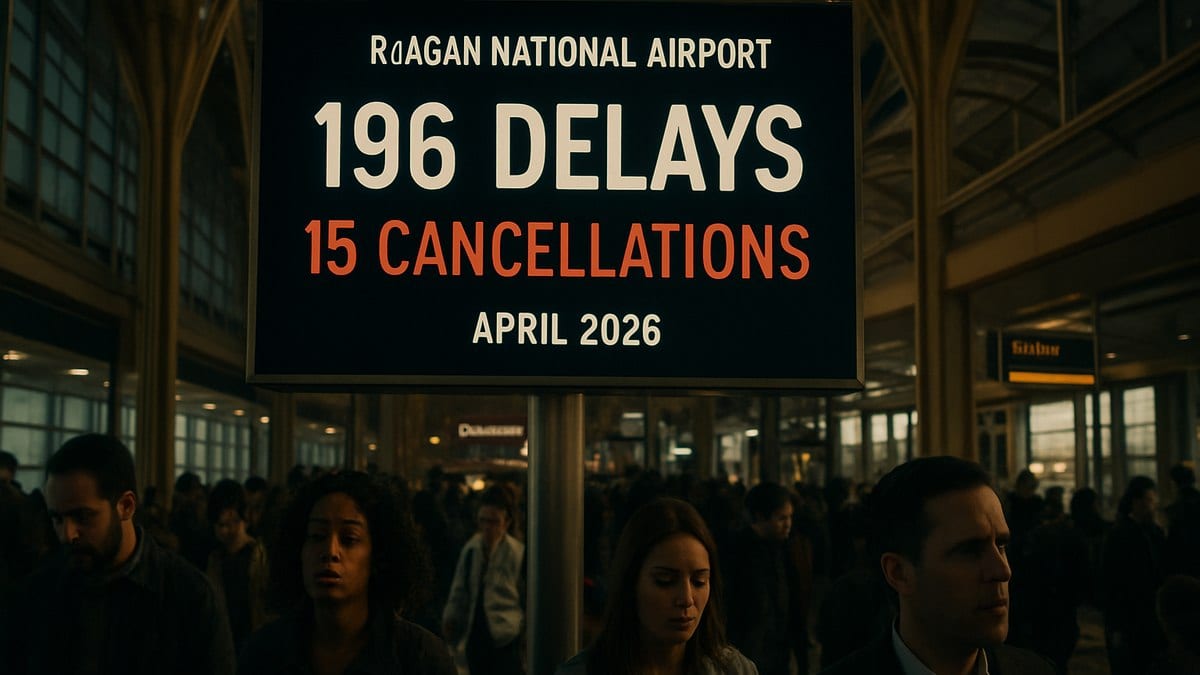
Ronald Reagan Washington National Airport recorded 196 flight delays and 15 cancellations in early April 2026, highlighting how the capital region has become a flashpoint in a wider pattern of spring travel disruptions across the United States.
Get the latest news straight to your inbox!
Heavy Disruption Hits Washington’s Close-In Airport
The latest delay and cancellation figures place Reagan National among the more heavily affected medium‑sized U.S. airports so far this month, according to aggregated flight‑tracking dashboards and published aviation analyses. While the totals are modest compared with the largest national hubs, they represent a significant share of the airport’s tightly scheduled daily operations.
Reagan National’s compact airfield and slot‑controlled schedule mean that even a relatively small number of off‑schedule operations can ripple quickly through the day. When departures push back late or arrivals queue for the runway, the knock‑on effect can compress connection windows and strand passengers attempting to move through the Washington region on tight itineraries.
Publicly available airport‑status feeds for the Washington area show that traffic management initiatives have become a recurring feature of recent weeks, including ground delay programs and metered arrival flows when capacity is reduced. Those measures are designed to keep traffic safe and orderly but often translate into longer gate and taxi times for individual flights.
The 15 recorded cancellations at Reagan National add another layer of complexity. Although numerically small, each canceled segment can disrupt crew rotations and aircraft positioning, affecting later flights on the same day or the following morning and contributing to the elevated disruption picture travelers are now encountering in April.
Weather, Infrastructure and Airspace Constraints Converge
The April slowdown at Reagan National follows a winter and early spring marked by bouts of severe weather and infrastructure strain across the Mid‑Atlantic. A major January winter storm brought Washington’s air traffic to a standstill, and subsequent systems in March prompted travel waivers and schedule adjustments for flights into and out of the capital region, according to meteorological summaries and airline advisories.
In addition to weather, recent weeks have seen several high‑profile air traffic control restrictions affecting all three major Washington‑area airports. Reports from aviation observers and passenger accounts describe periods in March when arrivals and departures at Reagan National, Washington Dulles and Baltimore/Washington International were temporarily limited after issues were reported at a regional air traffic facility that manages the area’s skies.
These constraints interact with the airport’s physical limitations. Sandwiched between the Potomac River and dense urban development, Reagan National operates a small number of runways and has little room for expansion. Federal records and congressional discussions about the airport have repeatedly cited those structural constraints, noting that Reagan National handles a level of traffic that pushes the limits of its design capacity.
With aircraft already operating in a tightly choreographed sequence, any interruption can quickly create a queue of delayed flights. Once those lines form, it can take hours for operations to return to normal, even after the original weather or equipment issue has been resolved.
Part of a Broader National Wave of Spring Delays
The difficulties at Reagan National are not occurring in isolation. National tallies compiled from flight‑tracking services and transportation coverage for the first days of April show several hundred cancellations and thousands of delays across the United States in a single 24‑hour period, reflecting strain at multiple hubs simultaneously.
Major airports such as Chicago O’Hare, Dallas‑Fort Worth, Phoenix Sky Harbor, Boston Logan and Atlanta have all reported elevated disruption levels in recent days, driven by a combination of thunderstorms, high winds, and knock‑on effects from air traffic control programs. When those hubs slow down, aircraft and crews can fall out of position, and the resulting network imbalance often reaches smaller but strategically important facilities such as Reagan National.
Industry analyses note that aircraft are flying fuller than in previous years, leaving fewer empty seats available for stranded passengers to rebook on later flights. At the same time, staffing across airlines, ground‑handling providers and federal agencies remains tight, limiting the system’s ability to absorb shocks without visible passenger impact.
Within that national context, Reagan National’s 196 delays and 15 cancellations stand as one localized snapshot of a broader spring pattern. The figures underscore how even secondary hubs can become pressure points when national operations are stretched.
What the Numbers Mean for Travelers Using Reagan National
For passengers, the statistics translate into longer lines, crowded departure lounges and a higher likelihood of missed connections. Travel‑advice columns tracking the current disruption wave have urged passengers at constrained airports such as Reagan National to build in extra buffer time, particularly when connecting to last‑flight‑of‑the‑day services or international departures from other hubs.
The airport’s role as a preferred gateway for business and government travelers adds another layer of sensitivity. Many itineraries through Reagan National involve same‑day trips or tightly timed returns, which are more vulnerable to delay‑related disruption. A late‑afternoon ground delay program or a cluster of weather‑related holds can turn a routine day trip into an overnight stay.
Consumer advocates observing the spring travel period point out that federal rules on passenger rights place clear responsibilities on airlines when flights are canceled or significantly delayed for reasons within a carrier’s control, such as crew or maintenance issues. Weather‑driven interruptions, which account for a substantial share of recent disruptions, often give airlines more limited obligations, leaving travelers dependent on individual carrier policies for rebooking or lodging assistance.
Travel experts recommend that passengers flying through Reagan National in the coming weeks monitor their flight status frequently, keep airline apps updated and consider morning departures whenever possible, since early‑day flights are generally less exposed to the cascading impact of network‑wide delays.
Looking Ahead to the Remainder of April 2026
Forecasts for the remainder of April suggest a continued risk of weather‑related turbulence across key U.S. regions, including the Mid‑Atlantic and Northeast. Aviation analysts expect that any new bouts of storms, strong winds or low ceilings could once again bring traffic‑management programs into play at Reagan National, with secondary effects on schedules throughout the day.
Policy debates over the airport’s capacity, slot rules and perimeter limitations are also likely to gain renewed attention if disruption levels remain elevated. Legislative hearings and regulatory documents in recent years have highlighted Reagan National’s chronic congestion and the tension between demand for additional flights and the infrastructure constraints that already contribute to high delay rates.
In the short term, however, most of the burden will continue to fall on travelers and frontline staff. With the airport already registering 196 delays and 15 cancellations in the opening stretch of April, passengers passing through the nation’s capital this month may need to brace for a level of unpredictability that has increasingly become a feature of modern U.S. air travel.