

More news on this day
Flying within the United States now demands stricter identification than at any point in the past two decades, as the long delayed REAL ID regime moves from fine print to front line at airport security checkpoints.
Get the latest news straight to your inbox!
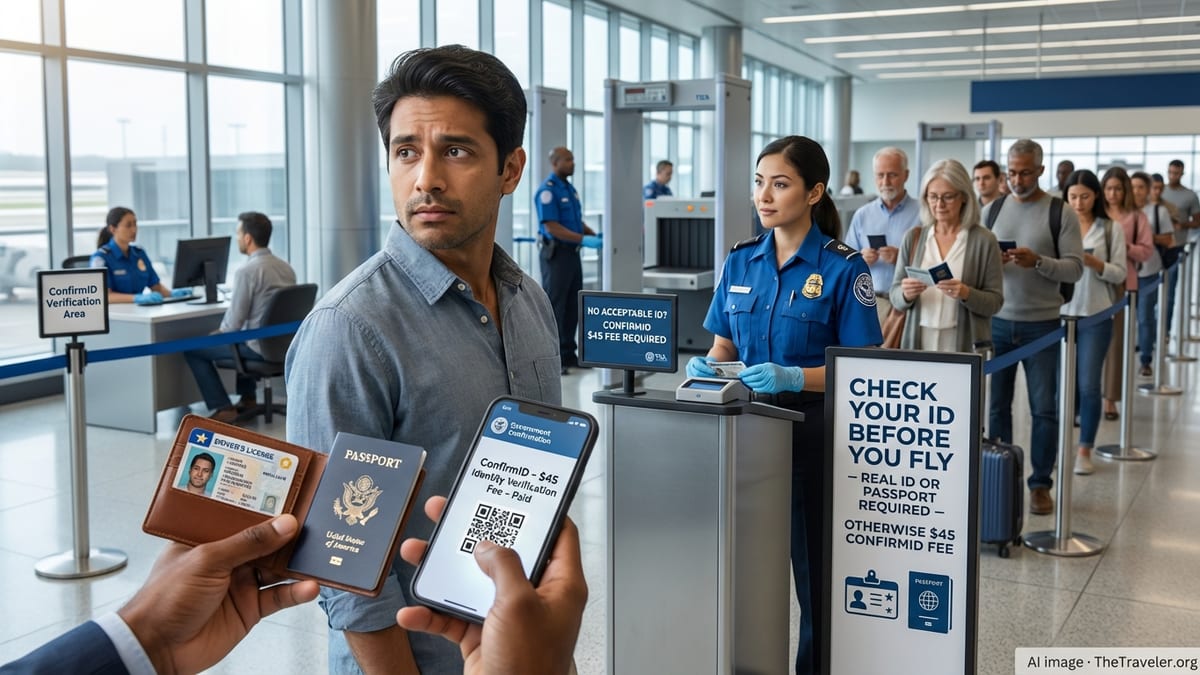
A Long Delayed Security Law Finally Reaches the Checkpoint
The REAL ID Act, approved in the mid 2000s to tighten standards for identification used at airports and other federal facilities, is now fully reshaping routine domestic air travel. The law set minimum security benchmarks for state issued driver’s licenses and ID cards, including more intensive document checks at motor vehicle agencies and new security features on the cards themselves.
After years of postponements, publicly available federal and state guidance indicates that the last major phase of implementation for air travel arrived on May 7, 2025. From that date, standard licenses that do not meet REAL ID standards are no longer accepted as stand alone identification at Transportation Security Administration checkpoints for adults seeking to board commercial flights within the country.
Transportation summaries and state travel advisories describe REAL ID compliant cards as those marked with a small star or similar symbol on the front, confirming that the issuing state has met federal vetting and card security requirements. The cards are now central to how identity is verified against airline reservations and security watchlists at U.S. airports.
Background material on the law notes that its airport provisions were designed in response to vulnerabilities exposed by the September 11 attacks, particularly the ease with which fraudulent or weakly vetted identity documents could be used to access secure areas of airports and commercial aircraft.
What Every U.S. Traveler Must Now Show to Fly
Under the current rules, adults aged 18 and older flying within the United States are expected to present either a REAL ID compliant driver’s license or identification card, or another form of identification that meets federal standards, such as a valid U.S. passport, passport card, certain trusted traveler cards, or U.S. military identification.
Travel advisories from airlines, state motor vehicle agencies, and travel publications emphasize that the crucial change is not the need for identification as such, but the quality of that identification. A non compliant state license that once worked for domestic flights is now treated the same as arriving at the checkpoint without any acceptable ID at all.
Reports indicate that a large majority of passengers presenting ID at U.S. checkpoints already use compliant documents, reflecting years of quiet preparation by states and travelers. However, adoption remains uneven by region, and local campaigns continue to urge residents to check their current cards for the REAL ID marking before booking trips.
For families, publicly available federal guidance explains that the requirement applies only to adult travelers. Children under 18 generally do not need to show identification for domestic flights when traveling with an adult, though airlines may have their own documentation policies for unaccompanied minors and name mismatches.
New Fees and Backup Identity Checks for Noncompliant Travelers
Even with widespread outreach, some passengers still reach the airport without a REAL ID or alternative acceptable document. Beginning in February 2026, coverage from outlets such as the Associated Press and Axios describes a new fallback process at checkpoints that comes with a financial sting.
Travelers who arrive for a domestic flight without compliant identification can be referred into an alternate identity verification system known as ConfirmID. According to published explanations of the program, this process relies on additional questioning and database checks to confirm a traveler’s identity for a limited travel window.
The alternative is far from a free pass. Recent reports state that adults using ConfirmID must now pay a fee of about 45 dollars for the extra processing. The result is valid only for a short period, such as ten days of travel, and even payment does not guarantee that a traveler will be allowed through if their identity cannot be verified to the required standard.
Commentary from travel industry analysts frames the new charge as a deliberate nudge, shifting the cost of last minute identity problems away from taxpayers and onto passengers who have not upgraded or who misplace their documents. For regular flyers, the practical message is that hoping to talk one’s way through security without proper ID has become both more expensive and less reliable.
State DMVs, Longer Paper Trails, and Who Needs to Act Now
For travelers who still rely on older licenses or ID cards, the path to compliance runs through state motor vehicle departments. State level notices explain that obtaining a REAL ID generally requires visiting a licensing office in person with a more extensive bundle of documents than many drivers supplied when they first obtained a license.
Typical checklists highlighted in state materials include proof of identity such as a birth certificate or passport, proof of Social Security status, and multiple documents establishing current residence, like utility bills or lease agreements. The exact combinations vary by state, but the underlying aim is a more rigorous and standardized verification process before a card is issued.
Many states now issue both REAL ID and noncompliant versions of their licenses, but note that only the compliant versions will work on their own at airport checkpoints. Residents who renewed licenses by mail or online in recent years without specifically requesting REAL ID may therefore hold cards that look current but will not meet federal airport standards.
Travel planning advice from major consumer travel outlets stresses that anyone who flies even occasionally within the United States should verify their card and, if needed, start the REAL ID application process weeks or months before their next trip. Processing times can spike before peak travel seasons, and appointments at busy licensing centers may be limited.
How the New Rules Are Reshaping the Airport Experience
The rollout of full REAL ID enforcement has produced a visible shift at security lanes. Aviation and travel coverage notes that, on balance, checkpoints have remained orderly, in part because most passengers arrive with compliant documents or passports. However, frontline accounts also describe last minute surprises for travelers who discover only at the podium that their long familiar license no longer qualifies.
Airport customer service updates indicate that airlines are increasingly reminding customers about identification rules in booking confirmations, mobile app notifications, and pre departure emails. Some carriers encourage passengers to double check IDs in the days before travel, reflecting concern that even a relatively small share of noncompliant travelers can translate into missed flights and rebooking challenges.
Security experts cited in public reports suggest that, over time, REAL ID should make it more difficult to use forged or fraudulently obtained licenses to access secure airport areas. At the same time, privacy advocates continue to monitor how expanded data sharing and document retention practices associated with REAL ID are implemented across the states.
For ordinary flyers, the most immediate impact is far more practical than political. Boarding a domestic flight now rests on a narrower set of acceptable documents, backed by tougher verification. In an era of crowded airports and complex itineraries, keeping that small star or an equivalent federally accepted ID in hand has effectively become the new price of admission to the U.S. skies.