

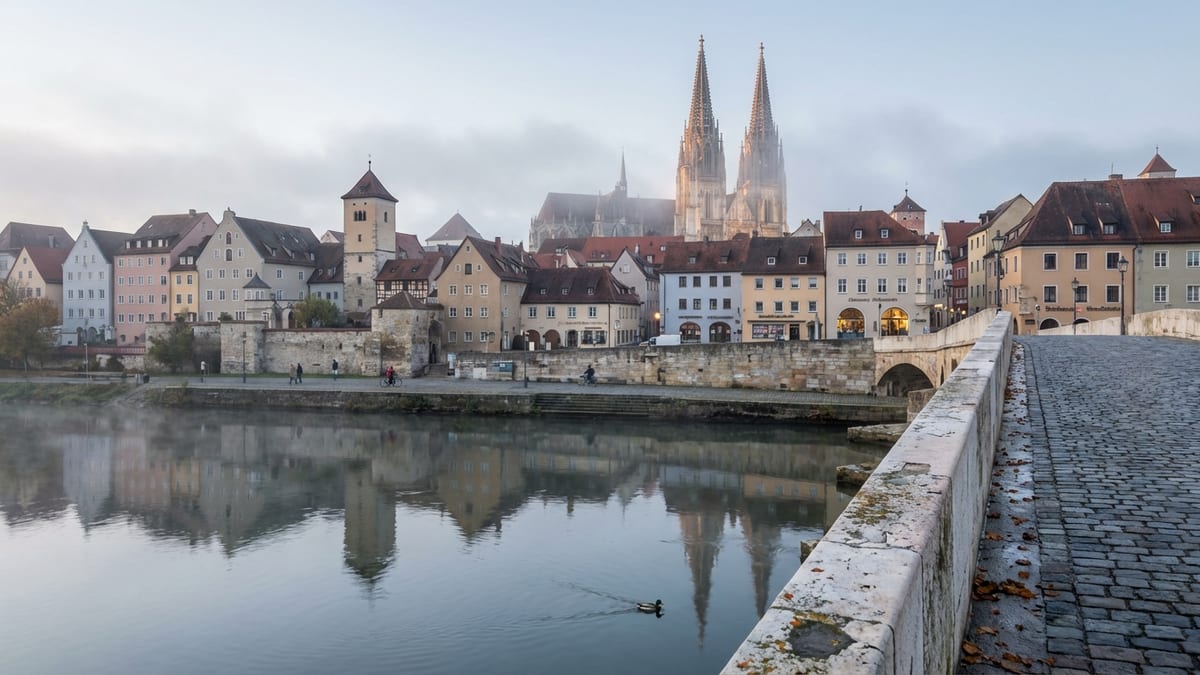
On a misty morning along the upper Danube, Regensburg’s skyline rises in a bristle of spires, medieval towers and steep red roofs. At street level, its cobbled lanes twist between patrician townhouses, Roman ruins and Gothic churches that seem to have slipped through history almost untouched.
This is not illusion but design: Regensburg is widely regarded as Germany’s best preserved medieval city, a place where more than 1,000 protected monuments form a continuous urban fabric that has changed remarkably little since the Middle Ages. For travelers, it offers a rare chance to experience a genuine medieval trading town in three dimensions, not as a museum but as a living city.
Why Regensburg Is Considered Germany’s Best-Preserved Medieval City
Regensburg’s medieval core survived where many others in Germany did not. During the Second World War, the city escaped the widespread destruction that leveled historic centers in places like Nuremberg, Dresden and Cologne. Strategic air raids damaged specific industrial sites on the outskirts, but the compact old town on the south bank of the Danube remained largely intact. The loss of a few individual churches and houses only underscores how extraordinary it is that the broader ensemble of streets, squares and monuments still reads today much as it did centuries ago.
Equally crucial was what did not happen in the postwar decades. As other cities tore out old quarters in the name of modernization, Regensburg’s sluggish economy inadvertently became a guardian of history. There was little money for ambitious redevelopment, and when prosperity finally arrived in the 1960s and 1970s, attitudes toward heritage had shifted. Instead of demolishing its narrow alleys and medieval blocks, Regensburg embarked on an extensive program of restoration that treated the old town as an asset rather than an obstacle to growth.
The result is an urban landscape of unusual authenticity and continuity. In 2006, UNESCO added the Old Town of Regensburg with Stadtamhof to the World Heritage List, citing it as an outstanding example of a central European medieval trading center whose fabric reflects two millennia of history. The organization and the city’s tourism board now describe Regensburg as the best preserved medieval city in Germany, and walking its lanes, the claim feels justified. Roman, Romanesque and Gothic structures stand shoulder to shoulder with later additions, yet the overall scale, street pattern and skyline remain resolutely medieval.
For visitors, this preservation is not only visual but experiential. The old town is compact, pedestrian in character and still filled with residents, students, businesses and markets. It is not a reconstructed stage set or an isolated heritage quarter. Instead, the medieval fabric is interwoven with everyday life, from grocery shops tucked into Gothic arcades to bicycle wheels rattling over stones laid by long vanished masons.
The Layers of History: From Roman Castra to Imperial Free City
Regensburg’s story begins long before medieval merchants filled its squares. Around the year 179, during the reign of Emperor Marcus Aurelius, the Romans established a fortified camp called Castra Regina on a commanding bend in the Danube. They built substantial stone walls, gates and administrative buildings, fragments of which are still visible in today’s city. The most famous is the Porta Praetoria, once the north gate of the legionary camp and now set into the wall of the bishop’s palace near the cathedral. To stand beneath its arches is to sense how the city’s strategic river position made it a frontier post of the Roman Empire.
After the fall of Roman authority, a settlement persisted around the fort’s remains. By the early Middle Ages, Regensburg had become a Bavarian ducal residence and an early Christian center. Its role expanded again in the High Middle Ages when the city emerged as a key meeting place of the Holy Roman Empire. Imperial assemblies and diets convened here, and later, from the 17th to the early 19th century, Regensburg hosted the Perpetual Imperial Diet, effectively giving the town a diplomatic status out of proportion to its size.
During this period, Regensburg was recognized as a Free Imperial City, with its own laws, council and considerable wealth derived from trade. Merchants dealt in salt, wine, cloth and luxury goods that flowed along the Danube and overland routes connecting Italy, Bohemia, Russia and the Byzantine world. The profits of this commerce are still etched into stone: towering patrician houses, ornate guild halls and richly endowed churches that crowded into the limited space within the old fortifications.
These historical layers are what make the city so compelling to explore. Roman walls sit behind Baroque facades; medieval townhouses incorporate late Gothic windows or Romanesque arcades; Renaissance or 19th century interiors are tucked behind austere stone fronts. Rather than being frozen in any single era, Regensburg shows how a European city evolved organically while keeping its basic medieval skeleton intact.
Streets, Squares and Towers: Experiencing the Medieval Urban Fabric
The power of Regensburg’s preservation becomes fully apparent when you lose yourself in its street network. Unlike many German city centers reshaped in the 19th and 20th centuries, the plan of the old town still follows its medieval pattern. Narrow lanes twist between irregular blocks, small internal courtyards lurk behind gateways, and unexpected vistas open onto church towers and house gables. The orientation is not centered on wide boulevards or car traffic. Instead it reflects the logic of foot traffic, trade routes and defensive walls.
Goliathstrasse, for example, is lined with grand patrician townhouses, several of which rise to five or six stories. Their facades may be painted in sober ochres or pastels, but look upward and you will spot the proud silhouettes of medieval towers. These so called “tower houses” were a hallmark of wealthy merchant families in the 12th and 13th centuries, built both as status symbols and as semi-fortified residences. While Italian cities such as San Gimignano are famous for such towers, Regensburg preserves one of the most extensive ensembles north of the Alps.
The city’s squares retain a similarly medieval feel. Haidplatz, framed by the Thurn and Taxis Palace and old burgher houses, was once a marketplace and gathering spot; today its cafes spill into the open space, but the dimensions and frontages remain much as they would have for medieval traders. Nearby Neupfarrplatz, laid out over the site of the former Jewish quarter, tells a more somber story. A synagogue stood here until it was destroyed during a 16th century pogrom, and the old quarter itself was erased when a new square was created. Modern installations trace the vanished outlines on the pavement, a reminder that preservation can also involve confronting painful history.
Even smaller corners of the city retain centuries of continuity. Passages beneath overhanging upper stories connect lanes, while arcaded walkways shelter medieval shopfronts. Many of the ground floor spaces along these streets function as they long have: as workshops, taverns, food sellers or small retailers. For travelers, the effect is immersive. Simply moving through the old town gives a sense of scale and atmosphere that no museum exhibit can replicate.
Icons of Stone: Regensburg Cathedral, the Stone Bridge and Roman Remains
Among the hundreds of historic buildings in Regensburg, a few architectural landmarks are essential to understanding why experts prize the city’s medieval fabric so highly. The twin spires of St. Peter’s Cathedral dominate almost every view, rising above a forest of rooftops. Begun in the 13th century and largely completed by the 15th, it is the only pure Gothic cathedral in Bavaria. Its tall, narrow nave, intricate stone tracery and stained glass cycles reflect the wealth and ambition of a city that competed symbolically with other imperial centers for prestige.
The cathedral complex also makes Regensburg’s long time scale tangible. Beneath nearby Niedermünster church, archaeological excavations have revealed earlier churches and Roman structures, now accessible in a documented underground site where travelers can walk alongside foundations spanning more than a millennium. Outside, the bishop’s courtyard hides the Roman Porta Praetoria, visually anchoring the medieval and ecclesiastical landscape to its imperial roots.
Down by the Danube, the Stone Bridge provides another key to the city’s medieval character. Constructed between roughly 1135 and 1146, this massive arched bridge of limestone blocks was for centuries the only reliable fixed crossing of the river between Ulm and Vienna. Traders, pilgrims, imperial armies and even Crusaders used it, and its completion helped redirect long distance traffic through Regensburg, boosting the city’s prominence as a commercial hub.
Today the Stone Bridge is closed to regular vehicle traffic, preserving its fabric and allowing pedestrians to appreciate the engineering up close. Its sequence of 16 arches marches across the Danube towards the suburb of Stadtamhof, itself part of the World Heritage listing. Look back toward the city from mid span and you see a skyline that could belong to the 14th century: towers, gables, the mass of the cathedral and the clustered roofs of merchants’ houses, all stacked tightly behind remnants of the old riverside walls.
Preservation in Practice: How Regensburg Protects Its Medieval Core
Regensburg’s survival as a medieval city is no accident of history alone. Since the mid 20th century, the municipality has taken active steps to protect and maintain its old town. Early preservation laws restricted demolition and major alterations, while detailed surveys documented facades, rooflines and significant interiors. This allowed planners to balance modern needs with conservation, guiding everything from shopfront renovations to street lighting.
In the 1960s and 1970s, as traffic volumes rose, the city began to limit cars in the historic center. Entire streets were pedestrianized, loading zones were carefully positioned and parking was shifted to the edge of the old town. These measures may seem unremarkable today, but at the time they prevented the kind of road widening and reconstruction that had already damaged older quarters elsewhere. The medieval street plan, narrow lanes and intimate squares remained intact instead of being forced to accommodate heavy vehicles.
UNESCO inscription in 2006 added another layer of protection and international scrutiny. The Old Town of Regensburg with Stadtamhof was recognized for its integrity as a medieval trading city and for the exceptional quality of its built fabric. Since then, conservation plans have been updated to address issues such as tourism pressure, building maintenance and climate resilience. Restoration projects often aim not merely to preserve appearances but to stabilize original materials, from ancient timber beams to stone facades weathered by centuries of river air.
For travelers, this careful stewardship is visible in the details. Street surfaces favor traditional paving, signage is relatively discreet, and new interventions tend to respect the scale and character of their surroundings. At the same time, the city has embraced adaptive reuse: former granaries and townhouses now contain museums, cultural centers, apartments and offices. Preservation in Regensburg is not about freezing the city in time, but about guiding change so that the medieval structure remains legible and vibrant.
Living Heritage: Everyday Life in a Medieval City
What sets Regensburg apart from an open air museum is that its medieval core is still a working city center. Roughly 150,000 people live in the wider municipality, and many of them study, work or reside within the historic area. The University of Regensburg and the OTH Regensburg, though located outside the old walls, send a steady stream of students into its cafes and bars. Government offices, professional firms and small manufacturers occupy centuries old buildings, their modern activities layered invisibly over ancient masonry.
This living character is one of the city’s strengths. Early mornings bring delivery vans and bicycles into the lanes, traders setting up stalls in the markets, and residents fetching bread from neighborhood bakeries. Midday sees business lunches, shopping and guided tours weaving past one another in the alleys. In the evening, vaulted beer cellars and open air terraces along the river fill with conversation as lights flicker on behind mullioned windows.
Regensburg’s food and drink scene also draws on its long history. Traditional Wurstkuchl, a riverside sausage kitchen that claims roots in the Middle Ages, serves beer and grilled sausages beside the Stone Bridge, while contemporary restaurants reinterpret Bavarian classics within medieval walls. Local breweries, some with origins stretching back centuries, continue the city’s brewing heritage. For visitors, such experiences reinforce the sense that the past has not been sealed off, but woven into daily routines.
Cultural life further animates the old town. Classical concerts echo beneath Gothic vaults, contemporary art is shown in historic halls, and festivals spill into the streets throughout the year. A World Heritage Visitor Center explains the city’s significance, but the best interpretation often comes simply from wandering: noting the wear on steps, the patched stonework, the eclectic doorways and inscriptions that testify to generations of use.
Planning Your Visit: How to Explore Regensburg’s Medieval Heart
Regensburg sits in eastern Bavaria at the northernmost bend of the Danube, roughly an hour and a half by train from Munich and about the same time by rail from Nuremberg. Its compact center makes it an ideal weekend break, though many travelers now pair it with other Danube or Bavarian destinations. The main railway station is a short walk from the medieval core, and visitors reach the old town by passing through the remains of the historic walls and along streets that quickly narrow from modern scale to medieval proportions.
Most travelers begin at the cathedral and surrounding squares, which form a natural orientation point. From there, loosely planned walks can lead through the former Roman zone around the Porta Praetoria, on to the patrician houses of Goliathstrasse and into the web of alleys stretching toward the river. Crossing the Stone Bridge into Stadtamhof offers a rewarding perspective back onto the old town and connects to riverside paths and parks.
Museums and documented sites provide deeper context. The Historical Museum of Regensburg, housed in a former monastery, explores the city’s development from Roman fort to Free Imperial City and beyond. The document Niedermünster and other archaeological presentations reveal the layers beneath churches and streets. For those with an interest in natural history and aristocratic gardens, Herzogspark on the western edge of the old town combines remnants of medieval defenses with a small botanical garden and a tower offering views over the Danube.
Guided tours, available through local tourism offices, can be particularly helpful in a city where much of the story is hidden behind facades or underfoot. Specialized walks focus on themes such as Jewish heritage, Roman Regensburg, architecture or World Heritage preservation. Yet even without a guide, the key to appreciating the best preserved medieval city in Germany is to slow down, look up at the rooftops and towers, and imagine the centuries of travelers who have paused on the same cobbles.
The Takeaway
Regensburg’s claim to being Germany’s best preserved medieval city rests on more than its atmospheric streets and postcard views. It is grounded in the rare survival of an entire urban structure: a Roman foundation, a medieval trading hub, an imperial meeting place and a later provincial town whose old core escaped both war and aggressive modernization. Unlike cities where historic reconstruction dominates, Regensburg offers authentic continuity. The same bridge that carried Crusaders still spans the Danube, the same cathedral towers over the market squares, and many of the same houses that sheltered merchants now host today’s residents and businesses.
For travelers, this makes Regensburg more than a pleasant stop on a Danube itinerary. It is a place to understand how medieval Europe functioned, how trade and faith shaped cityscapes, and how careful preservation can allow a historic center to remain a living heart rather than a fossilized fragment. Wander its lanes in the early morning or at dusk, when the crowds thin and the light softens on stone and plaster, and the city’s long history feels particularly close at hand.
FAQ
Q1: Why is Regensburg often called Germany’s best preserved medieval city?
Regensburg is widely described this way because its historic center retains an almost complete medieval street pattern and more than 1,000 protected monuments, including Roman, Romanesque and Gothic buildings. Unlike many German cities, it escaped heavy wartime destruction and large scale postwar redevelopment, allowing its medieval fabric to survive largely intact.
Q2: What makes Regensburg different from other historic cities like Nuremberg or Rothenburg ob der Tauber?
While cities such as Nuremberg and Rothenburg have impressive old towns, large parts of their historic fabric were destroyed or heavily reconstructed in the 20th century. Regensburg’s core, by contrast, is largely original, with continuous layers from Roman times onward. It also functions as a sizable, lived in city center rather than as a small, heavily touristed heritage enclave.
Q3: What are the must see medieval landmarks in Regensburg?
Key medieval sites include St. Peter’s Cathedral with its Gothic spires and stained glass, the 12th century Stone Bridge across the Danube, the Roman Porta Praetoria gate, and the patrician tower houses that line streets like Goliathstrasse. The overall experience of walking through the narrow lanes and squares is just as important as individual monuments.
Q4: How did Regensburg’s medieval center survive the Second World War?
Although industrial sites around Regensburg were bombed during the war, the compact old town was not a primary target and suffered relatively limited damage. A few churches and houses were lost, but the majority of the medieval street network and building stock remained intact, providing a strong foundation for later preservation efforts.
Q5: What role did the Danube play in Regensburg’s medieval development?
The Danube made Regensburg a strategic trading hub and border post. The Stone Bridge turned it into a vital crossing point for merchants, pilgrims and armies moving between western Europe, Italy, Bohemia and eastern regions. River trade fueled the wealth of local families and guilds, whose prosperity is still visible in the townhouses and civic buildings they funded.
Q6: Is Regensburg’s old town mainly a tourist area, or do people still live there?
People very much still live and work in the old town. Residential apartments, offices, shops, cafes, universities and public institutions all occupy historic buildings. This everyday use keeps the medieval core lively beyond peak sightseeing hours and helps support the ongoing maintenance of the historic fabric.
Q7: How does UNESCO World Heritage status affect the city today?
World Heritage status brings international recognition and stricter conservation guidelines. It requires Regensburg to manage development carefully, maintain its historic structures and balance tourism with residents’ needs. The designation has helped secure funding for restoration projects and raised awareness of the city’s global cultural significance.
Q8: Can visitors explore the Roman history of Regensburg as well as the medieval city?
Yes. In addition to the visible remains of the Porta Praetoria and sections of the legionary camp walls, museums and documented archaeological sites show Roman layers beneath later buildings. Exhibitions at places like the Historical Museum and underground sites such as document Niedermünster explain how the Roman fort of Castra Regina evolved into the medieval town.
Q9: How much time should I plan to experience Regensburg’s medieval heritage?
A full day allows you to see the main highlights, but two to three days provide a more relaxed exploration of the old town, its museums, churches and riverside paths. Staying overnight also lets you experience the city in the quieter early morning and evening hours, when its medieval atmosphere is especially evocative.
Q10: Is Regensburg a good destination for travelers interested in architecture and urban history?
Absolutely. Regensburg offers an unusually complete lesson in European urban development, from Roman fortifications and Romanesque churches to Gothic cathedrals, patrician houses and later Baroque and 19th century layers. For anyone interested in how cities grow, adapt and preserve their core structures, it is one of the most rewarding destinations in Germany.