


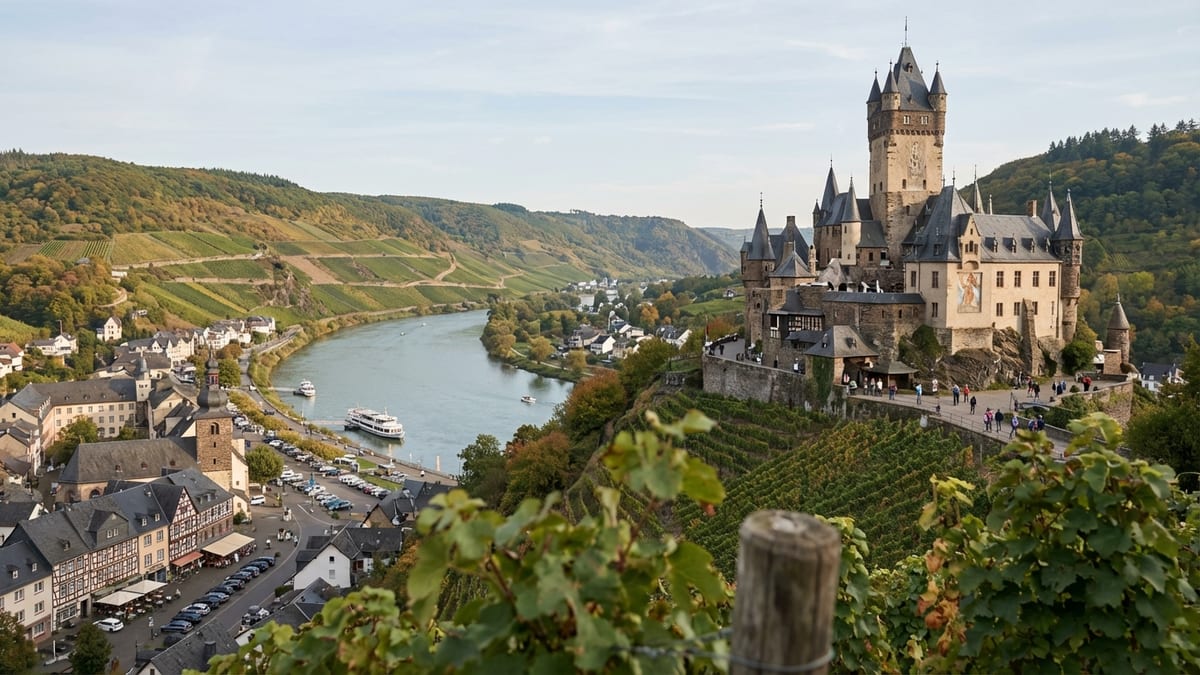
Reichsburg Cochem rises above the Moselle River like something out of a storybook, its turrets and battlements framed by steep vineyards and slate-roofed houses far below. For many travelers, this is the iconic image of the Moselle Valley.
Yet behind the romantic silhouette lies a complex history that stretches from the era of medieval toll lords to 19th century industrial wealth and modern tourism. Understanding that story, and knowing what to expect when you visit today, turns a pretty postcard view into a far richer experience. This castle is central to the main things to do in Cochem.
The Story of an Imperial Castle on the Moselle
The castle known today as Reichsburg Cochem began life as a hilltop stronghold guarding a strategic stretch of the Moselle. The rocky spur above Cochem narrows the river and forces traffic into a tight corridor, which in the Middle Ages made it ideal for monitoring trade and collecting customs dues.
Current research suggests that a fortified complex stood here by around 1100, probably founded by regional counts who held the land as imperial fiefs. Early references link the site to the powerful Palatine family and, within a few decades, to the kings and emperors of the Holy Roman Empire. Reichsburg plays a big role when evaluating if Cochem is worth visiting.
The term Reichsburg indicates that the castle became a direct imperial possession rather than the private property of a feudal lord. In the 12th century it briefly served as a residence for the Hohenstaufen dynasty, symbolizing royal control over this valuable river route. From the towers on the hilltop, soldiers could watch for approaching ships and caravans, while officials in the castle courts administered tolls and legal matters for the surrounding region. This was never simply a romantic hideaway. It was a working power center embedded in the economic lifeblood of the empire.
In later centuries, Reichsburg Cochem passed through shifting political hands, mirroring the fragmented politics of the Holy Roman Empire. By the late 13th century, a cash-strapped king pledged the castle and town to the archbishop of Trier in exchange for funds needed to secure his crown. That pledge was never redeemed, and Cochem became an important stronghold of the Trier electorate. For hundreds of years, archiepiscopal governors and their officials ran both a fortress and a regional administration from within these walls, cementing the link between castle and town that visitors sense even today.
Destruction, Ruin and Romantic Reinvention
The end of the medieval Reichsburg came abruptly in the late 17th century. During the Nine Years War, known locally as the War of the Palatine Succession, French troops followed a scorched-earth policy along the Moselle and Rhine. In May 1689 they bombarded and mined the castle, setting it ablaze and blowing up key defensive structures. What had been a bustling administrative and military hub became a blackened shell of broken walls and collapsed towers. For generations afterward, the ruins loomed over Cochem as a reminder of war and shifting power.
For a long time, no one had either the money or the motive to rebuild. Through the 18th and early 19th centuries, the ruins sat largely abandoned, with locals salvaging stones where they could. The romantic movement later cast a different kind of spell over the site. Painters, poets and early tourists were drawn to the overgrown walls and crumbling keep high above the river bends, seeing in them a picturesque symbol of a vanished medieval world. Sketches and engravings of the ruined Reichsburg circulated widely and helped fix Cochem in the imagination of early travelers on the Rhine and Moselle.
Everything changed in 1868, when a wealthy Berlin merchant and industrialist, Louis Fréderic Jacques Ravené, purchased the ruined hilltop from the Prussian state. This was the age of castle romanticism, when aristocrats and industrial magnates across Germany rebuilt or embellished old fortresses in neo-medieval style. Ravené, involved in major railway projects in the region, saw Cochem not as an antiquarian project but as a spectacular summer residence. Working with Berlin architects, he set out to recreate a vision of a medieval hill castle that also met the expectations of a 19th century residence.
Between 1868 and 1877, Ravené’s team cleared the rubble and erected new ensembles of halls, towers and residential wings, incorporating surviving medieval structures where possible. The result is not a reconstruction in the strict archaeological sense but a carefully staged neo-Gothic interpretation, very much a product of its time. Battlements, turrets and elaborate interiors were designed to evoke a romantic Middle Ages filtered through 19th century taste and national pride. When the rebuilt castle was inaugurated in 1877, its reappearance above the Moselle coincided symbolically with the era of a newly unified German Empire.
Architecture: Between Middle Ages and Neo-Gothic Fantasy
Visitors today encounter a castle whose outline and presence are dominated by 19th century building campaigns, yet traces of the medieval stronghold remain woven into the fabric. The core of the complex is a high, polygonal main tower with a distinctive octagonal lower section. The base and vaulted cellar of this tower likely date back to the earliest phase of the castle’s construction and may have formed the nucleus of the original keep. Above this older core rise later additions, including an upper story with corner turrets that reflect 19th century historicist design rather than genuine medieval forms.
A walk through the courtyard and around the walls reveals this layering of time. Sections of the curtain wall, the northern gate, certain towers such as the so-called Hexenturm and elements adjacent to the Knights’ Hall preserve medieval masonry and construction techniques. At the same time, many of the buildings that catch the eye, including the richly articulated residential wings and picturesque gables, date from the Ravené era. They were conceived to harmonize visually with the older fragments while offering a theatrical, almost stage-set interpretation of a medieval lord’s seat.
Inside, the historicist design is even more pronounced. The main rooms open to the public are furnished and decorated in neo-Renaissance, neo-Baroque and neo-Gothic styles that were highly fashionable among the 19th century elite. The dining hall, with its dark wood paneling, ornate fireplaces and coffered ceiling, stages an idealized image of a late medieval banquet space. The Knights’ Hall, with stained glass windows, heraldic motifs and carved wood, amplifies this atmosphere and was designed from the outset as a showcase room for entertaining guests and projecting status.
Even small details have stories attached to them. On the outer wall of the main tower, visitors can see a large mosaic depicting Saint Christopher, patron saint of travelers. The original 19th century mosaic was removed during the Second World War for ideological reasons and later replaced with a new version funded by local donations. It is a telling example of how this supposedly medieval castle has continually been reshaped by the values and conflicts of different periods.
Ownership, Museum Status and the Castle Today
After Ravené’s family used Reichsburg Cochem as a summer residence for several decades, the property’s fate again followed the political currents of German history. During the National Socialist period, the family was forced to sell the castle to the state. After the Second World War, ownership gradually shifted to public hands, and since the late 20th century the castle has belonged to the town of Cochem. That change in ownership marked a decisive shift from private retreat to public monument and tourist attraction.
Today Reichsburg Cochem functions primarily as a museum and event venue. The castle is protected under heritage legislation and listed as a cultural monument of the state of Rhineland Palatinate. Restoration and maintenance work are undertaken with attention to both the surviving medieval elements and the historically significant 19th century layers. For visitors, this means that the rooms on view are not only atmospheric but also furnished with period-appropriate pieces that reflect the aspirations and style of Ravené’s era.
Standard visits to the castle are by guided tour, which is required to access the main interior spaces. Tours typically run frequently in season and are offered in German and other languages, sometimes with printed translations or audio options. The guides focus on architectural features, historical anecdotes and the personalities associated with the castle, from medieval archbishops to Ravené himself. Visitors see representative rooms such as the dining hall, ladies’ chamber, Romanesque room, hunting room, Knights’ Hall and armory, each staged to illustrate a particular facet of castle life, whether real, imagined or a bit of both.
Outside the guided areas, the castle courtyard and surrounding terraces provide sweeping views over Cochem, the river and the steeply terraced vineyards. Even without entering every interior room, many travelers find that simply standing on the walls and looking out over the Moselle valley offers a powerful sense of place. The castle grounds also host a small restaurant or tavern-style venue where visitors can pause for refreshments amid stone walls and timber beams.
Planning Your Visit: Practicalities and What to Expect
Reichsburg Cochem stands on a hill roughly 100 meters above the old town, and reaching it is a memorable part of the experience. The traditional approach is on foot, following a series of signposted lanes and stepped paths that wind upward through residential streets and patches of woodland. Allow 15 to 25 minutes for the climb depending on your pace and fitness level. The route is short but fairly steep, so comfortable footwear and a relaxed schedule are advisable, especially on hot summer days.
For those who prefer less exertion, there is also a shuttle service that runs seasonally between the town center and the castle, as well as limited parking closer to the hilltop. Availability and operating hours can vary according to season, local events and ongoing works, so it is wise to check current details with the Cochem tourist office or the castle’s own visitor information shortly before your trip. Public transport travelers will find that the castle is within walking distance of Cochem railway station, though you should factor in both the stroll along the river and the climb uphill.
The castle’s main visiting season typically runs from spring through late autumn, with extended hours in the core summer months and reduced schedules in the shoulder seasons. In winter, there may be limited or special opening days, especially around Advent events. Because tour times are structured and interior capacity is finite, it can be prudent to arrive earlier in the day in peak months such as July, August and during school holidays. Larger groups are usually expected to book in advance.
Entrance to Reichsburg Cochem involves a paid ticket, with different rates for adults, children and often combined family tickets. The standard ticket generally includes the guided tour. Additional charges may apply for special experiences such as themed dinners or certain events. Payment by card is increasingly common but not universal across smaller venues in the Moselle region, so carrying some cash remains sensible. Photography policies inside the rooms can vary, and flash or tripods may be restricted to protect interiors and avoid disruption to tours.
Experiences, Events and Seasonal Highlights
Beyond the standard tour, Reichsburg Cochem has developed a lively program of experiences that add theatrical flair to a visit. One of the best-known offerings is a medieval-style evening with food and entertainment served in the historic halls. These events typically combine hearty regional dishes, costumed staff, music and storytelling, set against candlelit stone walls and heavy timber beams. They are extremely popular with groups and should be booked well ahead, especially on weekends.
Throughout much of the season, the castle hosts smaller cultural events that draw on the atmospheric setting. These can include concerts, readings, wine tastings and themed tours focusing on particular aspects of history or architecture. The Moselle is renowned for its steep-slope vineyards and Riesling wines, and some events highlight the link between castle and wine culture. Even if you do not attend a specific performance, you may find that your visit coincides with preparations, decorations or partial closures linked to the event calendar.
Two annual highlights stand out on the castle’s schedule. On the first weekend of August, Reichsburg Cochem stages a multi-day castle festival with a medieval theme. Reenactors, craftsmen, musicians and food stalls bring the courtyards and terraces to life, giving visitors a sense of how loud, crowded and colorful a fortified seat might once have been on market days or during feasts. In December, the castle participates in the region’s Christmas festivities with a special “Burgweihnacht,” which often includes seasonal programs, atmospheric lighting and sometimes nativity plays or choral performances set against the winter landscape.
In recent years, the castle has continued to adapt its offerings, balancing heritage protection with the needs of contemporary visitors. That sometimes means temporary closures of individual rooms for restoration or modern safety upgrades. It is worth remembering that every scaffolding, rope barrier or fresh coat of lime mortar you encounter is part of the ongoing effort to ensure that this hillside silhouette endures for future generations of travelers.
Reichsburg Cochem in the Context of Cochem and the Moselle
While the castle dominates the skyline, it is intimately tied to the town of Cochem spread along the banks of the Moselle below. Walking from the riverfront through the old town up toward the castle helps connect the two. Narrow streets lead past half-timbered houses, small squares and the former Capuchin monastery, creating a layered impression of centuries of town life nestled under the protection of the fortress above. From the castle terrace, you can trace the curve of the Moselle and see how the town grew along both banks.
The panoramic view from Reichsburg Cochem also makes sense of the wider landscape of terraces and vines. The steep slopes around the castle are covered by vineyards that have been cultivated for generations, often by small family wineries. The castle itself once stood at the center of a feudal economic system that drew wealth from river tolls, agriculture and wine production. Today, the Moselle’s wines and river tourism have replaced tolls, but the symbiosis between castle, town and landscape remains strong.
For many visitors, Cochem is part of a broader journey along the Moselle or a side trip from the larger Rhine corridor. Kekely spaced between Trier and Koblenz, the town offers an easily accessible taste of the Moselle’s quieter, more intimate character compared to some busier Rhine sites. Reichsburg Cochem thus functions as both a focal point and a gateway: a place to dive into one specific story of destruction and reinvention, and a vantage point from which to glimpse many more castles, villages and vineyards upstream and downstream.
Spending a full day in Cochem allows you to combine the castle visit with strolls along the river promenade, perhaps a ride on the local chairlift to another viewpoint, and time to sample regional specialties such as Riesling, Federweißer in autumn or traditional dishes in one of the town’s inns. In that context, the castle visit becomes less a stand-alone attraction and more a central chapter in a broader narrative of the Moselle Valley.
The Takeaway
Reichsburg Cochem is not a pure medieval relic frozen in time. It is a palimpsest of power, destruction, romantic reinvention and modern tourism, layered onto one dramatic hilltop above a bend in the Moselle. The fortress that once collected tolls and projected imperial authority was shattered by war, then resurrected as a neo-Gothic fantasy by a 19th century industrial magnate with both money and imagination to spare. Today the castle is a carefully curated monument where visitors move through re-created halls, gaze at stained glass and dark wood, and step out onto terraces that have watched the river traffic evolve from wine-laden barges to pleasure boats and cruise ships.
Knowing this history transforms the experience of standing in the courtyard or leaning on the battlements. You are not only admiring a picturesque skyline, but also reading chapters of European history etched into stone and slate. The practicalities of visiting are relatively straightforward: a climb or shuttle from the town, a guided tour through highlights of the interior, and time to absorb the views. Yet the real reward lies in seeing how this single silhouette connects medieval politics, 19th century nostalgia and the travel habits of the present day.
For travelers exploring the Moselle Valley, Reichsburg Cochem offers both a destination and an orientation point. It distills the river’s blend of scenery, wine culture and layered history into one hilltop experience. Approach it with an awareness of its reconstructed character, a willingness to let the theatrical interiors work their charm and enough time to linger on the terraces, and you will leave with more than just a postcard photograph. You will carry away a deeper sense of how landscapes, stories and people interact to shape the places we travel to see.
FAQ
Q1: Is Reichsburg Cochem an original medieval castle or a reconstruction?
The site has medieval origins and preserves authentic elements such as sections of the walls and towers, but the visible castle complex was largely rebuilt between 1868 and 1877 in a neo-Gothic style by the Ravené family. It is best understood as a romantic 19th century reinterpretation that incorporates genuine medieval fragments.
Q2: How do I get to the castle from the town of Cochem?
From the old town, you can walk up following signposted paths and stairways, which usually takes 15 to 25 minutes and is quite steep in places. Seasonal shuttles or taxis can take you closer to the entrance if you prefer not to climb. Cochem’s railway station is within walking distance of the town center, from which you continue on foot or by shuttle to the castle.
Q3: Do I need to join a guided tour to see the interior?
In most cases, yes. Standard entry to Reichsburg Cochem includes a guided tour, and independent wandering through the furnished rooms is generally not permitted. The courtyard and some exterior areas may be accessible without joining a tour, but the main interiors are viewed with a guide.
Q4: How much time should I allow for a visit?
Plan on at least two to three hours if you are walking up from town, taking a guided tour and spending time on the terraces to enjoy the views and perhaps a drink or snack. If you are combining the castle with other Cochem sights, a full day in town allows for a more relaxed pace.
Q5: Is the castle suitable for visitors with limited mobility?
The hilltop location and historic architecture mean that access is challenging for those with limited mobility. The path up from town is steep, and many interior areas involve stairs and uneven floors. Shuttles and closer parking can reduce the ascent, but not all rooms can be made fully accessible, so it is advisable to contact the castle in advance to discuss current options.
Q6: When is the best time of year to visit Reichsburg Cochem?
Late spring to early autumn offers the most reliable weather, lush vineyard scenery and a full program of tours and events. Summer months can be busy, especially on weekends and during school holidays. Late autumn and winter are quieter, and while opening hours are more limited, the castle has a special charm during Advent and around its Christmas events.
Q7: Are there special events or evening programs at the castle?
Yes. Reichsburg Cochem regularly hosts themed medieval-style evenings with food and entertainment, as well as concerts, wine events and seasonal festivals. Highlights include a castle festival with historical reenactments in early August and a Christmas-themed program in December. These events typically require advance booking.
Q8: Can I visit the castle with children, and is it family-friendly?
The castle is generally very appealing to children thanks to its towers, walls and knightly atmosphere. Families should factor in the steep walk and supervise younger children on steps and ramparts. Some tours adapt their explanations for younger visitors, and family tickets are often available, making it a popular outing for all ages.
Q9: Is there food or drink available at Reichsburg Cochem?
Yes. The castle typically operates a tavern-style venue or café where visitors can order drinks and light meals or snacks, often with the option to sit on a terrace with views over the Moselle. For more substantial dining, the themed medieval evenings provide elaborate multi-course meals by advance reservation.
Q10: Do I need to book tickets in advance?
For regular daytime visits, advance booking is not always required, though it can be helpful in peak season or for large groups. For special programs such as medieval banquets, evening events or group tours in specific languages, reservations are usually essential. Checking current arrangements with the castle or local tourist information shortly before your trip is recommended.