

More news on this day
Rising fuel prices and widening tax-driven price gaps between European countries are accelerating a new wave of cross-border “fuel tourism,” as drivers increasingly plan trips and detours around where they can fill up their tanks most cheaply.
Get the latest news straight to your inbox!
Price Gaps at the Pump Reshape Driver Behavior
Recent data from European fuel price trackers indicate that average petrol and diesel prices across the European Union remain elevated compared with pre-2020 levels, even after easing from their peaks in 2022. Weekly bulletins based on European Commission data show typical Euro 95 petrol prices clustered around 1.55 to 1.65 euros per liter for the bloc, masking sizeable differences between individual member states.
These differences are particularly clear at the bottom and top of the price range. Bulgaria currently sits among the cheapest markets for petrol in the EU, while high-tax countries such as the Netherlands and Denmark are near the top of the scale. Some comparative analyses suggest gaps of 30 to 40 euro cents per liter between the least and most expensive member states at any given time, a spread that can translate into double-digit savings on a single tank for long-distance drivers.
As household budgets remain under pressure from broader inflation, motorists are increasingly sensitive to these price gaps. Travel forums, fuel comparison websites and mapping tools highlight the lowest prices within driving distance, encouraging route planning that includes crossing borders specifically to refuel. The practice, long familiar to road freight operators, is now becoming more visible among private motorists as well.
Industry studies on fuel and toll trends in European road transport note that diesel and petrol have become a major variable in overall journey costs. Analysts point out that when a full tank can cost 15 to 25 euros less a short drive across a border, the incentive for drivers living near frontiers to refuel abroad is substantial.
Border Regions See Surge in Fuel Tourism
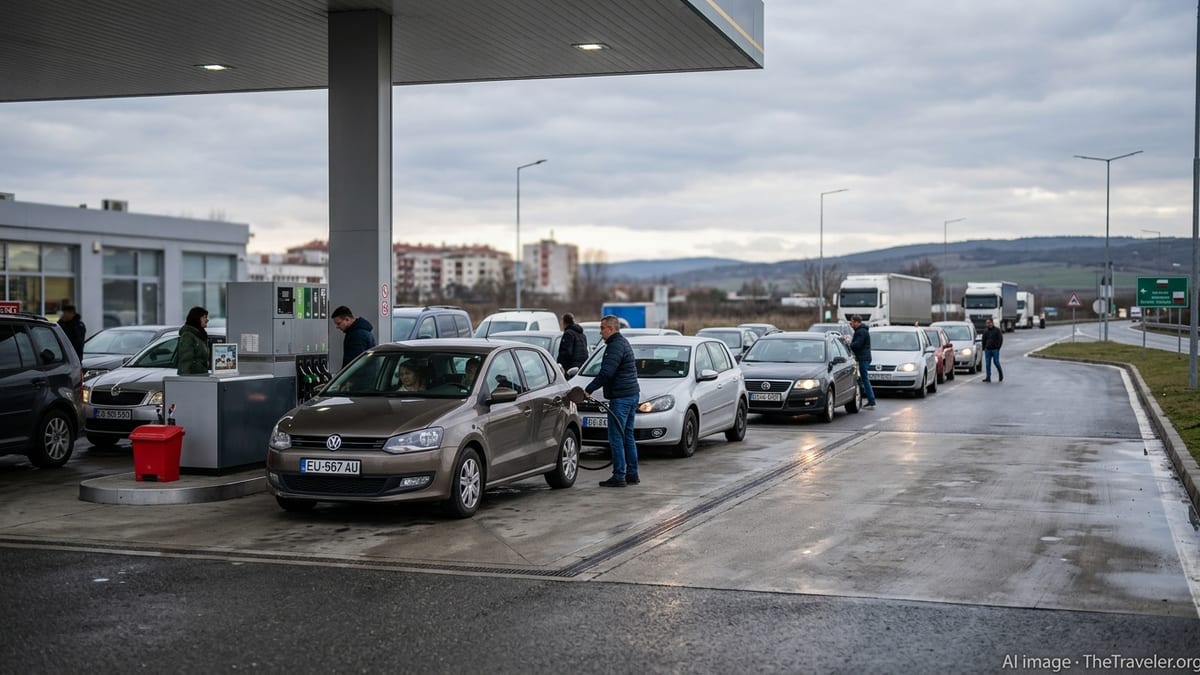
This incentive is particularly evident in Eastern and Southeastern Europe, where lower excise duties and generally lower price levels attract motorists from neighboring states. Recent coverage from Bulgaria describes busy scenes at filling stations near the Danube crossing at Ruse and around the Kulata border point with Greece, as Romanian and Greek drivers arrive in significant numbers to take advantage of cheaper petrol and diesel.
Reports indicate that these stations are experiencing noticeably higher traffic than those farther inland, with license plates from neighboring countries becoming a common sight. Motorists often combine refueling with other purchases such as groceries and tobacco, extending the economic impact beyond the fuel pumps themselves. In some cases, drivers calculate that even a dedicated trip to fill up remains worthwhile when factoring in the savings on a full tank.
Similar patterns are being reported along other EU borders where price gaps are pronounced. Motorists in higher-price markets like Germany and Italy are known to cross into neighboring countries such as Poland, Czechia, Slovenia or Austria to refuel when practical. While this behavior is not new, observers note that recent fuel price volatility has sharpened public awareness of these differences and increased the frequency of such trips.
For border communities, the phenomenon brings a mix of benefits and challenges. Local businesses on the cheaper side see increased turnover and fuel station operators report stronger volumes, while nearby roads and crossings can experience congestion spikes, particularly at weekends and during holiday periods.
Tax Policy and Subsidies Drive Cross-Border Flows
Underlying much of this cross-border traffic are differences in national tax and subsidy regimes. Analyses of European fuel markets highlight that excise duty and value-added tax account for a large share of the final pump price, and that these components vary widely from one country to another. A recent study of diesel prices in the EU, for example, identified excise levels ranging from around 0.33 euros per liter in some lower-cost member states to more than 0.60 euros per liter in higher-tax countries.
Policy responses to previous fuel price spikes have sometimes amplified these disparities. Several governments have experimented in recent years with temporary rebates, price caps or reduced duties to cushion the impact on consumers. Such measures tend to be applied nationally, which can abruptly widen price gaps with neighboring countries that rely on market pricing or less generous support schemes.
Central and Eastern Europe has been at the forefront of these interventions. In Hungary, the government has used a mix of price management and fiscal tools to keep domestic pump prices relatively low compared with regional peers. Analysts there have previously noted strong inflows of foreign motorists seeking cheaper fuel, prompting authorities over time to adjust or restrict certain discount mechanisms for vehicles registered abroad in an effort to preserve benefits for residents.
Elsewhere, governments have debated whether and how to respond to evidence of fuel tourism. Publicly available policy analyses discuss the dilemma: generous subsidies can help domestic households and businesses but risk drawing in foreign drivers and increasing budgetary costs. Conversely, keeping fuel at full market price can reduce cross-border inflows but may be unpopular with domestic motorists facing higher living costs.
Tourism, Transport and Environmental Implications
The growth of fuel tourism is also beginning to intersect with broader travel and tourism patterns across Europe. For leisure travelers planning road trips, the prospect of significantly cheaper fuel in neighboring countries is becoming part of itinerary planning, particularly for routes through Central, Eastern and Balkan states. Travel blogs and consumer media increasingly highlight “cheap fuel corridors,” encouraging drivers to enter certain countries with relatively empty tanks and leave with full ones.
For the tourism sector, this can have secondary effects. While many fuel tourists are focused primarily on savings at the pump, they often spend on roadside food, retail and short stays. Border towns with favorable fuel prices can see a lift in day-trip visitors from nearby foreign regions, blending cost-driven trips with more traditional cross-border tourism.
Road freight operators, meanwhile, have long optimized their refueling strategies around national price differences, but recent volatility has made this calculus more complex. Transport sector studies show that diesel remains one of the largest operating costs for hauliers, even as tolls and other regulatory charges rise. As a result, logistics firms continue to schedule refueling stops in lower-cost countries whenever regulations and driving time limits allow.
Environmental groups view the trend with some concern. While cross-border refueling itself does not necessarily increase total fuel consumption, the additional detours taken purely to access cheaper fuel can add emissions. There is also growing debate about whether divergent fuel taxes undermine efforts to create a consistent carbon price signal across the single market.
Looking Ahead: Harmonisation Debates and Consumer Tools
The persistence of large price spreads has fed into policy discussions in Brussels and national capitals about the degree to which fuel taxation should be harmonised across the EU. Existing rules set minimum excise levels but leave significant room for national variation, a flexibility that member states often defend as important for fiscal sovereignty and social policy.
Analysts note that deeper alignment of tax levels, or coordinated approaches to temporary rebates in times of crisis, could reduce the incentives for fuel tourism. However, such moves would also narrow the economic advantages currently enjoyed by lower-cost countries and might face resistance from governments that see competitive fuel prices as an asset for their transport and logistics sectors.
In the meantime, digital tools are likely to entrench the practice further. Smartphone applications and websites that aggregate weekly fuel price data by country, region and even individual station are widely used by European motorists. These platforms routinely highlight which side of a border offers the best price, and some include route-planning features that incorporate refueling stops into long-distance journeys.
As long as significant price gaps persist and households remain highly sensitive to transport costs, observers expect cross-border fuel tourism to remain a notable feature of European road travel. For many drivers, the calculation is simple: a short detour across an internal border can still mean meaningful savings every time they fill the tank.