

More news on this day
Two Canadian pilots were killed when an Air Canada Express jet collided with a fire truck on a rainy runway at New York’s LaGuardia Airport, as President Donald Trump moved to deploy Immigration and Customs Enforcement agents to major U.S. airports in response to mounting operational strains.
Get the latest news straight to your inbox!
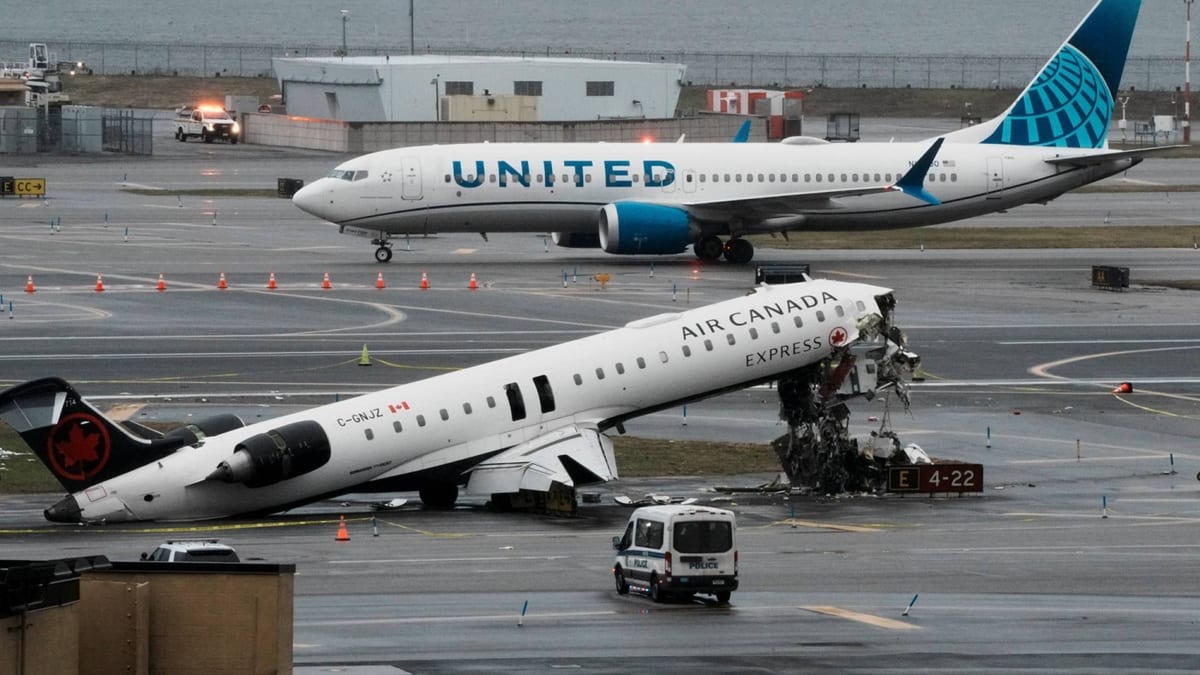
Image by japantimes.co.jp
Deadly Collision Shuts Key New York Runway
The collision occurred late Sunday at LaGuardia, one of the busiest gateways for domestic travelers in and out of New York City. Publicly available information indicates that the regional jet, operating as an Air Canada Express flight, struck an airport fire truck that was crossing the active runway as the aircraft landed in poor weather conditions.
The impact sheared away the front section of the jet and left wreckage and debris scattered along the wet tarmac. Reports indicate that both the pilot and copilot, based in Canada, were killed in the cockpit, while dozens of passengers and emergency personnel were injured. Several of those on board were transported to local hospitals with what have been described in published coverage as serious but non life threatening injuries.
Flight-tracking data and aviation reports show that the crash immediately forced the closure of one of LaGuardia’s two runways. In the hours that followed, operations at the airport were reduced to a fraction of normal capacity, causing widespread delays and cancellations cascading through airline networks across the United States and Canada.
A few days later, the damaged runway was repaired and inspected before reopening, but LaGuardia has continued to record some of the highest disruption levels in the country, underscoring the fragility of airport operations when a major piece of infrastructure is suddenly taken offline.
Investigators Focus on Air Traffic Control and Ground Movements
Early details from federal safety investigators and publicly released air traffic control recordings indicate that a single controller on duty cleared the airport fire truck to cross the runway shortly before the Air Canada Express jet touched down. Analysis of the audio suggests that the clearance was issued just seconds before the aircraft reached the threshold, leaving little time for either the ground vehicle or the flight crew to react.
In those recordings, the controller can later be heard expressing distress about the sequence of events, reinforcing concerns about workload and staffing in busy control towers. Aviation experts cited in published coverage note that LaGuardia, like many major U.S. airports, has been operating under sustained staffing pressure, with fewer controllers managing dense and complex traffic patterns.
Investigators are also expected to examine the procedures governing fire and rescue movements on active runways, including how emergency vehicles receive and confirm clearances to cross. Weather, visibility, runway lighting and possible miscommunication between tower staff and vehicle operators are likely to be central to the technical review.
While the full investigation will take months, the incident has already intensified debate about whether the nation’s busiest metropolitan airports have sufficient redundancy and staffing to safely handle peak operations in challenging conditions.
Trump Deploys ICE Agents to Airports Amid Strain
Against this backdrop, President Donald Trump has directed Immigration and Customs Enforcement personnel to deploy to major U.S. airports, including facilities in the New York region. Publicly available reporting describes the move as an attempt to ease operational strain and shorten security and screening lines that have grown longer during a period of federal budget standoffs and staffing gaps.
The deployment represents an unusual expansion of ICE’s presence in the aviation environment. Although ICE officers have long been involved in immigration enforcement and targeted operations connected to air travel, assigning armed immigration agents to help manage crowded terminals and support overstretched airport functions marks a notable shift in how federal resources are being used.
Travel industry observers note that the decision has raised questions about the balance between security, customer experience and civil liberties. Some passenger advocacy groups and immigration rights organizations have warned that a higher profile ICE presence inside terminals could heighten anxiety for travelers and airport workers, particularly those from immigrant communities or with foreign passports.
Supporters of the move argue that federal agencies must be flexible when critical infrastructure, such as a major runway at LaGuardia, is taken out of service and routine staffing cannot keep pace with demand. They contend that redeploying personnel from any available agency is preferable to allowing hours long lines and chronic delays to worsen.
Travelers Face Disruptions Across the Network
For travelers, the combination of the LaGuardia crash, reduced runway capacity and heightened federal activity has translated into a week of uncertainty. Flight data aggregators show hundreds of cancellations and delays radiating from New York to hubs across North America, as airlines have been forced to reroute aircraft, rebalance crews and trim schedules.
Passengers heading to or from LaGuardia have encountered extended wait times at check in, security and boarding gates, compounded by weather systems moving through the Northeast. With one runway offline for several days, carriers prioritized certain peak business and shuttle routes while trimming frequency on others, leaving leisure and connecting travelers especially vulnerable to last minute disruptions.
Reports from other major airports indicate that the ripple effect has been felt in places such as Chicago, Toronto and Atlanta, as aircraft and crews originally scheduled through New York remained out of position. Even after the damaged runway reopened, schedules have taken time to stabilize, and publicly available data suggests that on time performance in the New York region remains below seasonal norms.
Airport managers and airline officials have urged travelers to monitor flight status closely, arrive earlier than usual and be prepared for schedule changes. In the near term, the presence of additional federal agents, including ICE personnel, is expected to be most visible at security and boarding areas where bottlenecks are most acute.
Broader Questions for U.S. Aviation Safety and Policy
The LaGuardia runway collision and the subsequent decision to deploy ICE to airports have converged into a broader national conversation about aviation safety, federal staffing and the appropriate roles of different agencies in the travel system. Aviation safety advocates point to a series of recent close calls and high profile incidents as evidence that the system is under strain.
Public debates now extend beyond traditional questions of pilot training and equipment reliability to include chronic shortages of air traffic controllers, the aging of critical infrastructure and the impact of political gridlock on transportation budgets. The LaGuardia accident, which occurred at a time of heavy rainfall and intense operational tempo, has been cited as a stark reminder of how quickly a single misjudgment or miscommunication can lead to tragedy.
At the same time, the use of ICE agents to bolster airport operations has sharpened focus on how federal resources are allocated. Travel policy specialists are watching closely to see whether this is a temporary response to a moment of crisis or a sign of a longer term shift toward a more militarized or enforcement driven posture in civilian travel spaces.
For now, travelers passing through New York and other major hubs are encountering a system adjusting in real time to both a devastating accident and a contentious political response. As investigators continue their work and policymakers debate next steps, the events at LaGuardia have added new urgency to longstanding calls for investment and reform in the U.S. aviation network.