


More news on this day
Ryanair passengers across Europe are reporting missed flights, denied boarding and overnight disruption as the European Union’s new biometric border system beds in at busy airports ahead of the peak summer season.
Get the latest news straight to your inbox!
New EU border rule meets peak-season pressure
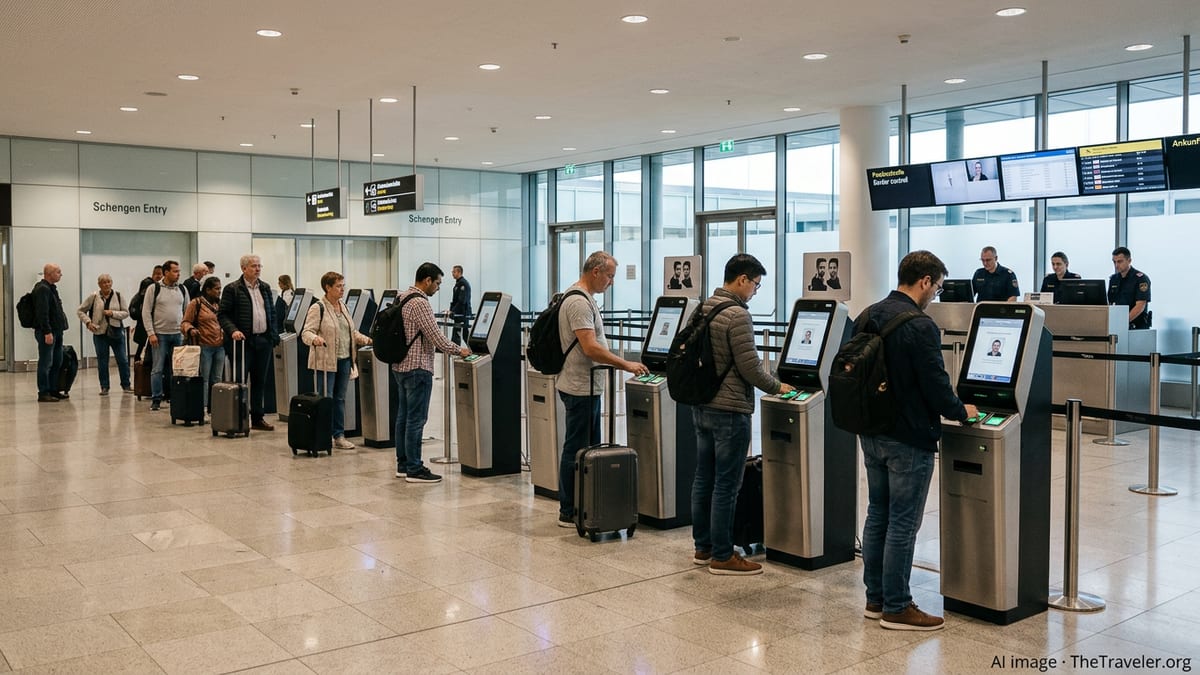
The rollout of the European Union’s Entry/Exit System (EES), which records non-EU travellers’ biometric data at external Schengen borders, is colliding with rising summer traffic and putting pressure on airport passport controls. Under the new process, many non-EU visitors must scan their passports, provide fingerprints and submit to facial imaging during their first entry, significantly lengthening processing times where infrastructure or staffing is tight.
Publicly available information shows that the EES launch has already generated long queues at several European hubs, particularly where arrivals from the United Kingdom and other non-Schengen countries converge at limited border booths. In some locations, reports indicate that passengers unfamiliar with the new rules are arriving with little time to spare, only to find bottlenecks at automated gates and manual counters.
Ryanair, Europe’s largest budget airline by passenger numbers, has been especially exposed, with its dense schedule of short-haul services leaving little room for delay at congested airports. The carrier’s point-to-point model means missed boarding due to slow border checks can quickly cascade into missed connections on separate tickets, last-minute rebookings and large numbers of stranded travellers in departure halls.
Travel forums and local media coverage describe scenes of confusion as ground staff try to manage queues of passengers who have cleared airline check in but remain stuck at passport control while boarding deadlines approach. In several cases, passengers have watched their Ryanair flight depart while they were still in line for new biometric checks.
Reports of stranded Ryanair passengers multiply
Recent coverage from regional outlets in France and Italy points to a pattern of passengers left behind as border queues lengthen under the new regime. In one widely reported incident at a French regional airport, a Ryanair flight departed with scores of empty seats after dozens of travellers were held up in border-control lines created by the EES rollout. Similar stories from Milan and other gateways highlight crowds of passengers who reached the gate minutes too late after waiting through unexpectedly slow checks.
Social media posts and travel discussion boards are amplifying these cases, with travellers sharing images of tightly packed passport-control areas and abandoned departure boards. Some Ryanair customers describe arriving at the airport within what they believed was a reasonable time frame, only to encounter queues that stretched beyond security and towards check in, leaving them effectively trapped between airline cut-off times and border bottlenecks.
Accounts from affected travellers also suggest uneven implementation between airports. At some hubs, newly installed kiosks and extra staffing appear to keep queues moving, while at others, limited infrastructure or available officers have turned the first EES registration into a time-consuming manual process. For short-haul leisure flyers on tight budgets, even small delays at the border can prove critical when boarding windows are narrow.
As more of these experiences circulate, consumer groups and travel commentators are warning that the early stages of the EES rollout could become a defining stress point of the 2026 summer travel season for low-cost carriers and their passengers.
Ryanair stance focuses on punctuality and passenger responsibility
According to Ryanair’s published guidance, the airline has repeatedly stressed that it will not hold flights for travellers delayed at border control, even where new checks are the primary cause of queues. Public notices and media reports on the carrier’s communications indicate a clear message: passengers are urged to arrive at airports significantly earlier than before, often three hours or more in advance, to allow for extended security and passport procedures.
Ryanair frames this approach as necessary to protect schedule reliability across its network. With aircraft operating multiple short sectors each day, any delay to one departure risks a domino effect for subsequent flights. Keeping to published times, the airline argues, prevents wider disruption and cancellations that would affect many more passengers than those caught in specific bottlenecks.
Critics counter that strictly enforcing boarding cut-offs while border systems change effectively shifts the risk of the new EU rules onto travellers. Consumer advocates point out that passengers who have complied with the airline’s check-in requirements may still be unable to reach the gate in time if airport processes are overwhelmed, leaving them to absorb the cost of new tickets, overnight stays or missed onward connections.
The tension between network punctuality and individual passenger hardship is likely to intensify if EES queues persist into July and August, when Ryanair typically operates at or near full capacity on many holiday routes.
New EU rules reshape the air-travel landscape
The EES introduction is part of a broader tightening and digitisation of the EU’s external border regime. The system sits alongside other recent moves in Brussels to update air-passenger rights rules and clarify when travellers are entitled to compensation for delays, cancellations or denied boarding. Lawmakers have been seeking a balance between robust rights for consumers and predictability for airlines facing rising costs and regulatory demands.
At the same time, low-cost carriers such as Ryanair are pushing back against aspects of the evolving rulebook, particularly proposals on cabin baggage and mandatory fare inclusions. Recent public statements from the airline criticise new requirements that, in its view, would force carriers to advertise higher bundled prices and limit the ability of passengers to choose cheaper, no-frills options.
Industry analysts note that the combination of stricter border controls and evolving consumer-rights rules is reshaping Europe’s aviation market. For budget operators that built their model on rapid turnarounds, unbundled pricing and lean staffing at secondary airports, the new environment may require operational changes that challenge long-standing practices.
For travellers, the immediate effect is most visible at border queues and boarding gates. Longer-term, the interplay of EU regulation and airline adaptation may influence where carriers base aircraft, how many flights they add on particular routes and how much flexibility they build into schedules during high-risk periods for disruption.
Practical implications for summer travellers
For passengers booked on Ryanair and other carriers into or out of the Schengen Area this summer, the emerging picture suggests that extra time and preparation will be essential. Public guidance from airports, border authorities and airlines now converges on a similar message: non-EU nationals, including many UK travellers, should anticipate first-time EES registration taking significantly longer than a conventional passport stamp.
Travel commentators advise checking airport-specific information, as some locations have invested heavily in new infrastructure, while others may still rely on manual processing during the initial phase. Families, large groups and passengers who need additional assistance may face particularly lengthy waits at peak times, increasing the risk of missing tightly timed departures.
Ryanair customers are being urged by consumer groups and online travel communities to factor in both security and border-control queues when planning their arrival time at the airport, rather than relying on past experience from pre-EES travel. Passengers connecting themselves between separate low-cost flights, or travelling to important events, are being advised to build in extra buffers or consider more flexible tickets where possible.
As the new border rule settles in and airports adjust staffing and technology, disruption levels may ease. For now, however, the stories of stranded Ryanair flyers illustrate how a major change to EU border management, implemented at scale and at speed, can quickly translate into very personal moments of chaos at the departure gate.