

More news on this day
A Ryanair flight bound for Norway returned to Manchester Airport for an emergency landing after declaring an in-flight alert, according to live flight-tracking data and eyewitness reports shared on aviation forums.
Get the latest news straight to your inbox!
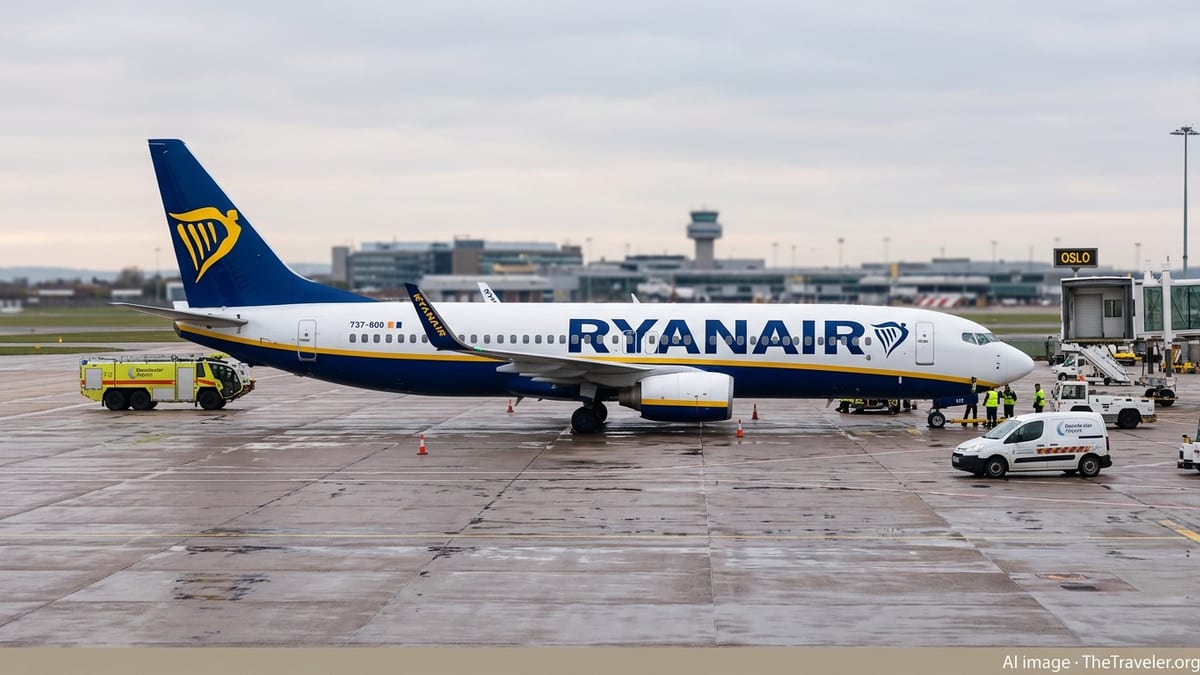
Norway Service From Manchester Forced to Turn Back
Publicly available schedules indicate that Ryanair flight RK3226 operates between Manchester and Norway, using a Boeing 737-800 aircraft on the route. On the latest rotation, the service departed Manchester before turning back and performing an emergency landing at the same airport, instead of continuing across the North Sea.
Flight-tracking enthusiasts on specialist platforms noticed the aircraft’s sudden change of course and the appearance of an emergency squawk code, a transponder signal used to indicate an in-flight issue. Data shared in real time showed the jet abandoning its planned north-easterly track and routing back toward northwest England for an expedited approach to Manchester.
Reports posted by users following the event indicate that the aircraft landed safely back at Manchester, where it was met by ground vehicles in line with standard airport procedures for emergency arrivals. Early observations suggested the issue may have been technical rather than weather-related, although the precise cause had not been formally detailed at the time of writing.
The incident added to an already busy morning for Manchester Airport, where traffic flows and strong seasonal demand can leave little spare capacity for unscheduled returns. Even with these constraints, operations teams appeared to prioritize the inbound Ryanair jet, facilitating a direct landing and taxi to a remote stand.
Initial Indications of a Technical Irregularity
Aviation hobbyists monitoring the flight shared that the Boeing 737-800 transmitted an emergency code and then flew a relatively direct path back to Manchester, rather than entering extended holding patterns. That profile is consistent with crews managing a technical irregularity that warrants an immediate but controlled return.
One widely circulated observation from enthusiasts suggested that ground personnel were concentrating activity around one of the engines after landing, alongside the presence of multiple airport service vehicles. Separate commentary referenced the possibility of an issue affecting thrust or engine performance during the latter stages of the flight, though such details remain speculative without an official technical statement.
Emergency landings of this nature are structured around well-rehearsed checklists followed by flight crews and airport teams. Even when specific technical symptoms differ, the framework for handling an in-flight alert, arranging priority airspace handling and preparing support on the ground remains largely the same across major European airports.
Recent media coverage of other Ryanair diversions, including a previous case in which a different aircraft arrived with very low fuel reserves after multiple weather-disrupted approaches in the United Kingdom, has kept attention on how carriers and crews manage abnormal events. In contrast, the Manchester turnaround of flight RK3226 appears to have been resolved more quickly, with no extended diversions or repeated landing attempts reported.
Passenger Experience and Operational Knock-On Effects
For travelers on board, the incident likely translated into a short-lived flight followed by a return to familiar surroundings rather than an arrival in Norway as expected. While detailed passenger accounts had not yet emerged through major news outlets, similar events typically involve a combination of reassurance from cabin crews, delays while the aircraft is inspected, and subsequent decisions on whether a replacement flight can be arranged.
Publicly available information on European air passenger rights indicates that travelers affected by significant delays or cancellations may be entitled to assistance, such as refreshments and rebooking support, and in some cases financial compensation depending on the cause and length of disruption. The specific entitlements for RK3226 would depend on the investigation outcome and how the schedule was ultimately adjusted.
Operationally, an unscheduled return of a medium-haul Boeing 737-800 can ripple through the day’s timetable. Aircraft planned to continue to other destinations may be held for engineering checks, and crews can reach duty-time limits sooner than expected, complicating rostering. For a high-utilization operator such as Ryanair, which runs tight turnarounds and relies on rapid ground handling, a single disruption can require swift rescheduling to keep the broader network moving.
For onward passengers in both Manchester and Norway, that can mean delays, equipment swaps, or temporary consolidations of services. Airport displays, mobile apps, and airline communication channels usually become the primary sources of information on revised departure times and alternative arrangements.
Safety Procedures Under the Spotlight
Although events like the RK3226 turnaround are uncommon relative to the volume of flights operating each day, they attract considerable attention whenever emergency codes are visible on public tracking platforms. The combination of live data, social media commentary, and aviation forums means that even routine precautionary returns are quickly noticed and discussed in real time.
Industry data and independent safety assessments continue to describe commercial air travel within Europe as one of the safest forms of transportation, with very low rates of serious incidents. Most emergency landings end with uneventful rollouts on the runway, followed by inspections that confirm systems worked as intended to mitigate risk.
In the case of Ryanair and other major low-cost carriers, large, standardized fleets of Boeing 737 aircraft allow for consistent training and procedures across crews. The Boeing 737-800, which forms a significant portion of Ryanair’s fleet, is a widely used model with a long operational history and well-documented performance in varied European weather and airspace conditions.
Nonetheless, each emergency return feeds into a broader cycle of safety review. Technical findings, if any, can inform maintenance practices, while air traffic control recordings and flight data help refine crew training. Even where an event is ultimately classified as minor, the documentation process contributes to the industry’s shared safety knowledge base.
What Happens Next for Flight RK3226
Following an event like the emergency landing of RK3226 at Manchester, standard practice involves engineering inspections of the aircraft, from engine and control systems to landing gear and onboard diagnostics. Depending on what is discovered, the jet may be cleared to return to service relatively quickly or held for deeper maintenance.
Passengers whose travel plans were affected are typically offered rebooking on later services to Norway or alternative routings via other Ryanair bases. Some may choose to travel on different carriers or postpone trips altogether, especially if the disruption overlaps with work commitments or connecting itineraries.
In the coming days, additional detail may emerge through aviation databases, regulatory summaries, or specialist media if the event meets the threshold for classification as an incident or serious incident. Even without high-profile coverage, the information gathered becomes part of the continuous monitoring of airline performance and aircraft reliability.
For Manchester Airport and the wider Scandinavian route network, the quick, safe conclusion of the RK3226 turnaround underlines how crews, controllers, and ground teams are trained to prioritize safety and manage disruptions, even at the cost of immediate schedule reliability. Travelers across Europe increasingly follow such events in real time, but behind the screens, the aim remains consistent: a safe landing and a structured path back to normal operations.