

More news on this day
Ryanair has reported a sharp rise in passenger traffic for February 2026, carrying 13.3 million travelers across its network, up 6 percent year on year, as the low cost carrier accelerates growth in central and eastern Europe with a major expansion that will double its operations in Warsaw this summer.
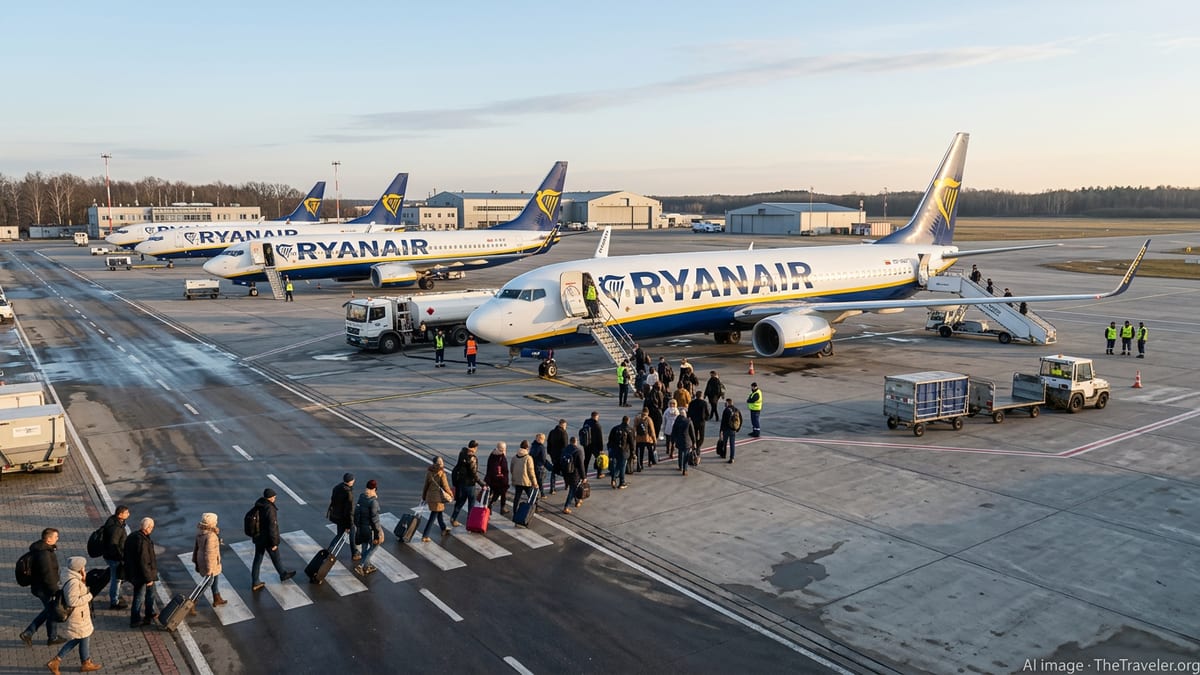
February Surge Confirms Strong Demand Across Europe
The latest figures from Ryanair show the airline operated more than 75,000 flights in February 2026, underscoring the scale of its network at a time of resilient demand for short haul travel across Europe. The month’s total of 13.3 million passengers compares with 12.6 million a year earlier, extending the carrier’s lead as the region’s largest budget airline by volume.
Crucially for profitability, Ryanair held its load factor at 92 percent, matching February 2025 even as it added capacity. That stability suggests that additional seats are being absorbed without discounting pressure severe enough to erode yields, an encouraging signal for an industry still navigating fuel price volatility and geopolitical uncertainty.
On a rolling 12 month basis to the end of February, the airline carried 207.6 million passengers, about 4 percent more than in the comparable period a year earlier. The rolling load factor remained a robust 94 percent, highlighting how Ryanair continues to fill the vast majority of its seats even as its fleet and schedule grow.
The February uplift also builds on solid momentum from early 2026, following a fiscal 2025 in which Ryanair became the first European airline to surpass 200 million passengers in a single year. Management has nudged its traffic outlook for the current fiscal year higher, reflecting confidence that demand will remain strong into the peak summer season.
Warsaw Modlin to See Traffic Double With New Base Investment
The most eye catching element of Ryanair’s latest growth push is focused on Poland’s capital, where the airline is set to double annual traffic at Warsaw Modlin Airport to around 3 million passengers. From the summer 2026 schedule, Ryanair will base seven aircraft at Modlin, representing a capital commitment of roughly 700 million dollars according to the company.
The expanded base will support 49 routes from Modlin, including seven new connections to Alghero, Bratislava, Lamezia, Milan, Palermo, Sofia and Valencia. Alongside the brand new destinations, Ryanair is also increasing frequencies on 29 existing routes, which should improve connectivity for both outbound Polish travelers and inbound visitors using Warsaw as a gateway to the Mazovia region.
For local tourism authorities and airport stakeholders, the doubling of traffic is expected to translate into higher hotel occupancy, increased spending in the capital and surrounding areas, and additional jobs linked to airport operations and tourism services. Ryanair has long argued that its model of high frequency, low fare point to point services stimulates new demand rather than merely capturing existing flows from competitors.
Modlin, located to the northwest of central Warsaw, has become a key base for the airline’s Polish operations, offering lower operating costs than the main city airport. The decision to anchor seven aircraft there for the summer underscores Ryanair’s commitment to using secondary airports as growth platforms while still granting access to major urban centers.
Expanded Presence at Warsaw Chopin Broadens Citywide Network
Ryanair’s Warsaw strategy is not confined to Modlin. The carrier is also building out its presence at Warsaw Chopin, Poland’s main hub airport, where it will serve 12 routes this summer. That includes three new services to Leeds, Porto and Seville, broadening the airline’s appeal to both city break travelers and those visiting friends and relatives across western Europe.
At Chopin, Ryanair expects to carry around 700,000 passengers annually under the enlarged schedule, targeting travelers who prefer to use the primary airport even if that comes with slightly higher charges and more congested airspace. The carrier is positioning its Chopin offering as a value alternative to full service rivals on key European city pairs.
The dual airport approach in Warsaw allows Ryanair to segment its network and pricing strategy, using Modlin for the bulk of its high density leisure and migrant worker routes while tapping Chopin for higher yielding city and business traffic. For travelers, the result is a wider choice of departure points and destinations, as well as competition that could help keep fares in check on some of the capital’s busiest corridors.
Local officials have welcomed the increased connectivity, noting that improved access to regional Italian and Spanish cities, as well as central European destinations such as Bratislava, should support both inbound tourism and Warsaw’s aspirations as a regional business hub.
What the Numbers Mean for Travelers and the Wider Market
For passengers, Ryanair’s February performance and Warsaw expansion point to a summer of plentiful capacity and an ever denser network across Europe. More seats typically translate into sharper price competition, particularly on leisure routes from central and eastern Europe to Mediterranean sun destinations and popular city break markets.
The steady 92 percent February load factor suggests that demand remains strong even in what is traditionally a shoulder period between the winter holidays and Easter. If that trend holds, travelers can expect busy flights but also a wide array of departure times and route options as Ryanair continues to push utilization of its fleet.
From an industry perspective, the combination of rising traffic and stable load factors at Ryanair underscores the resilience of European short haul travel despite macroeconomic headwinds. The carrier’s ability to add aircraft and open new routes in markets like Warsaw indicates that airports and tourism boards are still eager to court low cost capacity as a driver of growth.
However, the airline’s rapid expansion also increases competitive pressure on rivals, particularly other budget carriers and some flag airlines that rely on feeder traffic through larger hubs. With Ryanair now targeting more than 208 million passengers in its current fiscal year, its network decisions, including the doubling of operations in Warsaw, will continue to shape the way Europeans travel in 2026 and beyond.