

More news on this day
Persistent flight delays at San Diego International Airport in the wake of the 2025 federal government shutdown are sharpening focus on long-standing air traffic controller staffing gaps and raising questions about how resilient the nation’s aviation system really is.
Get the latest news straight to your inbox!
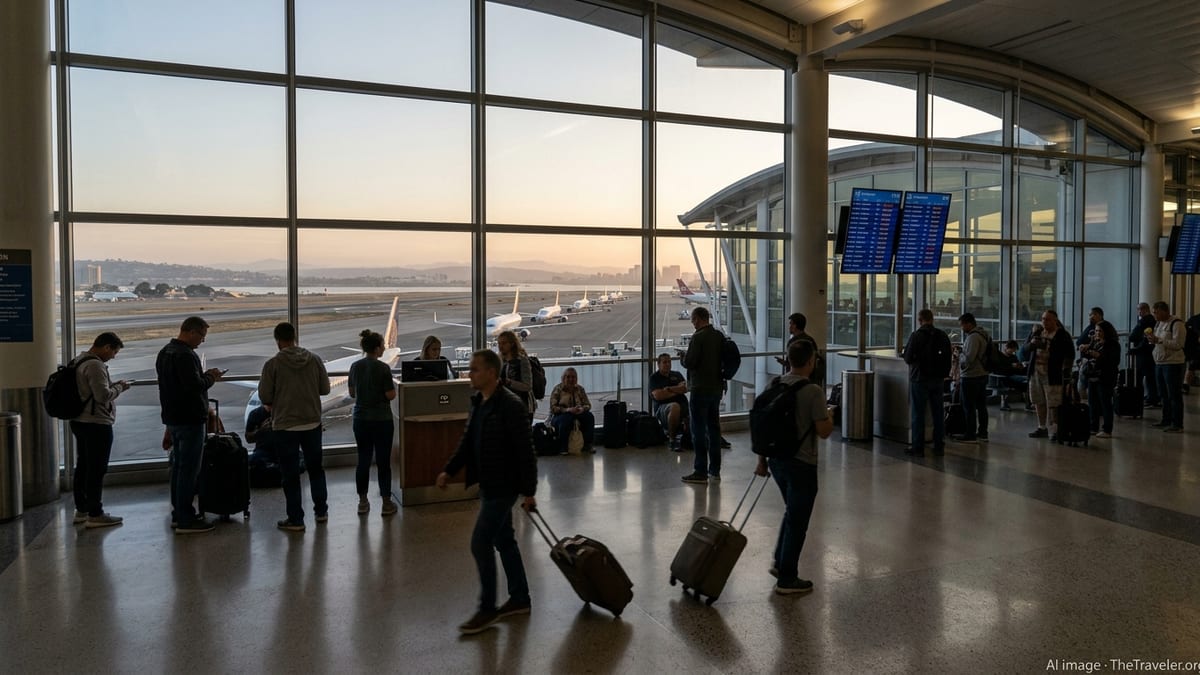
Delays at San Diego reflect a national bottleneck
San Diego International Airport has seen waves of disruption since late 2025, as air traffic controller shortages tied to the prolonged federal government shutdown filtered through an already stretched system. According to published coverage, delays and cancellations began to build in early November, when federal aviation managers slowed air traffic into dozens of busy airports to keep workloads manageable for reduced controller teams.
Board documents for the San Diego County Regional Airport Authority show that San Diego was among roughly 40 high-traffic airports where flight volumes were intentionally cut during the shutdown period. The move was intended to preserve safety margins but translated into longer wait times at gates, missed connections and rolling schedule changes for travelers across the region through the winter of 2025 and into early 2026.
Public data from the Federal Aviation Administration indicates that, on paper, controller-related staffing accounts for a small share of overall flight delays compared with weather or congestion. Yet the San Diego experience illustrates how even a modest reduction in available controllers can ripple quickly through a tightly choreographed network, particularly when compounded by peak-season demand and lingering staffing fatigue at major radar facilities.
Anecdotal accounts from travelers in recent weeks describe early-morning departure banks pushed back by ground holds and arrival streams metered more slowly than usual into San Diego’s single-runway airfield. Those accounts mirror patterns seen at other coastal hubs where approach-control facilities are operating below ideal staffing levels.
Southern California’s crowded sky magnifies the pressure
San Diego’s delays cannot be viewed in isolation. The airport sits inside one of the country’s most complex airspace regions, overseen by the Southern California Terminal Radar Approach Control center, or TRACON, which manages arrivals and departures for San Diego, Los Angeles, Orange County and several other busy fields.
In October 2025, published reports showed just how fragile that system can be when staffing thins. A shortage of certified controllers at Hollywood Burbank Airport, tied to the same federal shutdown, forced that tower to temporarily halt normal operations, with San Diego-based controllers stepping in remotely to handle traffic. Later that month, separate coverage detailed a temporary ground stop at Los Angeles International Airport after staffing at the Southern California TRACON fell below safe thresholds, triggering cascading delays throughout the region.
Events like those put additional strain on San Diego’s controllers and infrastructure. When neighboring airports slow or pause arrivals, flights are often rerouted or held in the airspace that Southern California TRACON oversees, complicating sequencing into San Diego’s tight coastal footprint. Each adjustment adds workload for controllers who are already contending with steady traffic growth and complex coastal weather patterns.
Regional aviation analysts note that Southern California’s geography offers little slack. With limited runways, mountainous terrain and dense urban development, there are few easy options for diverting traffic or expanding capacity, meaning staffing shortfalls are more likely to result in delays rather than simple schedule reshuffling.
Nationwide hiring efforts struggle to catch up
The disruptions around San Diego are part of a broader national workforce crunch. Federal workforce plans and independent analyses describe a shortfall of several thousand fully certified air traffic controllers across the United States, with many facilities operating below target staffing levels despite accelerated hiring since the pandemic.
Publicly available information from the FAA states that the agency met or slightly exceeded its hiring targets in 2025, bringing on just over 2,000 new controllers. However, separate reporting highlights that retirements, promotions and training washouts are eroding those gains. A Washington Post analysis in 2025 pointed to high trainee failure and dropout rates as a major driver of the persistent gap, alongside earlier disruptions from government shutdowns and the COVID-19 pause in academy training.
Additional industry reporting indicates that controller overtime has surged, with millions of extra hours logged nationwide as facilities lean on experienced staff to cover vacancies. Analysts warn that such reliance on overtime can help maintain day-to-day operations but risks compounding fatigue and burnout, particularly at high-volume hubs and regional approach centers such as the one serving Southern California.
For travelers in and out of San Diego, that structural imbalance translates into narrower margins. When a single sick call or weather diversion tips a facility below its planned staffing level, managers often have little choice but to reduce the rate at which aircraft are allowed to land or depart, creating the kind of rolling delays that characterized the 2025 shutdown period and continue to surface during busy travel stretches.
Shutdown aftershocks and infrastructure gaps
The 2025 federal government shutdown amplified problems that had been building for years in the national air traffic control system. During the funding lapse, thousands of controllers were classified as essential and required to work without pay, according to national news coverage, while support staff and technical personnel were furloughed. Reports from that period describe rising sick calls and a growing number of facilities forced to declare reduced capacity, triggering intentional slowdowns in air traffic.
San Diego’s inclusion on the list of airports subject to traffic reductions underscored its vulnerability. As a primarily origin-and-destination market with a single primary runway, the airport has limited flexibility to absorb prolonged flow restrictions. Shutdown-era board materials for the airport authority reference thousands of delays tied to systemwide staffing triggers and advise that the impact of similar events should be closely monitored in 2026.
Separate assessments of U.S. aviation infrastructure depict a system under simultaneous pressure from aging facilities and workforce gaps. Industry white papers and financial disclosures point to billions of dollars in deferred maintenance across air traffic control centers, as well as radar and communications equipment operating past their intended service life. Analysts argue that these constraints can exacerbate staffing issues, since older systems may demand more hands-on management from controllers and technical staff, further tightening capacity when personnel are scarce.
In this context, the delays experienced by San Diego travelers over the past several months serve as a visible manifestation of less visible stress points in the national airspace system. While the immediate triggers may be local staffing decisions or a particular storm, underlying infrastructure and labor challenges shape how quickly operations can recover.
What travelers should expect heading into peak seasons
Looking ahead to the busy spring and summer travel periods of 2026, aviation observers expect San Diego’s operations to remain sensitive to swings in controller availability at both the local tower and the Southern California TRACON. Even as airlines restore or expand service on popular routes, any renewed government funding disputes, regional weather events or spikes in controller attrition could again push the system toward throttled traffic flows.
Federal data show that weather remains the single largest driver of delays nationwide, but staffing-related constraints tend to compound disruptions when they coincide with storms or heavy holiday traffic. That dynamic is especially relevant for airports like San Diego, where a relatively small number of daily flights can translate into full terminals and limited options for rebooking when irregular operations occur.
Travel industry analysts suggest that passengers build additional buffer time into connections involving San Diego and other West Coast hubs, particularly when traveling through the early morning and evening peaks, which are more likely to be affected by metering and flow-control measures. Monitoring airline notifications and same-day schedule adjustments has become a routine part of flying, and recent San Diego disruptions indicate that this vigilance remains warranted.
For now, incremental progress on federal hiring and infrastructure funding offers some longer-term optimism. Yet the continued appearance of staffing-related slowdowns at airports across the country suggests that San Diego’s recent experience is less an anomaly than an early warning of how fragile the system can become when controller ranks and aging facilities are asked to absorb ever-growing demand.