

More news on this day
San Francisco International Airport is experiencing a sharp spike in flight disruptions in early April, with publicly available tracking data showing 224 delays and 7 cancellations in a single day as new federal capacity limits and ongoing runway work converge to slow operations.
Get the latest news straight to your inbox!
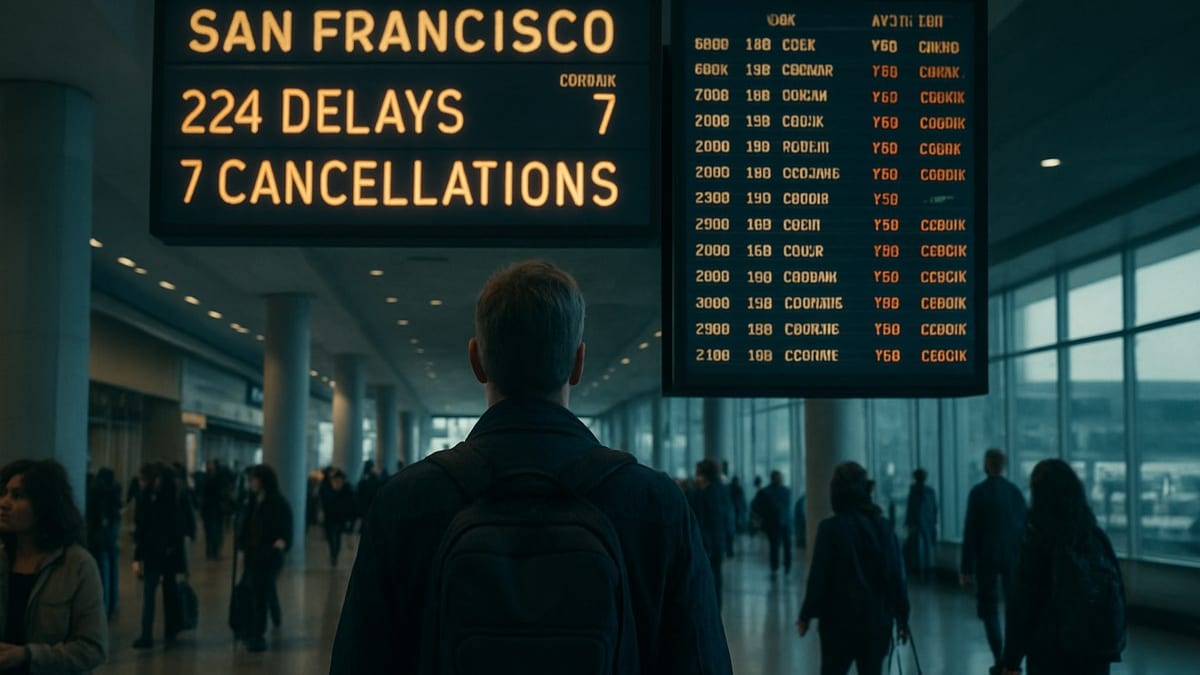
One Day, Hundreds of Disrupted Flights
The tally of 224 delayed flights and 7 cancellations at San Francisco International Airport in April underscores how quickly the travel experience can deteriorate when an already busy hub loses runway capacity. Flight tracking dashboards on April 3 and April 4, 2026, showed rolling delays through much of the day, with late departures and arrivals stacking up during the morning and late-afternoon peaks.
The disruption level is notable even for an airport long associated with weather and air traffic congestion. At various points in the day, a significant share of flights were operating behind schedule by more than 30 minutes, with some services running over an hour late. Travelers connecting through San Francisco faced missed onward flights and rebookings as delay minutes accumulated across the schedule.
While same-day cancellation numbers remained relatively low compared with the volume of traffic handled by the airport, the pattern points to a system running with little slack. Even minor schedule upsets had visible ripple effects across airlines and destinations, particularly on popular West Coast, transcontinental, and transpacific routes.
FAA Rule Change Cuts SFO Arrivals
The spike in delays comes just days after the Federal Aviation Administration imposed new limits on how many planes can land at San Francisco each hour. According to recent coverage from national and Bay Area outlets, the agency has reduced SFO’s maximum arrival rate from 54 flights per hour to 36, citing safety concerns around closely spaced parallel runways and complex local airspace.
The change effectively removes one third of the airport’s previous arrival capacity at a time when one set of north–south runways is already closed for a long-term repaving project. Reports indicate that the construction is scheduled to last several months, with a reopening target in early October 2026, keeping pressure on capacity through the busy summer travel season.
Airport communications and aviation industry reporting suggest that officials had initially forecast delays for roughly 10 to 15 percent of flights linked to the construction project alone. With the new FAA limits now in effect, more recent analyses indicate that as many as 25 percent of arriving flights could experience delays of at least 30 minutes on peak days, especially when weather or air traffic volume compounds the constraints.
Runway Work and Safety Concerns Shape Operations
The immediate catalyst for the capacity cut is an FAA review of long-standing arrival procedures at SFO, particularly the practice of conducting simultaneous landings on parallel runways that sit closer together than many comparable airports. Aviation trade publications report that the agency concluded these approaches no longer meet its current standards, prompting an order to curtail parallel arrivals and adjust traffic flows.
At the same time, construction crews are working on the north–south runway pair, limiting the airport to fewer configurations and leaving less flexibility to handle surges in arrivals. Federal documents and performance assessments released over the past year have already highlighted San Francisco as a location where runway projects and dense schedules could translate into significant “airborne holding” and taxi delays during peak periods.
Weather remains an additional wildcard. SFO has long been susceptible to low clouds and wind patterns that reduce arrival rates even under normal conditions. With the system now structurally capped at 36 arrivals per hour, any weather or traffic management initiative that further slows the flow can quickly translate into mounting delay minutes and, in some cases, cancellations when aircraft and crews can no longer complete their planned rotations.
What Travelers Are Seeing on the Ground
For passengers, the operational nuances translate into longer time at the gate, busier customer service counters, and tighter connections. On the day that generated 224 delays and 7 cancellations, travelers encountered a familiar set of issues: aircraft waiting for inbound crews, late-arriving planes turning around quickly for their next legs, and departure queues stretching along the taxiways.
Publicly available airline guidance encourages passengers flying through San Francisco in April to monitor their flight status closely on official apps and to allow extra time for connections, especially for itineraries involving international legs. Travel publications have noted that same-day schedule adjustments are becoming more common as carriers proactively pad block times, swap equipment, or reroute aircraft to keep overall operations stable.
Inside the terminals, congestion has been particularly noticeable near the busiest gates in the midmorning and early evening banks. Longer dwell times mean more people in hold rooms at once, crowding restrooms, concessions, and seating areas. At baggage claim, arriving passengers from delayed flights have at times faced additional waits as ground crews work through backlogs when multiple late flights arrive in quick succession.
Looking Ahead to Summer 2026 Travel
Industry forecasts suggest that the challenges seen in early April may foreshadow a difficult summer for SFO. With demand for both domestic and international travel expected to remain strong, the combination of runway work and the new FAA arrival limits could keep delay metrics elevated well into the peak season.
Analysts following the Bay Area aviation market point out that some travelers may shift to Oakland or San José, especially for point-to-point domestic trips, if they perceive San Francisco as less reliable for on-time operations. However, SFO’s extensive long-haul and connecting network means many itineraries will still funnel through the airport, leaving limited room for a broad redistribution of traffic.
As airlines and the airport refine schedules for late spring and summer, additional adjustments to flight timings and frequencies are possible in an effort to better match demand with the constrained arrival rate. For now, the April day that logged 224 delays and 7 cancellations serves as a snapshot of what can happen when high traffic meets reduced capacity, providing an early test of how San Francisco’s air travel system will cope in the months ahead.