

More news on this day
Qatar Airways is turning to nearby hubs in Saudi Arabia and Oman to move stranded travelers as the widening US-Israel and Iran conflict keeps much of the Gulf’s airspace restricted and Doha’s normally busy hub largely offline.
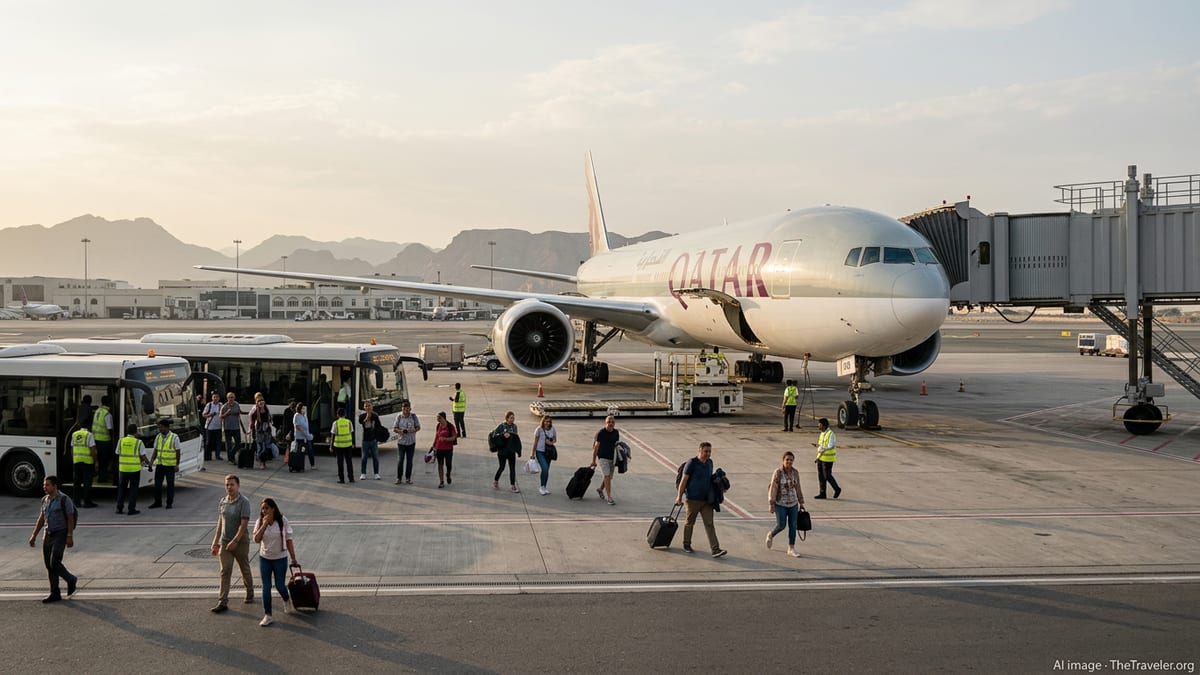
Qatar’s Hub Silenced as Conflict Upends Gulf Aviation
The US-Israel war with Iran has triggered days of airspace closures and flight cancellations across the Middle East, abruptly silencing Doha’s Hamad International Airport, one of the world’s key long-haul transit hubs. Qatari airspace was closed after missile and drone exchanges spread across the Gulf, forcing Qatar Airways to suspend regular passenger services and leaving tens of thousands of travelers in limbo from Europe to Asia and Africa.
Airlines have been scrambling to reroute or cancel services that would normally cross Iranian, Iraqi, Qatari and neighboring airspace. Aviation trackers and industry alerts show that carriers have had to abandon the dense Gulf corridor that handles a significant share of Europe to Asia traffic, instead flying longer routes over safer skies or pausing operations entirely. For Qatar Airways, whose network is built around rapid connections through Doha, the shutdown has effectively frozen its core business model.
With scheduled operations on hold, the Doha-based carrier has shifted into crisis mode, focusing on evacuation-style movements and coordination with regional regulators rather than selling new tickets. Its latest service updates emphasize that passengers should not travel to the airport unless specifically contacted, underscoring how far current operations have moved from normal commercial flying.
The disruption comes as governments issue urgent travel advisories and scramble to extract citizens from the region. The combination of closed airspace, intermittent missile activity and uncertainty over aviation insurance in conflict zones has made rapid restoration of regular schedules unlikely, even as some neighboring airports cautiously reopen with reduced traffic.
Muscat and Riyadh Become Qatar Airways Relief Gateways
Against this backdrop, Qatar Airways has confirmed plans to operate a limited program of relief flights using Muscat in Oman and Riyadh in Saudi Arabia as alternate gateways. Starting from Thursday 5 March, select services are being mounted from these cities to carry passengers who were due to connect through Doha but became stranded when Qatari airspace shut.
Muscat, whose airspace remains open, has quickly emerged as a critical staging point for repatriation and diversion flights by multiple carriers. Aviation industry briefings describe the Omani capital as the one major Gulf hub operating close to normal, making it a natural choice for Qatar Airways to funnel passengers onward to Europe, Asia and Africa. Relief flights are being scheduled around available slots and safe routing options, with priority given to travelers whose journeys were disrupted earliest.
Riyadh, meanwhile, is handling a growing share of diverted traffic despite operating under constraints of its own. Saudi authorities have confirmed that the capital’s King Khalid International Airport remains open, though some northern routes continue to face restrictions and delays. Qatar Airways’ decision to add Riyadh to its relief network reflects both geographic proximity to Doha and the relative flexibility of Saudi airspace compared with Qatar’s current total closure.
These relief operations are tightly controlled, targeted movements rather than a reopening of the airline’s global schedule. Seats are largely being allocated to passengers who already hold Qatar Airways tickets and were interrupted mid-journey, rather than to new bookings. The carrier has stressed that it will contact eligible customers directly with rebooking options and travel instructions.
Stranded Travelers Face Complex Journeys via Saudi Arabia and Oman
For travelers caught up in the shutdown, the new relief flights promise a path home but not a simple one. With Doha out of reach, many passengers have had to reposition by road or on limited local services to reach Muscat or Riyadh before continuing on long haul sectors arranged by Qatar Airways or partner airlines.
In practice, that can mean overnight bus transfers across the Arabian Peninsula, last minute hotel stays in secondary cities, and long waits for confirmation that a relief seat is secured. Some travelers originally ticketed through Doha are being advised to accept rebooking via other Gulf or European hubs if space becomes available, while others are opting to delay their trips entirely until conditions stabilize.
Travel agents and corporate travel managers report that communication has become as important as capacity. With schedules changing by the hour and safety considerations driving every routing decision, passengers are being urged to monitor airline apps and messages closely and avoid heading to airports without a confirmed seat. The relief flights from Muscat and Riyadh are heavily oversubscribed, and airports are trying to avoid crowding in terminals amid heightened security.
Despite the challenges, the use of Saudi and Omani airports as pressure valves for Qatar Airways is helping to chip away at the backlog of stranded travelers. Industry analysts say every incremental corridor that opens, even temporarily, eases pressure on airlines that had been forced to operate 16 hour flights that returned to their starting point or cancel entire days of service when safe routings vanished overnight.
Regional Airlines Reshape Networks Around Conflict Zone
Qatar Airways is not alone in improvising its way through the evolving crisis. Across the Gulf, major carriers have pivoted from expansive hub-and-spoke networks to emergency-style operations focused on relief and repatriation. Emirates and Etihad are running reduced schedules from Dubai and Abu Dhabi, concentrating on flights that can avoid the most sensitive airspace while still connecting key markets in Europe, Asia and Africa.
Other airlines, including Oman Air, Saudi carriers and a range of European and Asian operators, have begun using Muscat and selected Saudi airports as staging points or technical stops. Some have temporarily suspended services to cities such as Doha, Tel Aviv and Baghdad altogether, while leaving open the possibility of short notice recovery flights if windows of safe airspace open.
The rerouting has significant knock-on effects for flight times, costs and aircraft utilization. Longer journeys to detour around Iran, Iraq and Qatar mean higher fuel burn and tighter aircraft availability, limiting how many additional flights carriers can schedule to help clear backlogs. Airlines are also grappling with crew duty time limits and the logistical challenge of positioning staff to new gateways on short notice.
Aviation experts warn that even if hostilities ease, it could take weeks for schedules to normalize as airlines work through rebookings, maintenance bottlenecks and the broader disruption to freight and passenger flows. For now, relief flights such as those Qatar Airways is mounting from Oman and Saudi Arabia are likely to remain the primary lifeline for many travelers trying to exit the region or reconnect with long haul itineraries.
What Passengers Need to Know Right Now
With the situation changing quickly, Qatar Airways is advising customers to rely on official airline communications rather than airport departures boards or third party websites. The carrier has made clear that only passengers who receive direct notification about a relief flight from Muscat, Riyadh or any newly opened corridor should proceed to travel, and that most standard bookings through Doha remain on hold.
Travelers who have been rebooked onto relief flights are being told to allow extra time for security checks and potential last minute delays, and to be prepared for routing changes even after departure. Those without urgent travel needs are being encouraged to accept vouchers, flexible changes or full refunds where available, to free scarce seats for people stranded away from home or with essential travel.
For passengers planning future trips, industry bodies and foreign ministries are urging caution around nonessential travel into the wider region until there is sustained evidence of de-escalation and stable airspace arrangements. Insurance coverage for itineraries that pass near conflict zones is also under scrutiny, and some policies may not cover new bookings made after official advisories were issued.
In the meantime, Saudi Arabia and Oman’s willingness to host Qatar Airways relief operations highlights the importance of regional coordination in keeping at least some passenger flows moving amid a rapidly changing security landscape. For thousands of travelers now queuing for updates in hotel lobbies and departure halls, those temporary corridors via Riyadh and Muscat could make the difference between remaining stranded indefinitely and finally securing a route home.