

More news on this day
Air travel across Saudi Arabia has been thrown into turmoil after more than 200 flights were cancelled in recent days, disrupting major carriers including Qatar Airways, Gulf Air, Saudia and IndiGo and affecting key routes to Doha, Bahrain, Dubai, Riyadh, Amsterdam, Ahmedabad, Bengaluru, Hyderabad, Lucknow, Calicut and other important hubs.
Get the latest news straight to your inbox!
Regional Airspace Crisis Spills Into Saudi Hubs
The wave of cancellations comes amid an escalating regional airspace crisis that has forced airlines to reroute or suspend services across the Gulf. Although Saudi airspace remains open, its major international airports have been hit hard by knock-on disruption from neighboring closures and rapidly changing flight plans.
Operational data from Riyadh, Jeddah, Medina and Dammam over the past 48 hours shows more than 170 flights cancelled and hundreds more delayed, as aircraft and crew struggle to reposition around shuttered or constrained routes. Aviation analysts say these figures understate the wider impact, as many airlines are proactively scrubbing rotations days in advance to avoid last-minute chaos at the terminals.
Saudi Arabia’s primary gateway airports function as critical connective tissue between Asia, the Gulf and Europe. When carriers are forced to skirt restricted airspace or withdraw completely from nearby markets such as Doha, Bahrain and Dubai, Saudi schedules quickly become congested, with limited runway and stand capacity for diverted or rescheduled operations.
Airport authorities have urged passengers with upcoming departures to monitor airline communications closely and to avoid travelling to terminals without a confirmed, operating flight, warning that conditions can change at short notice as regional airspace notices are updated.
Major Airlines Cut Deep Into Schedules
The sharpest disruption has been concentrated among a cluster of high-frequency Gulf and South Asian carriers that rely heavily on Saudi gateways. Data from Saudi airports indicates that Saudia alone has cancelled dozens of flights since the start of the week, while low-cost Saudi operators have logged further cancellations and an unusually high volume of delays.
Qatar Airways has seen large parts of its regional operation thrown off balance, with dozens of services involving Saudi airports removed from schedules. Routes linking Doha with Riyadh, Jeddah and Dammam have been particularly affected, prompting many Qatar-bound passengers to seek alternative routings via other Gulf or European hubs when seats are available.
Gulf Air, Bahrain’s national carrier, has also been heavily impacted. With Bahrain’s connectivity constrained, multiple rotations touching Saudi airports have been cancelled or heavily retimed, further reducing options for travelers moving between the kingdom and the island state or connecting on to long-haul flights.
Indian low-cost giant IndiGo has suffered a notable hit to its Saudi network as well, scrubbing a significant number of services linking Saudi cities with Indian technology and commercial centers. These cancellations have intensified pressure on remaining seats operated by rival airlines on the same corridors.
Key Routes to Gulf, Europe and India Disrupted
The breadth of destinations affected underscores the central role Saudi Arabia plays in regional and intercontinental aviation. Flights connecting Saudi airports with Doha, Bahrain and Dubai have been among the worst impacted, as carriers recalibrate operations around partial or complete suspensions in neighboring states.
Long-haul connectivity has also taken a blow. Services linking Saudi hubs with Amsterdam and other European gateways have faced cancellations and diversions, leaving travelers to rebook via alternative routings that often involve backtracking through already strained hubs in the Gulf or Turkey.
For South Asian passengers, the disruption is especially acute. Routes between Saudi cities and Indian destinations such as Ahmedabad, Bengaluru, Hyderabad, Lucknow and Calicut have seen repeated cancellations and schedule changes over the last several days. Many of these flights normally carry a high proportion of migrant workers and visiting families with limited flexibility on travel dates.
Travel agents report that seats on remaining services are selling out quickly or only available at sharply higher fares, as those displaced by cancellations compete for a shrinking pool of viable itineraries. Some passengers are opting to delay travel entirely rather than accept complicated multi-stop journeys with uncertain connections.
Stranded Passengers Face Long Waits and Limited Options
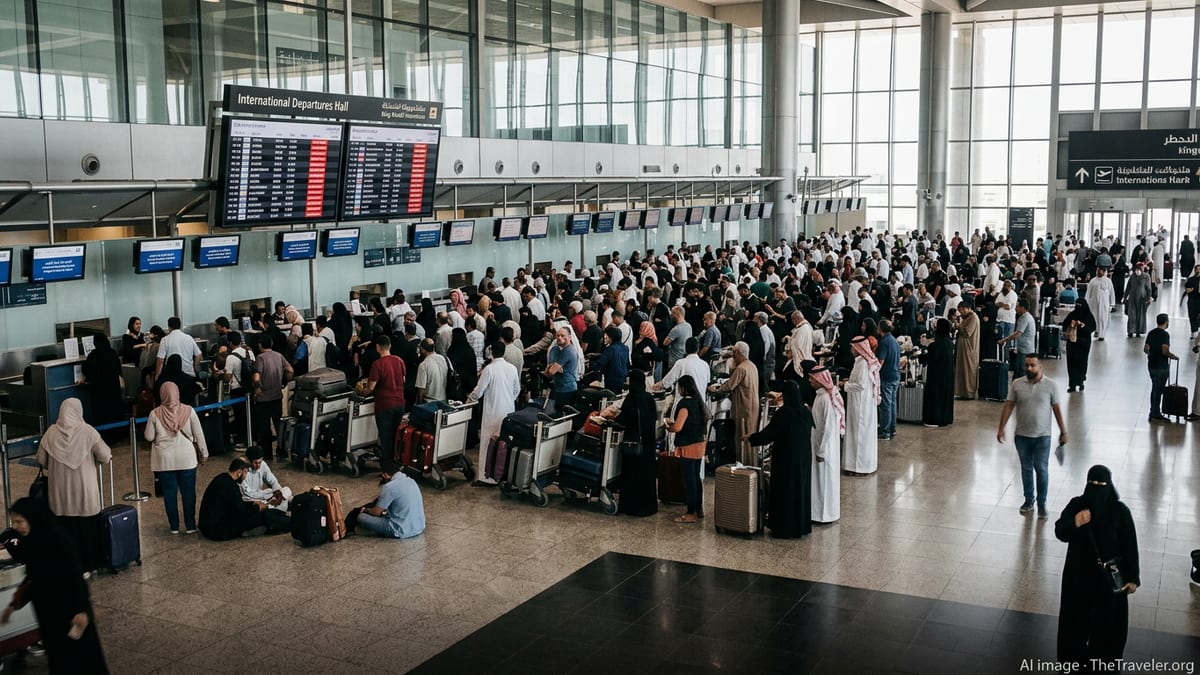
Inside Saudi terminals, scenes of overcrowded waiting areas and long customer service queues have become common as passengers attempt to salvage plans amid rolling updates. With many airlines trimming or suspending regional operations, same-day rebooking has become difficult, particularly for those travelling on the busiest Gulf and India routes.
Travelers report being offered rebookings several days out, or being rerouted through secondary hubs that add significant time to their journeys. Some passengers holding separate onward tickets risk missed connections and out-of-pocket costs if their first leg is cancelled or heavily delayed.
In response, airlines operating in and out of Saudi Arabia have introduced varying degrees of flexibility, including waivers on change fees and options for full refunds on affected itineraries. However, the speed of schedule changes means many customers are still learning of cancellations only hours before departure, limiting their ability to plan alternatives.
Consumer advocates are urging passengers to document all communications and expenses and to check their eligibility for refunds or re-accommodation under the conditions of carriage of the airline they are flying, which can differ significantly between full-service and low-cost carriers.
What Travelers Should Do Now
Aviation experts advise anyone scheduled to fly to or via Saudi Arabia in the coming days to treat itineraries as provisional until they have been reconfirmed directly by the airline on the day of travel. Third-party booking sites and screen displays can lag behind real-time operational decisions.
Passengers are encouraged to keep contact details updated with their carriers and to download airline apps where possible, as these often provide the fastest alerts on gate changes and cancellations. Those with critical travel, such as medical appointments or fixed-start employment abroad, are being urged to consider contingency plans, including alternative routings through less congested hubs.
Given the scale of the current disruption and the wider regional situation, industry observers warn that schedules may remain unstable beyond this week, even if some flights are gradually restored. Aircraft and crew positioning back to normal patterns will take time, and further waves of cancellations are possible if airspace or security conditions shift again.
For now, Saudi Arabia’s role as both a transit and destination market means its travelers are at the center of one of the most complex episodes of flight disruption the Gulf has seen in years, with knock-on effects likely to ripple through global networks well into the month.