

More news on this day
Passengers across Saudi Arabia, Kuwait, the United Arab Emirates, Qatar and beyond are facing mounting disruption after Saudia Airlines grounded 43 flights and imposed extensive delays on key regional routes linking Jeddah, Riyadh, Dubai and Doha, adding fresh turmoil to a Gulf aviation network already strained by widespread airspace closures.
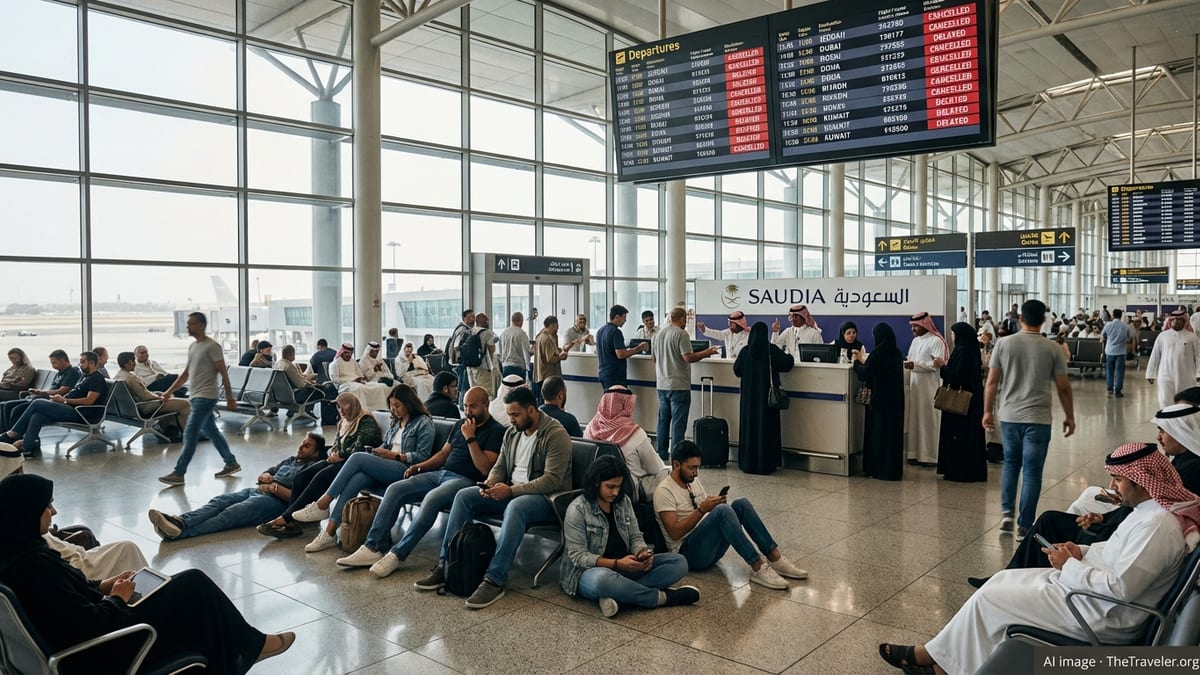
Grounded Flights Deepen Regional Air Travel Turmoil
Saudia’s decision to ground 43 flights has triggered scenes of confusion and frustration at major airports across the Gulf, with departure boards in Jeddah, Riyadh, Dubai and Doha filled with cancellations and rolling delays. The disruptions, reported on Monday, come at a time when many travelers were attempting to re-route through Saudi hubs after other Gulf gateways suspended or curtailed operations.
The affected services include high-demand connections between Jeddah’s King Abdulaziz International Airport and Kuwait City, Dubai, Doha, Abu Dhabi and Amman, as well as reciprocal flights feeding traffic back into Saudi Arabia from regional capitals and cities such as Peshawar. While the 43 flights represent a fraction of the carrier’s daily schedule, their concentration on trunk routes has created a bottleneck for transit passengers attempting to connect between Asia, the Middle East and Europe.
Saudia has issued a public apology and reiterated that passenger and crew safety remains its priority, but it has stopped short of offering a clear timeline for when normal operations will resume. Customers are being contacted using the details linked to their bookings and advised to verify their flight status before heading to the airport, yet many stranded travelers say they learned of cancellations only after lengthy queues at check in.
In terminals from Jeddah to Dubai, airport staff have struggled to accommodate rebooking requests as available seats on alternative flights vanish quickly. With airspace closures limiting routing options for multiple airlines, the usual fallback of rerouting via neighboring hubs has become far more difficult, leaving some passengers preparing for overnight airport stays or seeking last-minute hotel rooms in already crowded cities.
Major Hubs from Jeddah to Dubai and Doha Under Strain
The disruption is being felt most acutely at Jeddah’s King Abdulaziz International Airport, one of Saudia’s primary hubs and a critical gateway for religious and business travel. Several of the grounded flights were scheduled to depart Jeddah on Monday morning and midday, cutting links to Kuwait, Dubai, Doha, Abu Dhabi and Amman and interrupting onward journeys for connecting passengers.
Riyadh’s King Khalid International Airport is also seeing knock-on effects, as Saudia services between the Saudi capital and Dubai and Amman are among those affected. The timing coincides with a broader terminal transition program in Riyadh, which has already required passengers to pay closer attention to terminal assignments and arrival times, heightening the risk of missed connections.
Across the Gulf, Dubai and Doha are grappling with their own operational crises as regional airspace closures ripple through flight schedules. Dubai International, one of the world’s busiest hubs, suspended all operations on February 28 amid a wave of cancellations by Emirates, flydubai and dozens of foreign carriers. In Doha, Hamad International has been forced to scale back flights as Qatar’s airspace remains closed, pushing thousands of stranded passengers to seek alternatives via Saudi Arabia or Oman where possible.
The result is an intricate web of partial closures, rerouted services and last-minute schedule changes that has strained ground operations and customer-service channels. Airport announcements in multiple languages, long lines at transfer desks and crowded seating areas have become common scenes, as travelers wait for updates amid an evolving security and airspace situation.
Regional Conflict and Airspace Closures Behind the Disruption
The grounding of Saudia’s 43 flights cannot be viewed in isolation. It comes just days after a sharp escalation in Middle East tensions, with strikes on Iran triggering widespread airspace closures across the region and prompting civil aviation authorities to restrict or shut down key flight corridors. Countries including Iran, Iraq, Israel, Qatar, Bahrain and Kuwait have fully or largely closed their skies, while the United Arab Emirates and Saudi Arabia have imposed partial restrictions that limit commercial traffic on certain routes.
Industry data compiled over the weekend highlighted the scale of the resulting disruption. Analysis from aviation analytics firms indicated that nearly a quarter of all flights scheduled to arrive in the broader Middle East on February 28 were cancelled, with particularly high cancellation rates into the United Arab Emirates, Qatar and Bahrain. Major Gulf carriers such as Emirates, Qatar Airways, Etihad, flydubai and Kuwait Airways all reported dozens or even hundreds of cancellations in a single day as they reconfigured networks around newly restricted airspace.
Saudi Arabia has so far avoided a complete shutdown of its airspace, but partial closures near the Gulf and northern corridors have forced airlines to modify routings or suspend select destinations. Saudia confirmed over the weekend that flights to and from eight cities, including Amman, Kuwait, Dubai, Abu Dhabi, Doha, Bahrain, Moscow and Peshawar, would be suspended until late on March 2, citing ongoing regional developments and evolving safety assessments.
For passengers, the geopolitical backdrop remains partly abstract, but its consequences are immediate. Some travelers have described aircraft turning back mid-route or diverting to alternative airports as risk advisories were updated in real time. Others have seen their tickets canceled or converted into open vouchers while they wait for clarity on when airspace will reopen and schedules stabilize.
Knock-On Effects for Airlines and Global Connectivity
The Saudia cancellations form part of a broader shock to international aviation links that rely heavily on Gulf hubs for long-haul connectivity. Airlines from Asia, Europe and Africa routinely route flights through Dubai, Doha, Abu Dhabi and Saudi cities to feed passengers onto onward services, an intricate structure that is highly sensitive to airspace restrictions and sudden schedule changes.
In recent days, carriers such as Singapore Airlines and Malaysia Airlines have announced temporary suspensions of flights to Jeddah, Doha and other Middle Eastern destinations, rerouting certain long-haul services to avoid conflict-affected skies. Pakistan International Airlines has paused flights to the United Arab Emirates, Bahrain, Kuwait and Qatar, while maintaining limited services to Saudi Arabia on altered routings. Together, these moves underscore the scale of the operational challenge airlines face in maintaining safe yet commercially viable networks.
Experts warn that if closures and restrictions persist, the impact could spread far beyond the immediate region. Cargo flows, business travel and labor migration routes that depend on efficient Gulf connections may all see delays and capacity constraints. For now, carriers are prioritizing safety and regulatory compliance, but the financial and logistical toll of operating longer routes with additional fuel and crew costs is already mounting.
Travel industry observers note that the situation is especially difficult for smaller carriers and for passengers traveling on complex itineraries purchased through multiple airlines or travel agencies. Reaccommodation can be slow when alternative flights are controlled by different partners, and some travelers face the prospect of additional costs for accommodation, visas or surface transport while they wait for a viable way home.
What Stranded Travelers Are Being Told to Do
With uncertainty likely to continue in the short term, Saudia and other airlines have urged customers to rely on official communication channels rather than making unnecessary trips to the airport. Passengers are being advised to monitor airline apps, text messages and email alerts closely, and to update their contact details so carriers can reach them quickly if schedules change.
At affected airports, priority is being given to rebooking passengers whose flights were canceled outright, with many being shifted to later services once airspace allows or rerouted via alternative hubs that remain open. Airline staff are also processing refund requests under special waivers introduced in response to the crisis, though processing times vary due to the sheer volume of affected bookings.
Travel agents across the region report a surge in inquiries from customers seeking to adjust itineraries, delay departures or explore alternative routings through less affected corridors. Many are advising clients to build in longer connection windows where possible and to avoid tight same-day links through the busiest hubs until there is greater clarity on airspace restrictions.
For now, the message from carriers and aviation authorities is one of caution and patience. With the situation in flux and airspace decisions tied closely to security assessments, travelers through Saudi Arabia, Kuwait, the United Arab Emirates, Qatar and neighboring states are being warned that disruption could persist beyond the current wave of 43 grounded Saudia flights, shaping regional travel plans for days to come.