

More news on this day
Scoot is set to deepen air links between Singapore and Japan with a new daily service to Tokyo Haneda from March 2026, underscoring how low-cost carriers are reshaping regional connectivity just as Japan’s own aviation market enters a period of consolidation and strategic realignment.
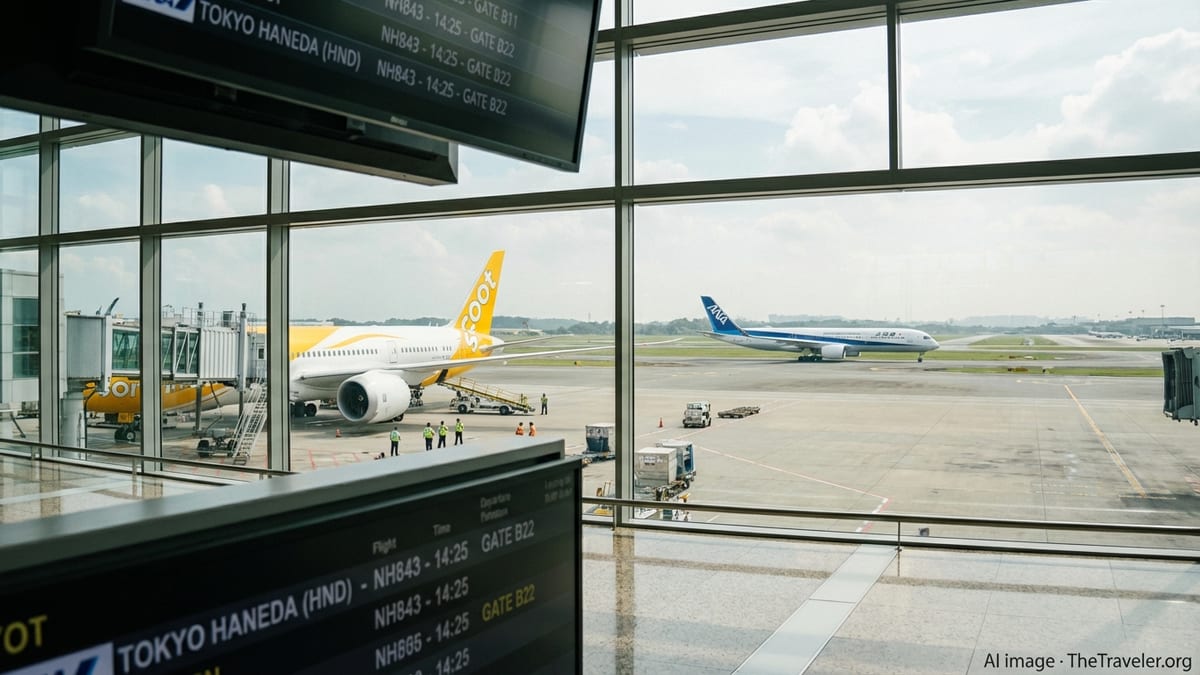
Scoot Targets Haneda as Singapore–Japan Demand Surges
The low-cost subsidiary of Singapore Airlines will launch daily flights between Singapore Changi and Tokyo Haneda on March 1, 2026, operated by Boeing 787 aircraft. The schedule pairs an evening departure from Singapore with a pre-dawn arrival in Tokyo, positioning the service to capture both leisure and budget-conscious business travellers seeking a nonstop option into the Japanese capital’s city airport.
Haneda is widely viewed as the more convenient gateway to Tokyo compared with Narita, thanks to its closer proximity to central districts and faster rail and road connections. By adding Haneda to its existing Tokyo Narita operations, Scoot gains a second point of entry into the world’s largest metropolitan area, giving passengers more choice on airport, timing and price tier.
The move also aligns Scoot more closely with its parent Singapore Airlines, which has steadily built up its own premium presence at Haneda in recent years. Once running, Scoot’s service is expected to complement rather than compete directly with the mainline carrier, broadening group capacity into Tokyo while segmenting traffic by price and service expectations.
For Japan-bound travellers from Southeast Asia and beyond, the new service strengthens Singapore’s role as a key transit hub. It provides an additional one-stop option into Tokyo from secondary cities in Indonesia, Malaysia and Thailand that lack direct links to Japan, reinforcing Changi’s position as a gateway for the broader region.
Japan’s LCC Landscape Shifts as Air Japan Exits
Scoot’s expansion into Haneda comes at a moment of notable turbulence within Japan’s own low-cost and hybrid airline sector. ANA Group has announced that its hybrid international brand Air Japan will cease operations by March 2026, with aircraft and crews to be folded back into ANA’s mainline network and its low-cost arm Peach Aviation.
Air Japan, launched to tap medium-haul demand from Tokyo Narita to cities such as Singapore, Bangkok and Seoul at lower price points, struggled to carve out a distinct niche between full-service ANA and no-frills Peach. Rising fuel costs, aircraft delivery delays and intensifying competition across Asia’s mid-market segment have made the hybrid model harder to sustain, prompting ANA to revert to a simpler dual-brand structure.
The withdrawal of Air Japan from the Singapore–Tokyo market will remove one competitor in the lower-fare space, even as Scoot increases its presence with the new Haneda service. Industry analysts expect ANA to redeploy capacity toward core premium routes, while Peach focuses on regional leisure markets, leaving more room for foreign low-cost carriers such as Scoot and Jetstar to capture price-sensitive international traffic.
This consolidation within Japan mirrors broader trends across Asia, where airlines are trimming overlapping brands and concentrating on clearer value propositions. For passengers, the shake-up may mean fewer branded options on some routes but a more predictable split between full-service and low-cost offerings.
Haneda Slots Highlight Strategic Value of Tokyo Access
Securing access to Tokyo Haneda remains one of the most prized assets in Asian aviation strategy. The airport’s limited slot pool, strong local demand and excellent connectivity into central Tokyo make any new service a significant competitive advantage, particularly for a low-cost carrier that can undercut legacy fares into a high-yield market.
By deploying widebody Dreamliners on the route, Scoot is betting on sustained demand from both ends of the corridor. Singapore continues to attract Japanese leisure travellers and business visitors, while Japan’s tourism boom, supported by a weak yen and a strong global appetite for travel, is drawing record numbers of visitors from Southeast Asia and beyond.
For the Singapore Airlines Group, handing Haneda capacity to Scoot on this timing pattern allows it to fine-tune fleet utilisation while defending market share against rival groups linked to other hubs such as Hong Kong, Seoul, Doha and Dubai. Scoot’s lower cost base can help the group maintain a strong presence on price-sensitive segments without diluting the premium positioning of Singapore Airlines on similar city pairs.
The service also supports connectivity deeper into Japan. With domestic and regional links from Haneda operated by ANA and its partners, travellers arriving on Scoot will have onward options, even as ANA’s internal restructuring shifts some traffic to Peach and other group brands over time.
Regional Competition Intensifies as Carriers Rebalance Networks
The launch of Scoot’s Haneda flights is part of a wider recalibration of networks among Asia’s low-cost and full-service airlines in the post-pandemic era. While Scoot is adding new points in Japan such as Okinawa alongside Haneda, other carriers have been pruning underperforming long-haul routes, particularly from Europe, to concentrate on high-demand Asian markets.
Japan’s domestic scene is also changing as ANA transfers more Kansai-based routes to Peach and as other Japanese low-cost operators refine their focus on leisure traffic and inbound tourists. This concentration of budget capacity on short and medium-haul sectors creates space for foreign LCCs to step into longer regional routes linking major hubs like Singapore with Japanese cities.
At the same time, traditional full-service airlines around the region are reasserting their strengths on premium-heavy routes and key business corridors. The overlapping strategies mean that in markets such as Singapore–Tokyo, travellers are increasingly offered a clear ladder of options, from no-frills to full service, rather than a proliferation of hybrid concepts.
In this environment, the success of Scoot’s Haneda service will hinge on its ability to balance aggressive pricing with reliability and acceptable comfort on an overnight widebody flight. The airline will be closely watched as a case study in how low-cost operators can leverage constrained gateway airports typically dominated by legacy carriers.
What Travellers Can Expect on the New Route
For passengers, the new Singapore–Tokyo Haneda route promises tighter access to central Tokyo and potentially lower fares, offset by late-night and early-morning timings that may require careful planning for airport transfers and hotel check-in. Transport links at Haneda, however, are built to handle off-peak arrivals, with rail and bus services connecting the airport to major districts in under an hour.
Scoot plans to operate the route with its Boeing 787s, offering a mix of standard economy seating and a small premium cabin marketed under its enhanced service product. While the carrier charges separately for extras such as checked baggage, meals and seat selection, its pricing model typically undercuts full-service competitors on the same corridor, particularly outside peak holiday windows.
For Japanese travellers heading south, Singapore will serve not only as a destination but as a springboard into the rest of Southeast Asia via Scoot’s and Singapore Airlines’ networks. For Southeast Asian travellers, the combination of a city-proximate Tokyo airport and a low-cost widebody service may tip the balance when choosing between Tokyo and other Asian capitals for their next long weekend or seasonal escape.
As the aviation landscape across Japan and Southeast Asia continues to evolve, Scoot’s move into Haneda illustrates how low-cost carriers are no longer confined to secondary airports and marginal time slots. Instead, they are increasingly central to how key city pairs are connected, even as legacy groups streamline their brands and refocus on their most profitable markets.