

More news on this day
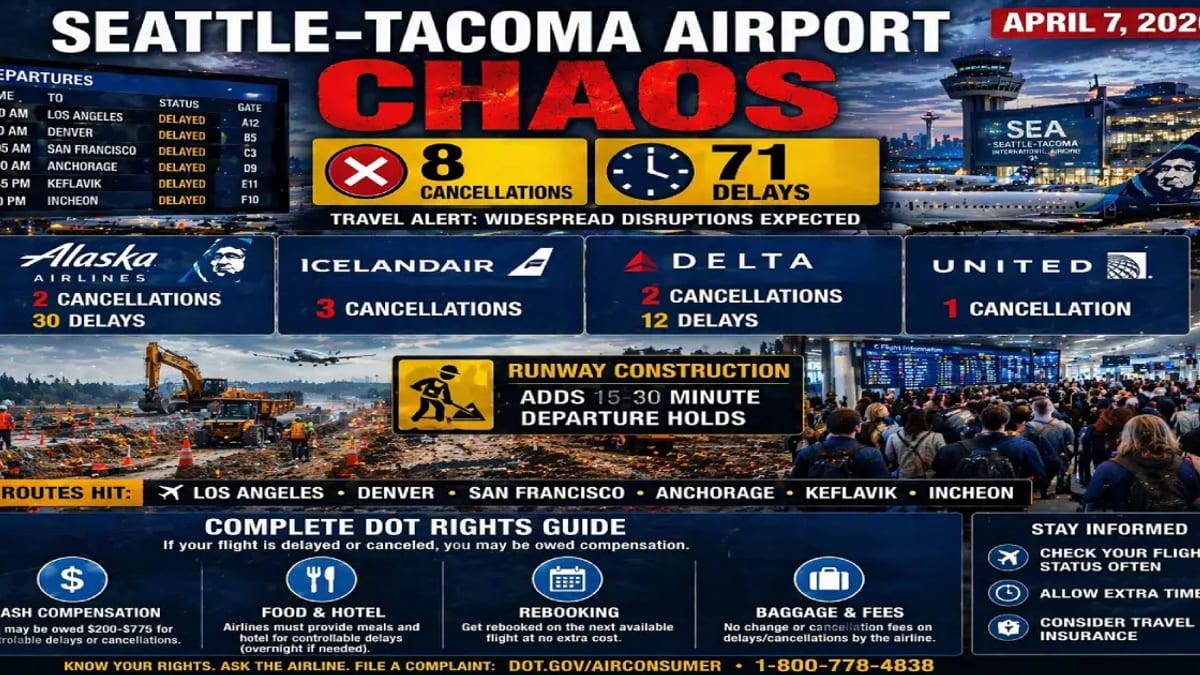
Travelers moving through Seattle-Tacoma International Airport on April 7 faced a difficult start to the week as a total of 79 flight disruptions, including 71 delays and 8 cancellations, rippled through one of the West Coast’s busiest hubs.
Get the latest news straight to your inbox!
Delays and Cancellations Ripple Across Key Domestic Routes
Publicly available flight-tracking data for April 7 indicate that Seattle-Tacoma International Airport logged 71 delayed departures and arrivals along with 8 outright cancellations, affecting a mix of short- and medium-haul domestic routes. The pattern placed SEA among a cluster of major United States hubs experiencing elevated disruption levels as the day progressed.
The delays were concentrated on heavily traveled corridors linking Seattle with Los Angeles, Denver, San Francisco, Anchorage and other core markets that anchor airline networks along the West Coast and into the Mountain West. Travel industry coverage notes that a number of the affected services were operated by large network and hybrid carriers, including Alaska Airlines, Delta Air Lines and United Airlines, whose schedules at SEA are tightly interconnected with operations across the country.
While no single, widely reported incident was identified as the sole trigger, the scale of disruption at Seattle aligned with a broader national environment of operational strain in early April. National tallies compiled by aviation and travel outlets for April 7 reported thousands of delays and more than 200 cancellations across U.S. airports, suggesting that airlines and airports were managing knock-on effects from weather, congestion and other routine pressures in multiple regions.
Seattle’s 8 cancellations, though modest in absolute terms, created pronounced challenges for affected passengers due to already busy loads and limited spare seat capacity on alternative departures. According to published accounts, some travelers faced multi-hour rebooking lines and were pushed to later same-day flights or next-day departures as seats became available.
How SEA’s Disruption Compares With National Trends
Seattle-Tacoma International Airport typically posts a solid on-time record relative to other large U.S. hubs. A national disruption report released earlier this year estimated that roughly three-quarters of SEA departures operate on schedule in a typical year, with about 23 percent experiencing delays and fewer than 1 percent cancelled. Against that backdrop, 79 disrupted flights in a single day stands out as an above-average operational challenge, though not an extreme outlier for a major hub.
On April 7, however, the effect of SEA’s 79 disruptions was magnified by a parallel spike in delays and cancellations nationwide. Travel-focused outlets tracking same-day performance reported more than 4,000 delayed flights and just over 200 cancellations across the United States, encompassing busy hubs such as Atlanta, New York, Chicago, Houston and Los Angeles. Within that broader pattern, Seattle featured as one of several nodes where local constraints fed into a much larger network of rolling schedule adjustments.
Industry analyses of recent months have highlighted several structural issues contributing to days like April 7, including tight airline staffing levels, limited slack in aircraft rotations, and air traffic control constraints in certain regions. A recent aviation trade report drew attention to repeated stresses on the Federal Aviation Administration’s infrastructure and controller workforce, warning that regional bottlenecks can quickly ripple into large multi-airport disruption events when demand is high.
For passengers, the result in Seattle on April 7 resembled the experience seen at other hubs: longer-than-normal waits at boarding gates, crowds clustering near departure screens and service counters, and a wave of rolling schedule changes as airlines attempted to re-sequence aircraft and crews to stabilize operations through the afternoon and evening peaks.
Operational Pressures at a Growing Pacific Northwest Hub
Seattle-Tacoma International Airport has been navigating sustained growth heading into 2026, supported by new domestic and international services, ongoing terminal improvements and expanded regional connectivity. Port of Seattle planning documents describe SEA as a critical economic engine for the Pacific Northwest, with tens of thousands of on-site workers and passenger volumes that place it among the nation’s busiest airports.
That growth, however, leaves less margin for error on congested travel days. When storms, staffing constraints or national system issues intersect with a tight schedule, relatively small disturbances can result in dozens of delayed flights. Aviation performance data for the United States show that even at generally well-run airports, a limited percentage of cancellations and a moderate share of delays can translate to thousands of affected travelers on any given day.
Recent national discussions about air traffic control resilience have also underscored the dependence of airports such as Seattle on the broader aviation system. Reports in early April highlighted federal efforts to modernize key systems and address controller shortages, with industry analysts cautioning that infrastructure bottlenecks could prolong or intensify disruption episodes until long-term fixes are fully implemented.
In that context, the 79 disruptions at SEA on April 7 fit into a wider story of an aviation sector still balancing post-pandemic demand recovery, staffing limits and infrastructure upgrades. For Seattle-area travelers, it meant an unwelcome reminder that even routine spring travel days can turn unpredictable when multiple pressure points converge.
Passenger Impact and Practical Advice for Future Trips
For travelers caught in Monday’s disruption, the immediate priorities were rebooking, re-routing and securing overnight stays where necessary. Reports from passengers across U.S. hubs on April 7 described long hold times with airline call centers and crowded service desks, patterns consistent with days when national delay and cancellation totals spike above the norm.
Consumer advocates generally recommend a series of steps that can help lessen the impact of such events. These include monitoring flight status frequently through an airline’s mobile app, enabling push notifications, and arriving at the airport early when forecasters or travel outlets flag widespread operational issues. Having alternative routings in mind, such as connections through secondary hubs, can also speed decision-making if a primary flight is cancelled.
Travel guidance from airlines and government agencies further emphasizes understanding the distinction between controllable and uncontrollable disruptions. In the United States, weather, air traffic control constraints and certain infrastructure problems are often treated as outside an airline’s direct control, while crew or maintenance-related issues may fall into the controllable category. This difference can affect what forms of assistance carriers voluntarily provide, such as meal vouchers, hotel accommodations or free rebooking on later services.
Passengers affected in Seattle on April 7 are generally advised to retain documentation of delays, cancellations and out-of-pocket expenses, including hotel and meal receipts, in case of future claims or customer-service appeals. While U.S. regulations do not require airlines to pay statutory compensation in most disruption scenarios, carriers often review cases individually, particularly when multiple flights on an itinerary were affected.
What April 7 Signals for Spring and Summer Travel
The turbulence at Seattle-Tacoma International Airport on April 7 arrives just as airlines and airports prepare for the busier late-spring and summer travel period. Forecasts for 2026 point to continued strong demand on domestic and transborder routes, with carriers adding capacity through SEA and other West Coast gateways to capture leisure and visiting-friends-and-relatives traffic.
Analysts observing U.S. performance metrics suggest that days like April 7 could become more common during peak periods unless system-wide improvements keep pace with demand. That includes not only air traffic control modernization but also investments in airport infrastructure, ground handling, deicing operations and customer-service staffing that can help absorb shocks from weather or cascading delays.
For Seattle-area travelers planning trips in the coming months, April 7 serves as a case study in the importance of preparation and flexibility. Travel planners recommend scheduling longer connection times when possible, avoiding the last flight of the day on critical legs, and considering travel insurance products that explicitly cover certain types of disruptions and trip interruptions.
While the aviation system is designed to recover from daily bouts of delays and cancellations, the experience at SEA on April 7 illustrates how quickly conditions can deteriorate for individual passengers when 79 flights in and out of a single hub are affected. As airlines, regulators and airports work to strengthen resilience, passengers remain on the front line of that volatility, tasked with navigating an environment where even ordinary travel days can turn chaotic with little warning.