

More news on this day
Escalating military tensions between Iran and a United States-led coalition are casting a growing shadow over Dubai’s Palm Jumeirah, as regional threats against Gulf infrastructure and ports feed fresh anxiety among residents, visitors, and investors at one of the Middle East’s most high-profile waterfront developments.
Get the latest news straight to your inbox!
Iconic Tourism Hub Under New Strategic Spotlight
Palm Jumeirah has long been marketed as a symbol of Dubai’s stability and openness, drawing high-spending tourists and property buyers to its luxury hotels, marinas, and beachfront residences. The artificial archipelago, jutting into the Arabian Gulf opposite key shipping lanes, has generally been insulated from the region’s recurring crises.
The latest conflict cycle, triggered in late February by large-scale strikes on Iranian targets and followed by a series of retaliatory attacks and threats across the Gulf, is reshaping perceptions of risk. Publicly available security and maritime assessments describe a significant deterioration in the wider Gulf environment, with missile and drone activity, airspace restrictions, and heightened naval deployments affecting travel and logistics patterns.
While Palm Jumeirah itself has not been reported as a direct target, its proximity to Dubai’s shoreline, major ports, and busy sea routes places it within a broader geography now being scrutinized by risk analysts. Travel and corporate security bulletins in recent days have emphasized that the conflict has ended the long-held assumption that commercial hubs in the lower Gulf would remain largely untouched by regional confrontation.
Concerns among hospitality operators and real estate stakeholders center less on immediate physical damage and more on how sustained tension could slow visitor arrivals, complicate insurance coverage, and cool high-end property demand if travelers begin to associate the archipelago with a conflict-adjacent coastline.
Iranian Threats Expand From Shipping To Coastal Infrastructure
Since early March, Iranian-linked rhetoric and military moves have increasingly focused on Gulf energy, maritime, and port infrastructure. Regional situation reports note that Iranian officials and allied media have warned of potential action against desalination and power facilities in neighboring states in response to Western threats against Iranian plants.
Published intelligence and maritime briefings highlight a pattern of drone and missile activity targeting ports, refineries, desalination sites, and logistics hubs across the Gulf. Attacks and attempted strikes have been documented in Bahrain, Qatar, and Oman, while insurance and shipping advisories describe a steep reduction in traffic through the Strait of Hormuz and a re-routing of cargo to alternative ports farther from the main threat zone.
Within the United Arab Emirates, international news coverage has drawn attention to Iranian warnings urging the evacuation of ports and docks in key emirates, including Dubai and Abu Dhabi, following accusations that facilities on UAE territory were used to support strikes on Iranian infrastructure. Analysts note that such public warnings are designed both to signal military reach and to sow uncertainty among commercial operators that rely on Gulf sea lanes and coastal assets.
For Palm Jumeirah, which lies a short distance from Dubai’s main shoreline and within sight of offshore shipping routes, the broadening scope of threats against coastal infrastructure is raising questions about theoretical exposure. Security specialists say that even if the archipelago is never named in public statements, any escalation involving Dubai’s ports, power systems, or nearby offshore assets could have indirect implications for safety perceptions on the palm-shaped island.
Travel, Aviation, And Insurance Impacts Reach Dubai’s Waterfront
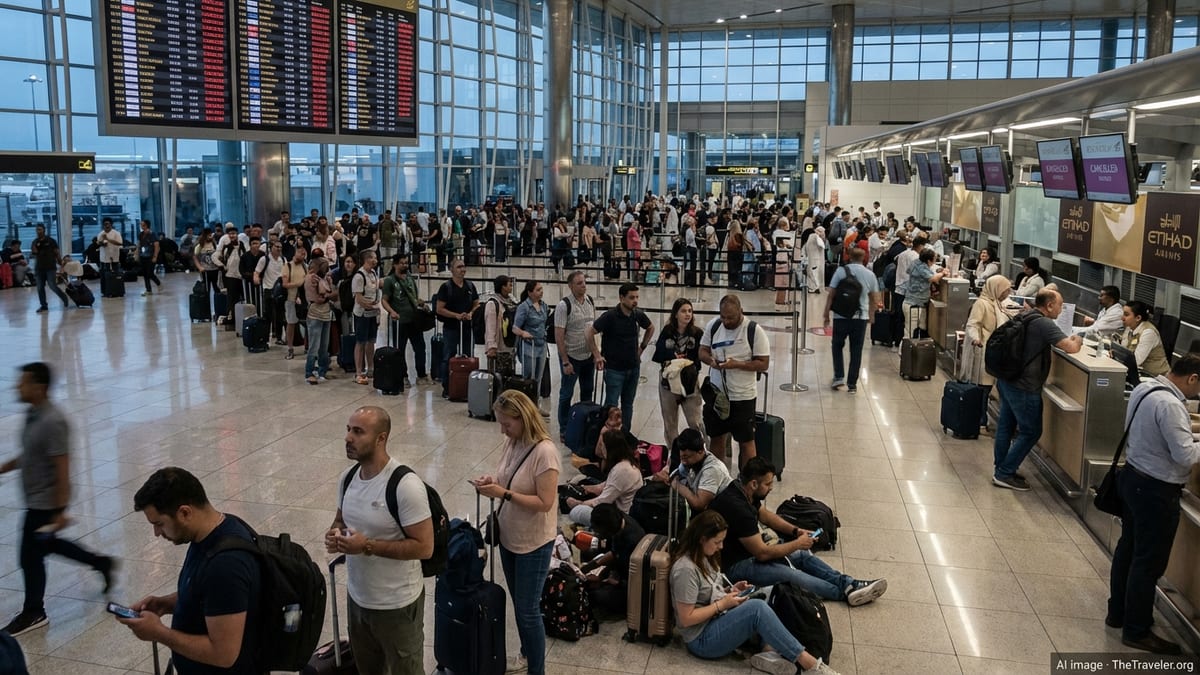
Regional aviation and travel guidance since late February describes a patchwork of airspace closures and restrictions across multiple Gulf countries, including emergency measures implemented in the UAE. Although Dubai’s airports and tourist districts have continued to function, travelers are facing disrupted routings, longer flight times, and evolving security screening protocols.
Corporate travel advisories circulating in the international business community recommend enhanced journey management for trips into the UAE, including Dubai, with particular attention to movements between airports, central business districts, and coastal resort areas. Some guidance points to temporary pauses or slowdowns in group incentive travel and large-scale events, a core segment for Palm Jumeirah’s flagship hotels and conference venues.
In maritime sectors, war-risk surcharges and revised insurance terms are affecting the cost of operating near Gulf ports. Shipping industry coverage indicates that several major carriers have suspended or curtailed bookings involving key UAE gateways, while others are diverting vessels to Omani ports and relying more heavily on overland corridors into Gulf markets. These shifts can ripple outward to Palm Jumeirah, where yachting, cruise calls, and waterfront retail are closely tied to the region’s broader maritime economy.
Travel risk consultants note that despite the elevated environment, Dubai continues to emphasize continuity of operations, with tourism promotion campaigns and hotel groups assuring guests that robust security arrangements remain in place. The challenge for Palm Jumeirah, they add, will be balancing the need for visible security presence with the island’s longstanding appeal as a relaxed, resort-style enclave.
Investor Sentiment, Property Markets, And Long-Term Perceptions
The luxury real estate market on Palm Jumeirah has been one of Dubai’s standout performers in recent years, attracting global investors seeking both lifestyle properties and safe-haven assets. The current conflict is now testing assumptions about geopolitical insulation that underpinned some of that demand.
Market commentary from regional analysts in March points to rising volatility across Gulf exchanges and a reassessment of risk premiums tied to energy infrastructure and financial centers. Although Dubai’s property market has not seen an abrupt reversal, agents and consultancies report more frequent questions from foreign buyers about contingency plans, building resilience, and insurance coverage for waterfront towers and villas.
Travel and security think tanks argue that how quickly tensions ease, and whether Iranian threats against Gulf neighbors materialize into further high-profile attacks, will shape investor sentiment toward destinations such as Palm Jumeirah. A short, contained conflict with limited damage to civilian infrastructure might allow the island to maintain its image as a resilient global address, while a drawn-out confrontation could encourage some buyers to diversify holdings to less exposed geographies.
Industry observers also highlight reputational risk. Even if Palm Jumeirah escapes any direct security incident, repeated references to Iranian threats against Gulf ports, power plants, and maritime hubs may gradually influence how international travelers and corporations perceive Dubai’s offshore developments as places to live, invest, or host major events.
Heightened Vigilance And Evolving Risk Calculus For Travelers
As the regional situation evolves, travel risk assessments for Dubai and Palm Jumeirah are being updated frequently, incorporating new data on missile and drone trajectories, airspace restrictions, and maritime incidents. Tour operators and multinational companies are increasingly leaning on specialized intelligence providers to refine destination profiles for the UAE’s coastal cities.
Guidance for individual travelers emphasizes staying informed about local security updates, maintaining flexible itineraries, and registering contact details with consular services where possible. For visitors planning stays on Palm Jumeirah, recommendations typically include monitoring airline advisories, confirming hotel policies on disruptions, and allowing extra time for airport and road transfers during periods of heightened alert.
Regional analysts underscore that, despite the gravity of the Iran-related tensions, daily life in much of Dubai continues with a degree of normality, and core tourism infrastructure remains operational. Palm Jumeirah’s beaches, restaurants, and entertainment venues are still functioning, even as they adapt contingency plans and coordinate with citywide security frameworks.
For now, the island’s future as a marquee travel and investment destination appears closely tied to wider diplomatic efforts to de-escalate the Iran conflict and restore confidence in the Gulf’s air and sea corridors. Until clearer signals emerge, Palm Jumeirah is likely to remain emblematic of both the opportunities and vulnerabilities that define high-profile coastal developments in an increasingly contested region.