

More news on this day
Seoul is moving closer to an ambitious goal of becoming a “data-free city,” expanding high-speed public Wi-Fi in key visitor areas so tourists can stay connected without racking up roaming charges.
Get the latest news straight to your inbox!
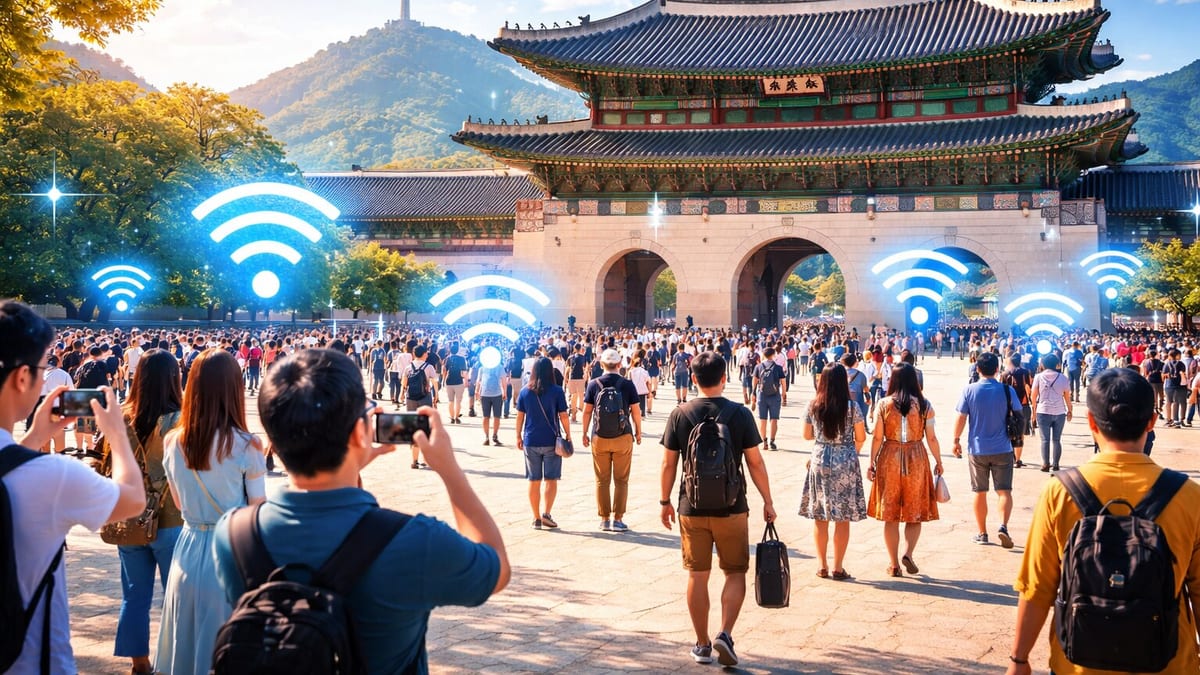
Image by Travel And Tour World
From Smart City Vision to “Data-Free” Tourism
Publicly available city documents describe a long-term plan to turn Seoul into a place where residents and visitors can access data “anytime, anywhere” through free or low-cost networks. City publications outline a trajectory that began with early smart city projects and has evolved into broader digital inclusion initiatives often described as a move toward a “data-free city.”
Over the past decade, Seoul has steadily expanded free Wi-Fi access points in parks, major streets, subway stations, buses, museums, and riverside leisure areas. Earlier projects focused on civic services and bridging the digital divide, but recent materials emphasize the role of connectivity in enhancing the visitor experience, from seamless navigation to rich cultural content.
The “data-free” concept does not remove the need for mobile subscriptions altogether. Instead, it aims to create dense coverage of high-speed Wi-Fi in spaces where visitors actually spend time, reducing dependence on roaming or local SIM cards for many everyday travel tasks.
Dense Network of High-Speed Wi-Fi in Tourist Hotspots
Reports on Seoul’s smart infrastructure indicate that free public Wi-Fi now operates at thousands of locations across the city, including popular areas such as Myeongdong, Hongdae, Jamsil, and riverside parks along the Han River. Transport hubs, cultural facilities, and shopping districts have been priority zones, reflecting the typical movement of international travelers.
Technical documents describing the rollout point to network speeds designed to support more than basic messaging and map checks. Average speeds reported in user-focused summaries often exceed 100 Mbps in central districts, approaching the performance of many home broadband connections. For tourists, that means streaming videos, uploading photos, and accessing cloud-based apps can be done comfortably over public Wi-Fi in many core areas.
Subway and bus connectivity are central to the strategy. Seoul’s metro system has offered Wi-Fi for years, and more recent efforts have focused on improving stability and coverage in trains and stations. Public buses have increasingly been equipped with wireless access points, allowing travelers to stay online while moving between neighborhoods, an important factor for those relying on translation apps and real-time navigation.
How “Data-Free Zones” Could Change On-the-Ground Travel Habits
The expansion of high-speed public Wi-Fi is expected to reshape how visitors plan and move through the city. With reliable access in major tourist and transport zones, travelers can increasingly depend on apps for real-time route planning, ticketing information, restaurant discovery, and language assistance without monitoring roaming usage.
For budget-conscious visitors, stronger Wi-Fi coverage may reduce or even eliminate the need for traditional roaming packages or dedicated pocket routers, especially for shorter stays focused on central Seoul. Many travel accounts already describe itineraries built around hopping between hotel, café, subway, and public hotspots, and the city’s ongoing expansion of access points appears likely to reinforce that pattern.
The “data-free zones” concept also encourages richer use of digital tourism services. Museum guides, augmented-reality experiences, location-based storytelling, and city tourism apps become more attractive when travelers trust that they will work smoothly on public networks. This, in turn, supports Seoul’s broader branding as a technologically advanced, visitor-friendly smart city.
Opportunities and Limitations for International Tourists
Travel commentary and user experiences suggest that, while coverage is extensive, public Wi-Fi in Seoul is not yet a complete substitute for mobile data in every scenario. Some visitors report that connections can be inconsistent in side streets, underground areas, or at peak times, and that logging in to certain networks may be confusing for first-time users who are unfamiliar with local providers.
Security and privacy considerations also shape how tourists use “data-free” connectivity. Public guidance often recommends avoiding sensitive activities such as mobile banking or accessing confidential work platforms over open networks. Many travelers combine free Wi-Fi for general browsing and media with limited mobile data for secure tasks, creating a hybrid approach that still substantially reduces roaming costs.
Another limitation is geographic. The most robust “data-free” environments are concentrated in Seoul and other large cities, while rural destinations and some smaller towns may offer far fewer hotspots. For itineraries that extend beyond the capital, many travel planners continue to advise at least a basic local eSIM or roaming package as a backup.
What Travelers Should Expect in the Coming Seasons
Recent presentations on Seoul’s digital infrastructure indicate that the city continues to add new access points in areas of high tourist demand, including waterfront parks, cultural districts, and major event venues. The emphasis is shifting from simply increasing the number of hotspots to improving quality of service, such as higher throughput, better handoff between access points, and clearer network names for non-Korean speakers.
Tourism materials highlight official city Wi-Fi brands and encourage visitors to connect to secure versions where available. Clearer signage, multilingual instructions, and integration with city apps are likely to become more common as Seoul refines its “data-free zones” concept into a recognizable part of the destination’s identity.
For travelers planning trips in 2026 and beyond, the direction of travel is clear. While carrying some form of mobile data remains prudent, Seoul’s push toward a “data-free city” is rapidly making it possible to navigate, share, and stream across much of the urban core using high-speed public Wi-Fi, reshaping expectations of what a connected city break can look like.