

More news on this day
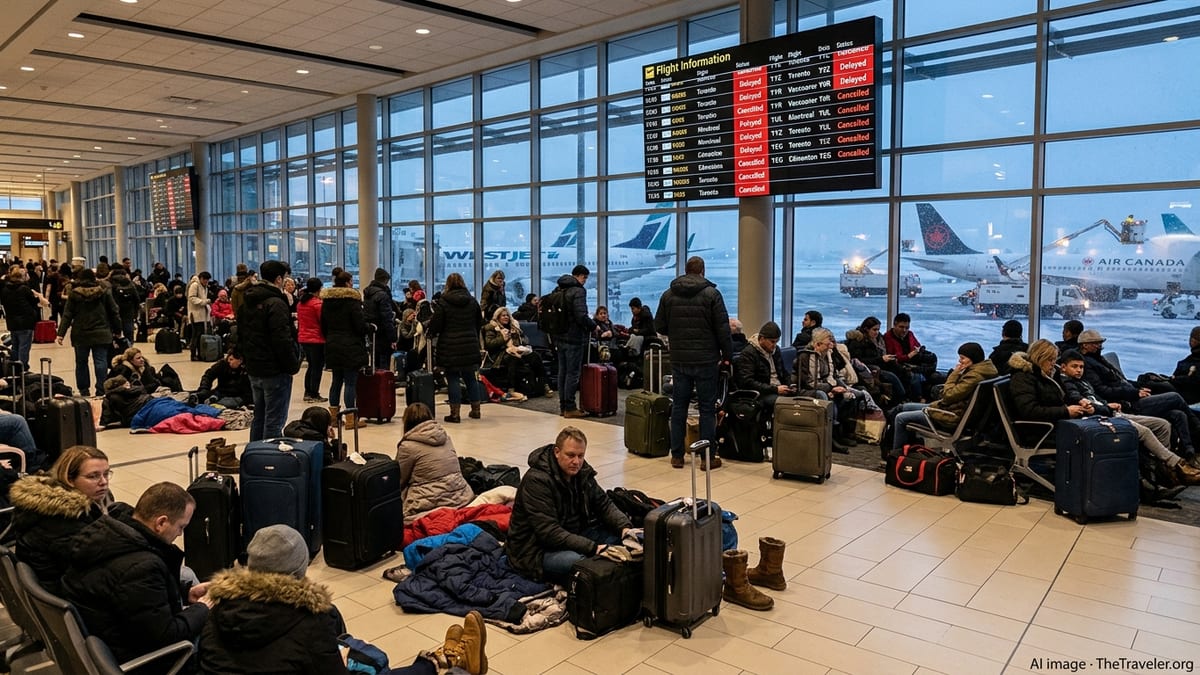
Travelers across Canada faced major disruptions this week as Calgary International Airport reported 165 delays and 12 cancellations affecting WestJet, WestJet Encore, and Air Canada services, stranding passengers on some of the country’s busiest corridors linking Calgary with Toronto, Vancouver, Montreal, and Edmonton.
Get the latest news straight to your inbox!
Sudden Storm Turns Calgary Hub into Bottleneck
Publicly available flight-tracking data and aviation community reports indicate that a fast-moving snowstorm over Calgary triggered a cascade of schedule problems at Calgary International Airport, a primary hub for WestJet and an important base for Air Canada. The storm intensified more quickly than many forecasts suggested, leading to rapid deterioration in visibility and runway conditions and forcing airport operations to slow sharply.
Accounts shared by travelers and airline watchers describe an extended ground stop, with aircraft held at gates, de-icing pads, and taxiways as snow removal teams worked to clear the airfield. With departures paused and only intermittent arrivals permitted, the number of delayed flights climbed steadily through the day, ultimately contributing to at least 165 delays across WestJet, WestJet Encore, and Air Canada operations.
The resulting congestion on the ramp meant inbound aircraft often had no available gates, further compounding the disruption. Flights connecting Calgary with Toronto, Vancouver, Montreal, and Edmonton were among the most affected, as tight turnaround schedules became impossible to maintain and knock-on delays spread across each carrier’s national network.
Weather-related slowdowns are a familiar challenge for Canadian airports, but observers note that the pace and volume of schedule changes at Calgary this week were particularly acute, turning the airport into a chokepoint for travelers moving between Western and Eastern Canada.
Passengers Face Long Delays, Cancellations, and Overnight Stays
As the operational backlog grew, many passengers reported extensive waits both in terminal buildings and on board aircraft parked on the apron. Some travelers described being held on planes for several hours while waiting for de-icing or gate access, while others found themselves rebooked onto flights departing a day or more later than originally planned.
Publicly shared accounts from stranded travelers referenced missed connections in Toronto and Vancouver, vacations cut short, and business trips abruptly extended. Routes between Calgary and Edmonton, typically used as short hops for regional connections, also saw significant disruption as airlines prioritized longer-haul services and struggled to reposition aircraft and crews.
For some passengers, particularly those arriving late in the day, the combination of cancellations and limited remaining capacity meant unexpected overnight stays in Calgary. Social media posts and forum discussions describe families with young children seeking last-minute hotel rooms, as well as international travelers unfamiliar with the city attempting to rearrange ground transport and accommodation at short notice.
While many travelers acknowledged that heavy snowfall and poor visibility made flying conditions difficult, frustration centered on the pace of information and the limited same-day alternatives once flights were scrubbed. Several passengers reported waiting in long lines at service desks or spending hours on customer-service phone lines to secure new itineraries.
Network Ripple Effects Hit Toronto, Vancouver, Montreal, and Edmonton
Because Calgary functions as a major connecting hub, the disruption quickly radiated outward to other Canadian cities. Flight-status boards at Toronto Pearson, Vancouver International, Montreal–Trudeau, and Edmonton International showed a growing list of delayed and cancelled services linked to Calgary, as aircraft and crews failed to arrive on time.
Toronto-bound passengers reported missed onward connections to Atlantic Canada and transborder U.S. destinations, while Vancouver travelers faced delays reaching Pacific and Asian routes. In Montreal and Edmonton, travelers on domestic legs found themselves waiting for Calgary-originating aircraft that had yet to depart, with some services ultimately cancelled due to crew- and curfew-related constraints.
Published schedule data for WestJet, WestJet Encore, and Air Canada show that Calgary is deeply embedded in their domestic networks, with many itineraries funnelling passengers through YYC rather than offering nonstop alternatives between secondary cities. This hub-and-spoke structure can be efficient during normal operations, but it leaves carriers and travelers exposed when a single hub experiences a severe weather event or infrastructure constraint.
Industry observers note that the current episode follows a broader trend of Canadian carriers consolidating capacity through a smaller number of key hubs, including Calgary, Toronto, and Vancouver. While that strategy can optimize aircraft utilization, it also means that a local snowstorm in Alberta can rapidly translate into missed flights and extended delays for travelers thousands of kilometers away.
Questions Raised Over Recovery Planning and Passenger Care
As operations gradually normalize, attention is turning to how airlines managed the disruption and whether recovery plans were sufficient for the scale of the event. Public commentary from travelers suggests that communication about rolling delays, gate changes, and rebooked itineraries was inconsistent, with some passengers receiving timely app notifications while others learned of cancellations only upon reaching the airport.
The situation unfolds against the backdrop of Canada’s Air Passenger Protection Regulations, which lay out minimum expectations for care and compensation in the event of delays and cancellations. Regulators have previously scrutinized carriers, including WestJet, for how they handle extended disruptions, particularly on issues such as food and water provision, hotel accommodation, and rebooking on alternate carriers when delays stretch beyond 48 hours.
Legal and consumer advocates following the latest Calgary disruptions are expected to examine whether airlines accurately categorized the causes of delay as weather-related, carrier-controlled, or a mix of both. That classification can significantly influence what support and compensation travelers may be entitled to claim in the days and weeks ahead.
Publicly available reports already show some passengers preparing documentation of their experiences, including boarding passes, receipts, and screenshots of flight-status updates, in anticipation of filing formal complaints or reimbursement requests once they complete their journeys.
What Travelers Can Expect in the Coming Days
With the immediate snow event now past, operational data and airline schedule updates indicate that flight volumes at Calgary are recovering, but residual delays remain possible as carriers reposition aircraft and crews to restore normal patterns. Travelers scheduled to pass through Calgary over the next several days are likely to encounter tighter-than-usual connections and limited spare capacity on peak routes to Toronto, Vancouver, Montreal, and Edmonton.
Industry analysts recommend that passengers build additional buffer time into itineraries involving Calgary and monitor flight status closely on the day of departure. For those who experienced significant disruption this week, publicly available guidance from consumer agencies suggests keeping detailed records and submitting claims through airline channels first, before escalating to federal regulators if resolutions are not satisfactory.
The recent episode underscores how quickly a single weather system can upend travel plans across Canada’s interconnected air network. For WestJet, WestJet Encore, and Air Canada, the challenge in the days ahead will be not only clearing the operational backlog but also rebuilding trust with travelers who unexpectedly found themselves stranded by the storm.