

More news on this day
Thousands of travelers were stranded at Charlotte Douglas International Airport on Sunday as severe winter weather tied to a powerful nor’easter forced airlines including American, Piedmont, Republic, Endeavor Air, Frontier and others to ground 81 flights and delay more than 200 across major East Coast routes, snarling connections to Newark Liberty, Philadelphia, Rhode Island, Baltimore, Salisbury and a wide swath of the Mid-Atlantic and Northeast.
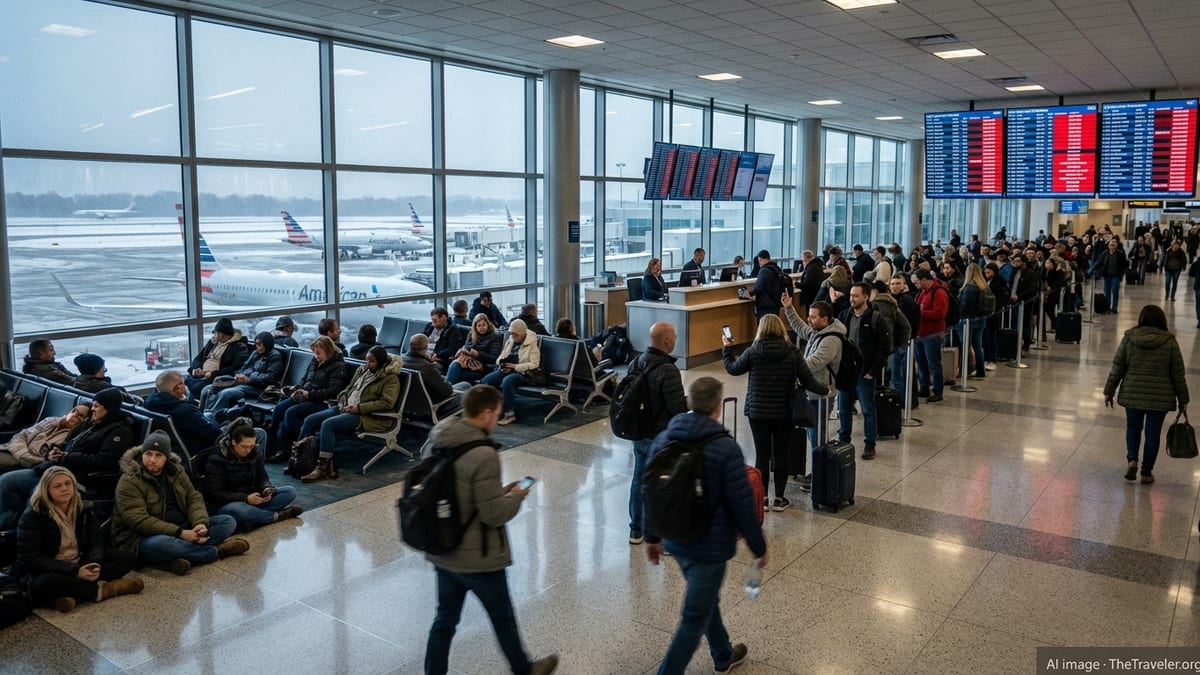
Charlotte Hub Buckles Under Mounting Cancellations
By early afternoon on February 22, Charlotte Douglas, one of the nation’s busiest hubs and American Airlines’ second-largest fortress operation, had shifted from routine Sunday bustle to a tableau of rolling suitcases and anxious crowds. Departure boards showed growing clusters of red as cancellations and delays stacked up, reflecting cascading disruptions from the blizzard taking shape along the Northeast corridor.
Airport operations data indicated that roughly four in ten departures were experiencing significant delays and a smaller but rapidly rising share of flights were being scrubbed outright, leaving many passengers with no clear path to connect onward. For American and its regional partners, Charlotte’s role as a connective hub meant that a snowstorm hundreds of miles away in New Jersey, Pennsylvania or New England could paralyze operations in North Carolina.
While conditions in Charlotte itself fluctuated between light wintry mix and brisk, gusty winds, the real operational choke points were farther north. Aircraft and crews scheduled to route through Newark, Philadelphia, Providence and other threatened airports were either held in place or pulled from rotation entirely as the nor’easter intensified, leaving dozens of Charlotte departures without airplanes or legal flight crews.
Inside the terminal, long customer service lines formed at American’s rebooking counters as agents worked to reroute travelers through remaining open hubs or push their trips back by 24 to 48 hours. “Every time the screen refreshes, there’s another cancellation,” one traveler remarked, echoing the mounting frustration and uncertainty felt throughout the concourses.
Nor’easter Turns Northeast Corridor into a No-Fly Zone
The turmoil in Charlotte was a direct symptom of the powerful nor’easter, unofficially dubbed Winter Storm Hernando by some media outlets, which on Sunday began blasting the Northeast with heavy snow, powerful winds and rapidly deteriorating visibility. Blizzard warnings stretched from coastal New Jersey through Long Island and into parts of New England, with forecasters warning of near-impossible travel conditions along key interstate and aviation corridors.
Airports from Newark Liberty and New York’s major fields to Philadelphia, Providence in Rhode Island and Boston were bracing for one to two feet of snow, with snowfall rates of several inches an hour amid gusts strong enough to trigger whiteout conditions. Airlines had already preemptively canceled thousands of flights for Sunday and Monday in the region, turning much of the Northeast corridor into a temporary no-fly zone.
For carriers operating complex connecting networks, that preemptive strategy was designed to prevent stranded aircraft and crews from being trapped at closed or severely constrained airports. But the trade-off was a wave of disruptions across the rest of the country. Flights that might otherwise have departed Charlotte for cities like Newark, Philadelphia, Providence, Baltimore or Salisbury were scrubbed to avoid sending planes into the heart of the storm.
Meteorologists noted that this nor’easter comes on the heels of an already active winter for the Mid-Atlantic and Northeast, amplifying concern about infrastructure stress, power outages and further travel shutdowns. State and local officials in major metropolitan areas urged residents to avoid nonessential travel, further signaling that commercial aviation would remain severely limited at least through Monday.
American and Its Regional Partners Bear the Brunt
As Charlotte’s dominant carrier, American Airlines and its web of regional affiliates, including Piedmont and Republic, absorbed the bulk of Sunday’s cancellations and delays. Dozens of their flights were either grounded or pushed back by several hours, particularly those feeding smaller East Coast markets that rely heavily on connections through Charlotte and the Northeast.
Industry analysts say this pattern reflects the vulnerability of hub-and-spoke networks when a major storm stalls over a densely connected region. Aircraft operating short-haul routes between secondary cities and major hubs are often scheduled for multiple quick turns in a single day. When one or two of those legs are canceled because a destination airport closes or faces severe flow restrictions, it can render the rest of the aircraft’s and crew’s schedule unworkable.
Piedmont, which operates many of American’s shorter regional segments in the Mid-Atlantic, saw disruptions ripple along routes linking Charlotte with communities in Maryland, Delaware and Virginia. Republic, with a large presence on East Coast connector routes, also recorded a sharp uptick in grounded flights. Endeavor Air, best known as a regional operator for another major carrier but sharing some of the same constrained airspace and airport infrastructure, reported operational slowdowns and knock-on delays as well.
Frontier, with a smaller footprint in Charlotte and the Northeast but a highly utilization-driven business model, faced a different sort of challenge. Even a handful of cancellations or rolling delays in a weather event can upend a tight schedule covering multiple cities, forcing the carrier to reposition planes and crews once conditions improve. Guests on affected flights often face longer waits for the next available departure, with limited alternative options on that airline.
Northeast Routes Snarled from Newark to Rhode Island
Among the most affected routes were those linking Charlotte with Newark Liberty and Philadelphia, two crucial gateways into the nation’s largest population centers. As snow intensified around the New York metropolitan area, airlines slashed operations at Newark, transforming the airport from a bustling Sunday hub into a field dominated by rows of idle jets and snowplows moving between gates and taxiways.
Flights between Charlotte and Providence, Rhode Island, as well as other key New England and Mid-Atlantic destinations, were also heavily impacted. Passengers bound for Rhode Island’s T. F. Green International Airport reported seeing their flights repeatedly pushed back before receiving cancellation notices, leaving them scrambling to secure hotel rooms or rental cars when overland travel remained risky.
To the south, Baltimore and nearby Salisbury, Maryland, experienced their own share of disruptions as the outer bands of the storm swept across the Mid-Atlantic. While snowfall totals there were expected to be somewhat lower than in New York or Boston, a combination of icy runways, strong winds and regional air traffic control constraints triggered ground stops and reduced arrival rates, forcing airlines to throttle back their schedules.
The result was a trans-regional tangle of delays and diversions. Flights departing from sunny destinations in the Southeast or Florida for the Northeast were diverted to intermediate airports or held at departure gates, while southern hubs like Charlotte and Atlanta increasingly became holding points for passengers whose final destinations were effectively shut down by the storm.
Stranded Passengers Face Long Lines and Limited Options
For travelers on the ground in Charlotte, the cascading operational decisions translated into a familiar but no less stressful experience: long lines at service counters, crowded seating areas and the search for any available charging outlet or quiet corner. Families returning from midwinter breaks in the Caribbean or Florida found themselves unexpectedly marooned in North Carolina, weighing whether to wait out the storm or divert to alternative cities.
Airlines responded by issuing broad travel waivers for affected dates and routes, allowing customers to change their itineraries without the usual fees or fare differences in many cases. Yet even with relaxed rules, the practical challenge remained: finding open seats on flights not yet canceled and routing passengers through hubs that were not already overburdened by the weather event.
Some travelers, particularly those with urgent commitments or limited flexibility, turned to creative solutions such as rebooking to more distant airports and planning to drive the final leg, or using a combination of trains and rental cars once they could reach cities like Washington, DC, or Richmond. Others simply settled in at Charlotte’s terminals for what they expected would be an overnight wait, setting up makeshift camps with blankets and carry-ons near gate areas.
Local hotels near the airport reported a surge in last-minute bookings, and ride-hailing services saw intermittent spikes in demand as travelers opted to abandon their air itineraries altogether, at least for the day. Airport staff moved through the concourses clarifying gate changes and cancellations, while concession stands stayed busy serving passengers who increasingly realized they might be spending much longer in the terminal than planned.
Airlines Activate Storm Playbooks and Fee Waivers
Behind the scenes, major US carriers activated their storm operations playbooks even before the nor’easter’s worst conditions set in. These plans, honed over years of winter disruptions, typically involve a combination of proactive cancellations, flexible rebooking policies, targeted aircraft repositioning and close coordination with federal aviation authorities to manage limited runway and airspace capacity.
Delta, United, American and several low-cost carriers had already posted winter weather advisories covering a wide swath of East Coast airports, encouraging passengers to check flight status frequently and adjust their travel dates if possible. For flights touching storm-affected cities between February 22 and 24, many airlines offered one-time fee-free changes or allowed customers to cancel and retain credits for future travel.
In Charlotte, that translated into repeated public address announcements reminding passengers to use mobile apps or self-service kiosks rather than wait in line at counters, particularly if their travel dates were flexible. For those with fixed plans, gate agents worked case by case to find creative routings, sometimes sending travelers on circuitous journeys through the Midwest or the Southeast to bypass the crippled Northeast corridor.
Even with these mitigations, aviation experts warned that recovery from a major storm like this nor’easter can take days, not hours. Aircraft and crews must be restored to their scheduled rotations, backlogs of displaced passengers need to be cleared and airport infrastructure has to be fully dug out from snow and ice. For travelers booked through Charlotte and other major hubs early in the new week, the message from airlines remained consistent: expect continued delays and sporadic cancellations until operations stabilize.
Broader Impact on US Winter Travel Patterns
Sunday’s chaos at Charlotte Douglas and across the East Coast underscored how vulnerable the US air travel system remains to intense winter weather, especially when a single storm intersects with multiple high-density corridors at once. The combination of a major hub in the Southeast feeding traffic into a blizzard-battered Northeast created a textbook example of how quickly disruptions can propagate.
Transportation analysts noted that this winter has already tested airline resilience with a succession of storms impacting regions from Texas to New England, leading to high-profile cancellations, power outages and infrastructure strain. While airlines have invested heavily in more sophisticated forecasting tools and operational planning, the sheer scale of the networks and the tight margins in crew and aircraft availability mean that no carrier can fully insulate itself from a storm of this magnitude.
For travelers, the latest disruption is likely to reinforce a growing trend toward more conservative planning in the winter months: building in extra buffer days before critical events, choosing midday flights that are less vulnerable to chain-reaction delays and keeping a closer eye on extended forecasts when booking. The events at Charlotte and along the Northeast corridor served as a stark reminder that in peak storm season, even flights departing clear skies can be at the mercy of a system-wide weather shock.
As the nor’easter continues its march up the coast, attention will now turn to how quickly airlines can restart normal operations and how long it will take stranded passengers to reach their destinations. For thousands stuck in Charlotte and at airports from Newark to Providence and Baltimore, the answer, for now, depends less on airline schedules and more on when the storm finally releases its grip on the East Coast.