

More news on this day
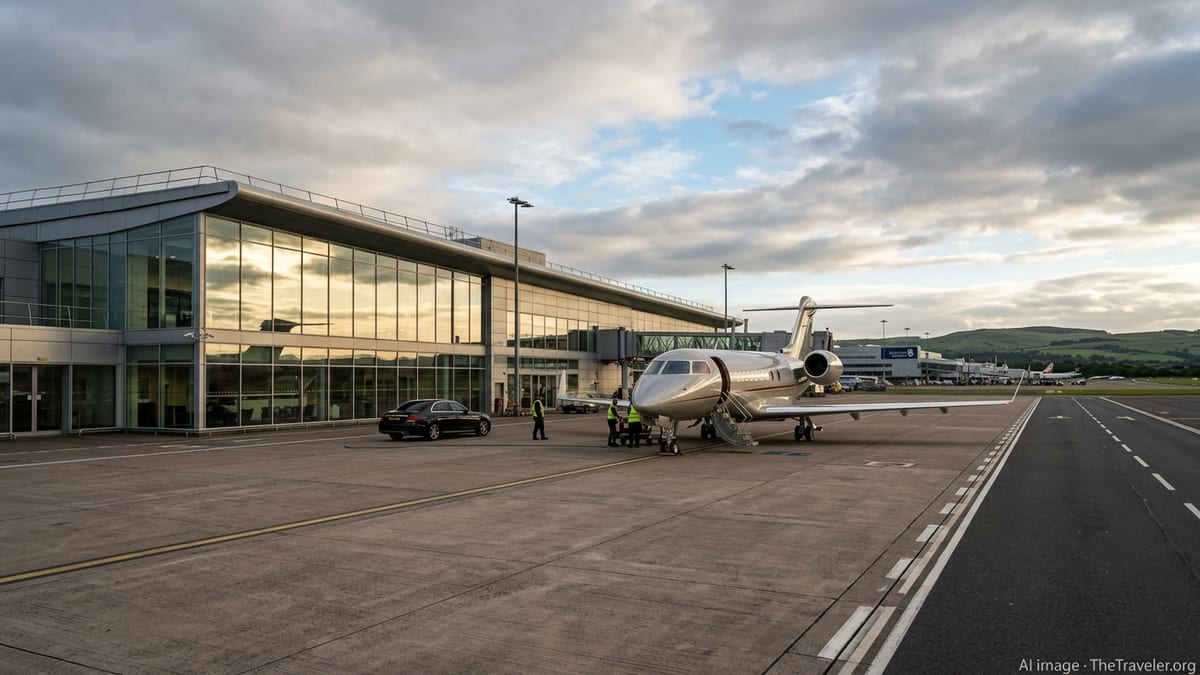
Glasgow Airport has gained a fresh boost to its premium travel offering as Signature Aviation opens a new private terminal, adding higher-end facilities and services for business and leisure passengers in Scotland.
Get the latest news straight to your inbox!
Strategic Expansion for Scotland’s Business Aviation Market
The launch of a new Signature Aviation private terminal at Glasgow Airport represents a significant investment in Scotland’s business and general aviation sector. Publicly available information shows that Signature already operates one of the world’s largest networks of fixed-base operators, and the move in Glasgow aligns with a broader programme of modernising facilities across Europe and North America.
Glasgow has been steadily rebuilding and diversifying its air services, including renewed long-haul and transatlantic links, and industry coverage notes that the region has been targeting higher-yield corporate and inbound tourism traffic. A dedicated private terminal is viewed as a way to support that goal, offering an alternative to the main passenger terminal for high-net-worth travellers, sports teams, film and music tour charters, and corporate shuttles.
Business aviation activity in the UK has remained resilient compared with some scheduled airline segments, and market reports indicate that Scotland’s central belt continues to attract investment in energy, financial services, and creative industries. The new facility at Glasgow positions the airport to capture more of this demand, particularly from operators seeking efficient access to the city and the wider region.
Industry observers also point out that having a branded, full-service private terminal at Glasgow helps the airport compete more effectively with rival gateways in Edinburgh and elsewhere in the north of England, where premium facilities have historically been more developed.
Features Designed for Privacy, Comfort and Speed
While the new Glasgow location is tailored to the scale of the local market, its design reflects the typical Signature template of a discrete, self-contained terminal separated from the main commercial passenger flows. According to published coverage of comparable Signature facilities, passengers can generally expect private check-in and security processing, comfortable lounges, meeting spaces, and direct access to aircraft on the apron.
Such terminals are configured to minimise dwell times: crews can coordinate fuel, catering and ground handling while passengers remain in quiet lounge areas, often boarding within minutes of arrival at the facility. For travellers arriving into Scotland, private immigration and customs coordination, where available under local rules, can streamline formalities and reduce queueing compared with the main terminal.
Glasgow’s new private terminal is expected to mirror these priorities, with emphasis on fast turnarounds for business jets, on-site concierge-style assistance with hotel and ground transport arrangements, and tailored support for complex itineraries. The set-up typically allows airside access for chauffeured vehicles, enabling passengers to transfer between car and aircraft with minimal exposure to the wider airport environment.
For aircraft operators, a full-service fixed-base operation usually brings consolidated fuel arrangements, ramp and hangar options, and support for flight planning and crew rest. The Glasgow facility forms part of that infrastructure, giving operators a single point of contact at the airport for a range of technical and customer-facing services.
Enhanced Connectivity for Glasgow and the West of Scotland
The new private terminal is also significant in terms of how Glasgow connects with the wider world. While scheduled carriers link the city to key hubs, premium travellers and corporate flight departments often prefer direct point-to-point business jet flights, especially for secondary cities, remote project sites or multi-stop tours that are not easily served by commercial networks.
With a modern fixed-base operation in place, Glasgow Airport can more credibly market itself as a base for aircraft and as a convenient origin or destination for charter operations. That has implications beyond the airport perimeter, potentially supporting local hospitality, conference venues and tourism providers who seek to attract high-spending visitors and corporate events to the city and surrounding regions such as Loch Lomond, Argyll and the Highlands.
Analysts of the UK regional aviation market have observed that competition between Scottish airports often centres on the quality and scope of their route networks and facilities. By strengthening its business aviation product, Glasgow adds another point of differentiation that may help retain and win traffic that might otherwise gravitate toward Edinburgh or airports in northern England.
In addition, a more robust private aviation offering could support sectors such as film and television, live events and sports, which frequently rely on ad hoc charter flying. The ability to process teams, performers and equipment quickly through a dedicated facility is considered an important operational advantage.
Focus on Service Standards and Sustainability Trends
Signature Aviation has publicly highlighted service consistency and sustainability as key pillars of its global strategy. Recent announcements about the roll-out of blended sustainable aviation fuel and electric ground support equipment across selected European locations indicate the direction of travel for the network as a whole, and Glasgow is expected to benefit from those group-wide initiatives over time.
The company’s wider programme has included refurbished and newly built terminals with upgraded interiors, improved crew facilities and enhanced digital tools for slot coordination and handling requests. Sector commentary suggests that customers increasingly prioritise predictable, high-touch service, especially when operating complex itineraries or flying into unfamiliar airports.
In Scotland, environmental considerations are particularly prominent in public debate, and aviation operators face pressure to demonstrate efforts to reduce emissions and noise. While business aviation remains a small fraction of overall traffic, the introduction of more efficient ground operations, support for alternative fuels where feasible, and attention to local community impacts are viewed as important steps in maintaining the sector’s license to operate.
Observers note that any improvements at Glasgow’s new private terminal that reduce fuel burn on the ground, shorten taxi times through better coordination, or facilitate the use of lower-carbon fuel blends would align with these expectations, even as flying activity continues to evolve.
Implications for Passengers and Operators
For passengers, the immediate benefit of the new private terminal at Glasgow Airport lies in discretion, speed and tailored service. Those arriving or departing on business jets can expect a more controlled environment than the main terminal, with quieter spaces to work or relax and fewer touchpoints between curb and cabin.
Charter brokers and corporate flight departments gain another well-known brand option when planning operations into western Scotland. Having a large network provider on the field can simplify logistics, particularly for multi-leg itineraries that route through several Signature locations where processes and expectations are broadly aligned.
For Glasgow Airport itself, the project reinforces its position in a competitive landscape. The presence of a dedicated private terminal operated by a global brand signals that the airport is investing in premium segments of the market alongside efforts to grow scheduled services. Local stakeholders will be watching to see how the facility performs in attracting new aircraft basing, additional movements and incremental visitor spending in the years ahead.
As the business aviation sector continues to adapt to economic shifts and sustainability pressures, the new Signature Aviation terminal at Glasgow Airport adds another piece to Scotland’s evolving aviation infrastructure, aiming to combine higher service standards with an eye on future environmental expectations.