

More news on this day
Passengers at Singapore Changi Airport are facing fresh disruption this week after multiple carriers, including Qatar Airways, Gulf Air, Singapore Airlines and Qantas, cancelled or reshuffled more than a dozen flights linking the city-state to Doha, Jeddah, Sydney, Phuket, Jakarta, Bali, Kuala Lumpur and other key hubs.
Get the latest news straight to your inbox!
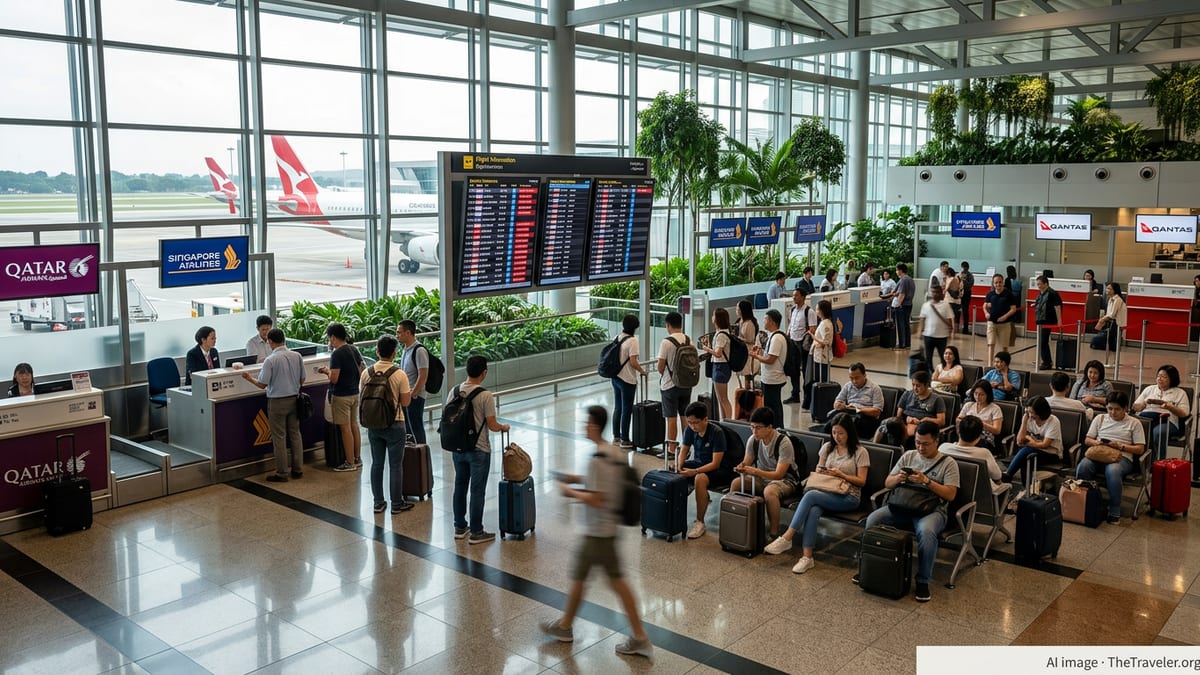
Middle East Airspace Crisis Reaches Singapore
The latest wave of cancellations at Changi is closely tied to the wider Middle East airspace crisis that has already forced Qatar Airways and other Gulf carriers onto sharply reduced schedules. With Qatari airspace only partially available and temporary corridors subject to tight controls, airlines are trimming or suspending services that can no longer operate efficiently along their usual routes.
Qatar Airways, a major operator at Changi on the Singapore to Doha corridor, has been running a limited network out of Doha since late February. Its rolling schedule updates for flights between February 28 and March 22 highlight a rotating list of destinations that can be served on any given day, leaving some Singapore departures and arrivals cancelled at short notice as the carrier reallocates scarce slots to higher priority routes.
Data compiled from regional aviation trackers this week shows Singapore among the hardest hit hubs in Southeast Asia, with multiple cancellations and more than a hundred delays recorded in the first days of March. The majority of the cancellations are concentrated on services that either overfly or connect through the Gulf, amplifying impacts on long-haul itineraries to Europe, Africa and the Americas.
Gulf Air and other regional carriers have also pared back operations through their home hubs as they navigate the same restricted airspace. For Changi, that has translated into a thinning of services to Bahrain, Doha and beyond, as well as missed connections for passengers booked on through-tickets to onward destinations such as Jeddah, Riyadh and Cairo.
Routes to Doha, Jeddah, Sydney and Regional Leisure Hubs Affected
Among the most visible impacts for Singapore-based travelers are cancellations on the flagship Singapore to Doha route, traditionally operated by Qatar Airways with multiple daily frequencies. Several of those services have been removed from schedules over the coming days as the airline concentrates on a short list of corridors approved under temporary operating authorizations.
Saudi routes have also come under pressure. Carriers serving Jeddah via Gulf hubs have been forced to cancel or re-time flights where onward connections through Doha, Dubai or Abu Dhabi are no longer viable. Travel agents in Singapore report that some passengers heading for Umrah or business travel in Saudi Arabia have seen itineraries reissued two or three times in the past week, often with detours via alternative hubs in South or Southeast Asia.
The disruption is not confined to the Middle East. A combination of aircraft and crew being out of position and longer flight times on rerouted services has had knock-on effects on Asia-Pacific and Australian routes. Qantas has adjusted portions of its network that rely on transiting the region, while Singapore Airlines has issued fresh travel advisories and maintained its suspension of selected Middle East services, tightening capacity on popular links out of Changi.
As a result, passengers are encountering cancellations and heavy delays on flights from Singapore to Sydney, Jakarta, Denpasar in Bali, Phuket and Kuala Lumpur. In many cases the affected services are those that feed or are fed by long-haul flights touching the Middle East, meaning that even ostensibly regional leisure routes are now feeling the strain.
What Airlines Are Doing for Stranded Passengers
With schedules changing day by day, major carriers are leaning on flexible rebooking policies to keep passengers moving. Qatar Airways has been offering full refunds and free date changes for travelers with tickets falling within its disruption window, while also attempting to re-accommodate customers on remaining services or on partner airlines where seats are available.
Singapore Airlines and its low-cost arm Scoot have similarly expanded waiver policies on affected routes, particularly for itineraries touching the Middle East. In practice, that has meant fee-free changes, refunds in travel vouchers, or rerouting via alternative hubs such as Bangkok, Seoul or Tokyo for customers whose original plans depended on now-cancelled connections through Gulf airports.
Qantas, which relies on Singapore as a key stopover on some long-haul flows, has focused on schedule adjustments and re-timing to keep its core Australia to Europe services intact. Travel industry briefings indicate that the airline is working case by case with passengers whose Changi connections have been disrupted, offering date changes or alternative routings on alliance and codeshare partners where necessary.
Gulf Air and other regional operators present at Changi are following a similar pattern, prioritizing refunds and rebookings. However, capacity on many alternative routes is tight, and some passengers are reporting waits of several days for seats on replacement flights as peak departure banks from Singapore to Northeast Asia and Europe fill up.
Advice for Travelers Flying Via Singapore in the Coming Weeks
For anyone booked to travel through Singapore in the next two weeks, particularly on itineraries involving Doha, Jeddah or other Gulf gateways, aviation experts are urging a more hands-on approach than usual. Passengers are being advised to check their flight status daily, and again within 24 hours of departure, as airlines continue to publish rolling schedule changes rather than firm long-range timetables.
Travel agents recommend building in longer connection times and, where possible, selecting routings that do not rely on transiting the Gulf at all. Options may include flying from Singapore to Europe or North Asia direct, then onward to final destinations, even if that means a longer journey or a brief overnight stay en route.
Travelers with flexible dates are encouraged to consider postponing non-essential trips until after March 22, when airlines are expected to have greater clarity on airspace restrictions and operating windows. Those who must travel sooner should keep all documentation on hand, including e-tickets and receipts, in case they later need to pursue compensation under applicable passenger rights frameworks or claim on travel insurance.
Above all, airport authorities and carriers at Changi are urging patience. Check-in staff, call centers and customer service desks have been handling elevated volumes since late February, and queues at ticketing counters can be lengthy during peak periods. Officials stress that safety remains the overriding priority while airlines and regulators work to restore more stable connectivity across the Middle East and its vital links to Asia.