

More news on this day
Skydream has officially launched its Space Camping smart travel trailer in the United States, introducing a high-tech, space-inspired mobile living pod that aims to merge smart-home convenience, electric power and automated towing assistance for the next generation of road-trippers.
Get the latest news straight to your inbox!
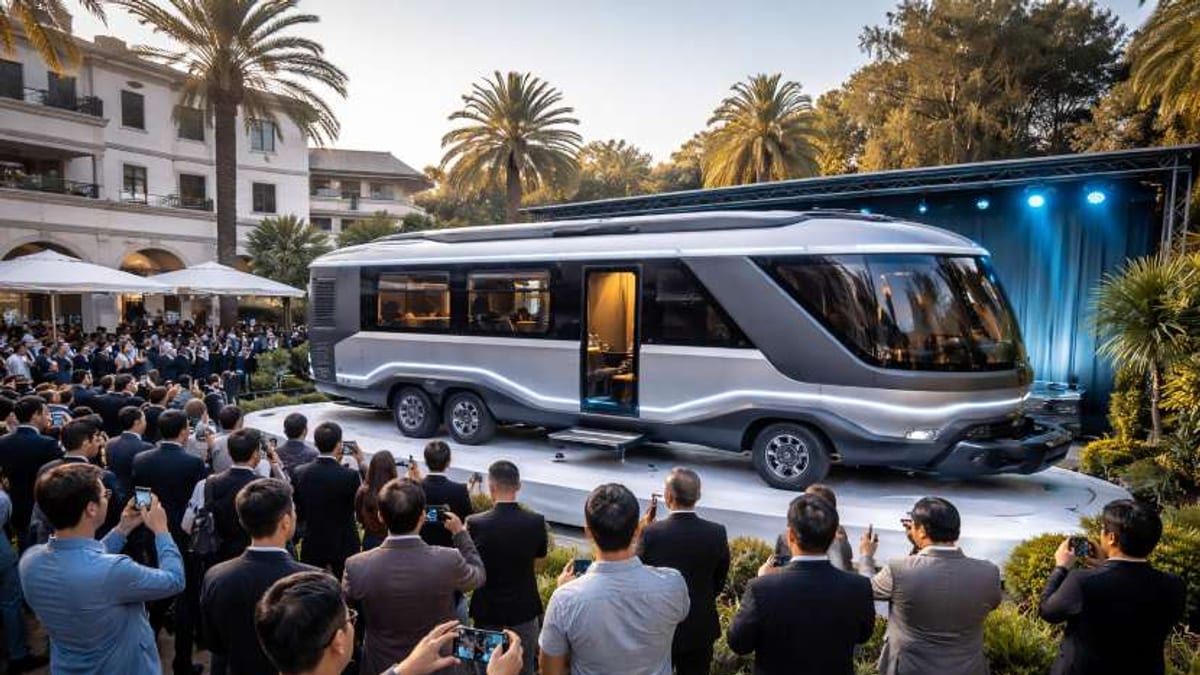
Image by Latest International / Global Travel News, Breaking World Travel News
Flagship Smart Trailer Takes the Stage in Silicon Valley
The Space Camping trailer made its first formal United States appearance at a Skydream brand launch event in San Jose, California, where the startup presented its vision of an intelligent, electric-era RV. Publicly available information from the launch indicates that the model is positioned as Skydream’s flagship product and as a showcase for what the company sees as the future of mobile living.
According to company materials and recent coverage, the trailer is built on a proprietary skateboard-style chassis that integrates batteries, motors, tanks and electronics into a single platform. This approach is intended to support both electric propulsion assistance and the dense packaging of systems required for extended off-grid travel, while also giving the vehicle its distinctive low-slung, pod-like proportions.
Skydream is targeting initial deliveries for the North American market in late 2026, following a rollout that began with European debuts at caravan shows and concept presentations. The brand is also signaling plans for eventual expansion to other regions, including Europe and Australia, as it builds dealer networks and refines its production model.
Intelligent Living: A Smart Home on Wheels
At the heart of the Space Camping concept is an intelligent living environment designed to function more like a compact smart home than a traditional towable RV. Publicly available descriptions describe a unified control system that manages temperature, lighting, power and security as one integrated environment, accessible by touch panels, mobile app and voice control.
The interior adopts a modular layout inspired by spacecraft design, with configurable zones for sleeping, lounging and dining, framed by large panoramic windows. Ambient lighting, climate functions and privacy features can be adjusted through preset scenarios, allowing the cabin to shift between travel, work and relaxation modes at the touch of a button.
Over-the-air software updates are intended to keep the trailer’s systems current, adding new functions and refinements over time. That approach mirrors the automotive and consumer electronics sectors more than the conventional RV industry, where hardware changes have typically outpaced digital upgrades.
Smart Mobility and Automated Towing Assistance
Beyond the living space, Skydream is emphasizing what it describes as full-scenario intelligent driving assistance tailored specifically for RV towing. Published materials indicate that the Space Camping platform supports trailer hitching assistance, automatic parking and automated low-speed maneuvering to help drivers position the trailer at campsites or storage locations.
Reports on the system describe a suite of sensors and control algorithms designed to reduce trailer sway, assist with backing and simplify one-person setup. The company positions these features as a response to long-standing pain points for new RV owners, many of whom are intimidated by towing large trailers in traffic, tight campgrounds or urban environments.
These mobility functions are intended to work alongside the intelligent living systems, so that arrival at a campsite can trigger a coordinated sequence that includes auto-leveling, deployment of stabilizers, and activation of exterior lighting and awnings. The result is envisioned as an almost theatrical arrival experience, with much of the heavy lifting handled by software and electric actuators.
Off-Grid Power and Energy Management
Energy independence is another pillar of the Space Camping trailer’s design. According to product descriptions and recent analyses, the trailer can be equipped with a large lithium iron phosphate battery pack, with capacities reportedly ranging from about 45 to 85 kilowatt-hours, paired with roof-mounted solar arrays in the 1.1 to 2.2 kilowatt range.
This combination is projected to support up to around two weeks of off-grid living under suitable conditions, covering climate control, lighting, onboard appliances and entertainment without the constant use of external hookups or portable generators. The system is managed by an intelligent energy platform that prioritizes loads, optimizes charging and can adjust consumption based on available solar input and state of charge.
In addition to powering onboard systems, Skydream promotes the idea of the trailer functioning as a mobile energy hub. Company materials describe scenarios where the Space Camping unit could supplement a home’s power during outages or provide a base of operations for remote work and travel, highlighting a convergence between the camper segment and emerging trends in residential energy storage.
Design Awards, Funding and Market Outlook
The Space Camping concept has already attracted attention in the design and startup communities. The trailer secured a Platinum Award at the MUSE Design Awards, one of the program’s highest recognitions, for its blend of space-inspired aesthetics and integrated smart technology. Separately, Skydream has announced a significant pre-A funding round to accelerate development, manufacturing preparation and international expansion.
Industry coverage notes that the Space Camping trailer arrives at a time when interest in electrified and tech-forward RVs is growing, but many concepts remain in early stages or limited production. Analysts and commentators point out that bringing a complex, software-centric trailer to volume production will require navigating regulatory approvals, supplier coordination and the practical realities of RV use in campgrounds that were not designed with advanced electric systems in mind.
For travelers, the Space Camping launch adds a new name to the emerging category of smart camping trailers that promise more automation and comfort on the road. As Skydream moves from prototype showcases to pre-sales and, eventually, deliveries targeted for 2026, the trailer’s real-world performance, durability and service support are likely to determine whether this ambitious take on space-age camping can become a common sight in campgrounds and RV parks across North America.