

More news on this day
Europe’s winter of travel disruption intensified on February 26 as snow, high winds and coordinated strike action converged to paralyse key airports in the Netherlands, Italy and Sweden, while looming industrial unrest in Belgium threatened to further snarl an already fragile flight network linking France, Italy, the Netherlands and Sweden.
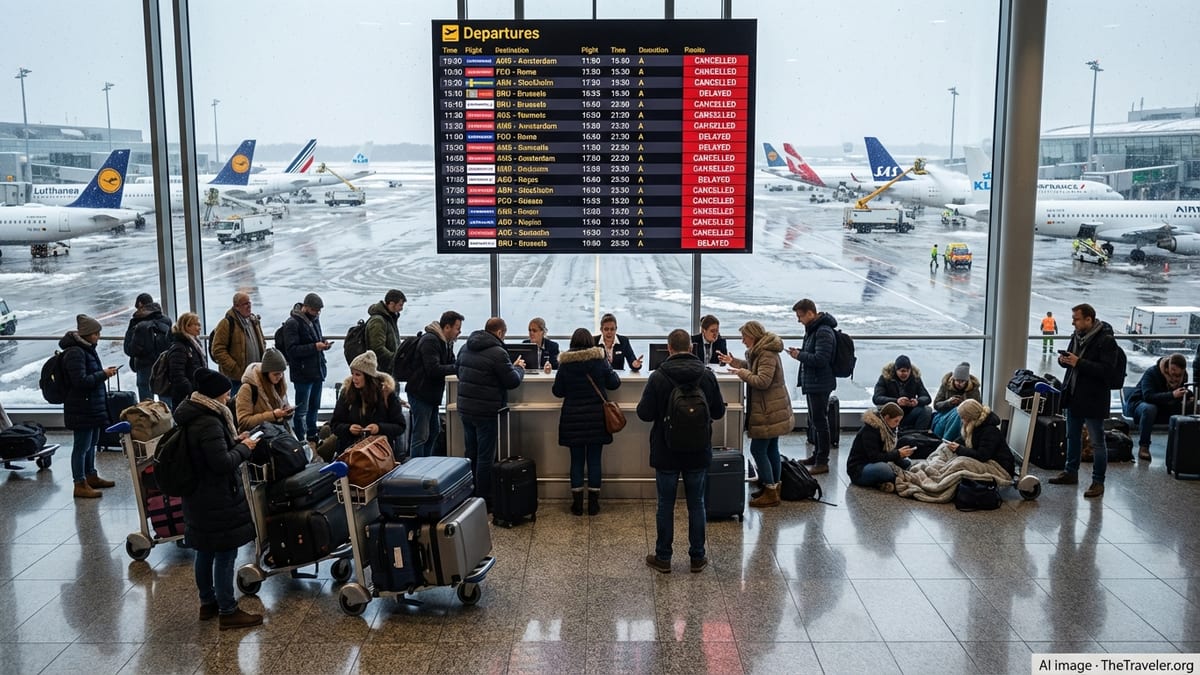
Snow and Strong Winds Slam Amsterdam and Stockholm
Harsh late-winter weather has again exposed the vulnerability of Europe’s busiest hubs, with Amsterdam Airport Schiphol and Stockholm Arlanda reporting fresh waves of cancellations and delays driven by snow, strong crosswinds and freezing temperatures. Flight-tracking and airport operations data on February 26 show Schiphol alone coping with dozens of cancellations and more than 70 delays as airlines trimmed schedules and slowed operations to maintain safety margins during de-icing and low-visibility procedures.
The latest disruption comes on the heels of January’s severe blizzards, when a powerful storm system brought heavy snow and gusts of up to 90 kilometres per hour to the Netherlands, forcing Schiphol to reduce runway capacity and cancel hundreds of flights in a single day. Airlines such as KLM and easyJet were hit particularly hard as ground handlers struggled to keep up with de-icing demands and ramp work was temporarily paused during the worst gusts.
In Scandinavia, Stockholm Arlanda has faced similar turbulence, with Swedish authorities and carriers working through repeated bands of snow since mid-February. On February 26, Arlanda registered a cluster of cancellations and more than 70 delays as ploughs worked to keep runways clear and aircraft queued for de-icing before departure. The knock-on effects were felt across the Nordic region and into continental Europe, especially on routes feeding Amsterdam, Paris and London.
Operational planners say that while airports across northern Europe are built to handle winter conditions, the combination of intense, fast-moving squalls with already stretched staffing levels has left little buffer in the system. When delays accumulate at hubs like Schiphol and Arlanda, connections to France, Italy and other destinations are quickly unsettled.
Italy’s Nationwide Aviation Strike Grounds Flights
If weather was the first blow to European travellers this week, industrial action in Italy delivered the second. A 24-hour nationwide strike in the aviation sector on February 26 prompted Italy’s flag carrier ITA Airways to cancel around half of its flight schedule, with easyJet crews in the country also joining the walkout. The action, called by a broad coalition of unions representing pilots, cabin crew, ground handlers and airport staff, effectively grounded large parts of Italy’s domestic and international network.
Major gateways including Rome Fiumicino, Milan Bergamo and Naples International reported substantial cancellations, with passengers arriving at terminals to find departure boards lit with red “annulato” notices. While Italian regulations require a limited number of flights to operate during protected time bands in the morning and early evening, airlines thinned out frequencies on many routes, particularly intra-European services that rely on tight turnarounds and connecting traffic.
Travellers on routes linking Italy with France, the Netherlands and Sweden were among the most affected. Morning links between Rome or Milan and Paris, Amsterdam and Stockholm were cancelled outright in many cases, while others operated with heavy delays or aircraft substitutions. Rail strikes scheduled to follow on February 27 and 28 have also raised fears that rebooked passengers could struggle to reach alternative airports or cities once flights resume in full.
Union leaders have framed the action as a response to what they describe as unsustainable workloads, pay pressure and uncertainty around staffing levels ahead of the Milano-Cortina 2026 Winter Olympics. Italian officials, meanwhile, have urged both sides to return to talks, warning that repeated walkouts risk undermining the country’s tourism recovery just as long-haul demand from North America and Asia shows signs of strengthening.
Belgium’s Strike Threat Adds a New Flashpoint
Compounding the immediate weather and strike disruption is the spectre of a nationwide general strike in Belgium on March 12, which Brussels Airport has warned could shut down almost all departing flights for a full day. Trade unions representing security staff, baggage handlers and other essential airport workers have filed 24-hour strike notices that, if fully observed, would leave airlines unable to board or dispatch aircraft, even if crews and jets are available.
Belgium’s role within Europe’s aviation ecosystem means the impact would extend well beyond its borders. Brussels and nearby Charleroi serve as key nodes for both full-service and low-cost carriers, feeding traffic to France, Italy, the Netherlands and Scandinavia. A near-total halt in departures would strand tens of thousands of passengers and disrupt carefully balanced aircraft rotations across the continent, particularly for carriers that use Belgian airports as crew bases or maintenance points.
Travel analysts note that a one-day shutdown can trigger several days of knock-on disruption as airlines reposition aircraft and clear backlogs. With Eurocontrol data already indicating higher-than-average delays across Europe in January, additional shocks to the network from Belgian industrial action could further strain on-time performance during a period when winter weather remains an ever-present threat.
Airports and airlines are urging passengers with March bookings through Belgium to monitor schedules closely and consider flexible itineraries. Some carriers are already offering free date changes or alternative routings via Paris, Amsterdam or Frankfurt to minimise the risk of travellers being caught in the middle of a nationwide stoppage.
Network Effects Across France, the Netherlands and Sweden
What began as country-specific challenges in Italy and Belgium is increasingly manifesting as a network-wide issue touching France, the Netherlands and Sweden. Paris airports have been grappling with elevated delay levels in recent weeks, driven by a mix of winter weather, high traffic volumes and staffing constraints. When partner hubs such as Amsterdam and Stockholm experience sudden capacity reductions, French airports absorb diverted flights and misaligned arrivals, adding further strain to slots and ground resources.
In the Netherlands, KLM and its SkyTeam partners are juggling a complex operational puzzle as they attempt to stabilise schedules out of Schiphol while also coping with disruptions to feeder routes from Italy and Scandinavia. Aircraft that would normally rotate through Rome, Milan or Stockholm are being rescheduled or parked, temporarily reducing capacity on some intra-European links and prompting last-minute equipment swaps.
Sweden’s carriers, notably SAS and Finnair on shared Nordic routes, have also felt the ripple effects. Disruption at Arlanda has cascaded into secondary airports, and delays on northbound flights from Amsterdam, Paris and London have in turn pushed back evening departures from Stockholm. For travellers, the result has been long waits at gates, missed connections and overnight stays at airport hotels from Gothenburg to Lyon.
Industry observers say these rolling disruptions illustrate how interconnected Europe’s aviation network has become. A snowstorm in the Netherlands or a strike in Italy now rapidly propagates across borders, particularly when events hit multiple hubs within days of one another.
Travellers Face Prolonged Uncertainty as Winter Continues
As February draws to a close, there is little sign that Europe’s air travel turbulence will abate immediately. Meteorological services are warning that further cold snaps and snowfall remain possible into March, particularly across northern Europe, meaning airports like Schiphol, Arlanda and their regional counterparts must remain on high alert for sudden capacity reductions.
At the same time, labour tensions show no sign of easing. Italy’s aviation and rail strikes, coupled with Belgium’s looming national stoppage and smaller actions in countries such as France and Spain, point to a winter dominated as much by industrial disputes as by weather systems. Eurocontrol’s latest figures already highlight a notable rise in average delay minutes per flight compared with last year, driven by a combination of adverse weather, staffing challenges and airspace congestion.
For travellers planning journeys between France, Italy, the Netherlands, Sweden and beyond, flexibility is increasingly essential. Airlines and airports are advising passengers to leave extra time for connections, keep contact details updated for real-time notifications and be prepared for last-minute gate changes or rebookings. Travel insurers, meanwhile, report growing interest in policies that specifically cover strike and severe-weather disruptions.
While Europe’s aviation sector has proved resilient through past winters and crises, the current convergence of snow, strikes and structural staffing pressures is testing that resilience anew. How quickly the network recovers in the coming weeks will shape not only late-winter getaway plans, but also confidence heading into the crucial spring and summer travel seasons.