

Alaska sits at the edge of the United States, but reaching it often runs straight through another country and several layers of border law. Confusing rules for crossing between the continental United States, Canada and Alaska, plus different documentation standards for cruises, flights and road trips, mean some travelers arrive with the wrong papers or the wrong assumptions. The result can be denied boarding, canceled vacations and unexpected detours at the very moment people hope to see glaciers, fjords and northern wildlife.
Why Alaska Travel Creates Unique Border Confusion
On a map, Alaska looks like another US state, simply detached and floating in its own box. In reality, the only overland route from the rest of the United States to Alaska crosses thousands of kilometers of Canadian territory. Many Alaska cruises call at Canadian ports such as Vancouver or Victoria, and even itineraries advertised as "Alaska" may start or end in Canada or another foreign country. These geographic quirks mean that what seems like a domestic trip often has international segments built in, with all the documentation requirements that entails.
Travelers who are used to flying domestically within the United States sometimes assume that the same relaxed documentation rules apply when they are heading to Anchorage, Juneau or Fairbanks. In fact, whether a trip to Alaska counts as domestic or international depends on how you get there. A direct US domestic flight between two US cities is one thing. A cruise that begins in Vancouver or a road trip along the Alaska Highway through Yukon is something else entirely, and it triggers both US and Canadian entry rules.
Because the legal framework behind these rules is complex and shifts over time, there is also a gap between what travelers remember from earlier trips and what is required today. Border agencies in both countries periodically tighten or clarify their standards, adjust hours at land crossings and introduce new electronic registration systems for longer stays. Even when changes are modest, partial information shared on social media or travel forums can fuel myths such as "the border is closed" or "you only need a driver’s license," which are not accurate for most Alaska itineraries.
These misunderstandings rarely make headlines unless a group is denied boarding for a cruise or turned around at a remote land border. Yet for the individuals involved, the impact is significant. A once-in-a-lifetime journey to see Alaska’s coastal fjords or Denali can end at a check-in counter if documents do not match the precise requirements for each stretch of the route.
Driving the Alaska Highway: Transit Through Canada
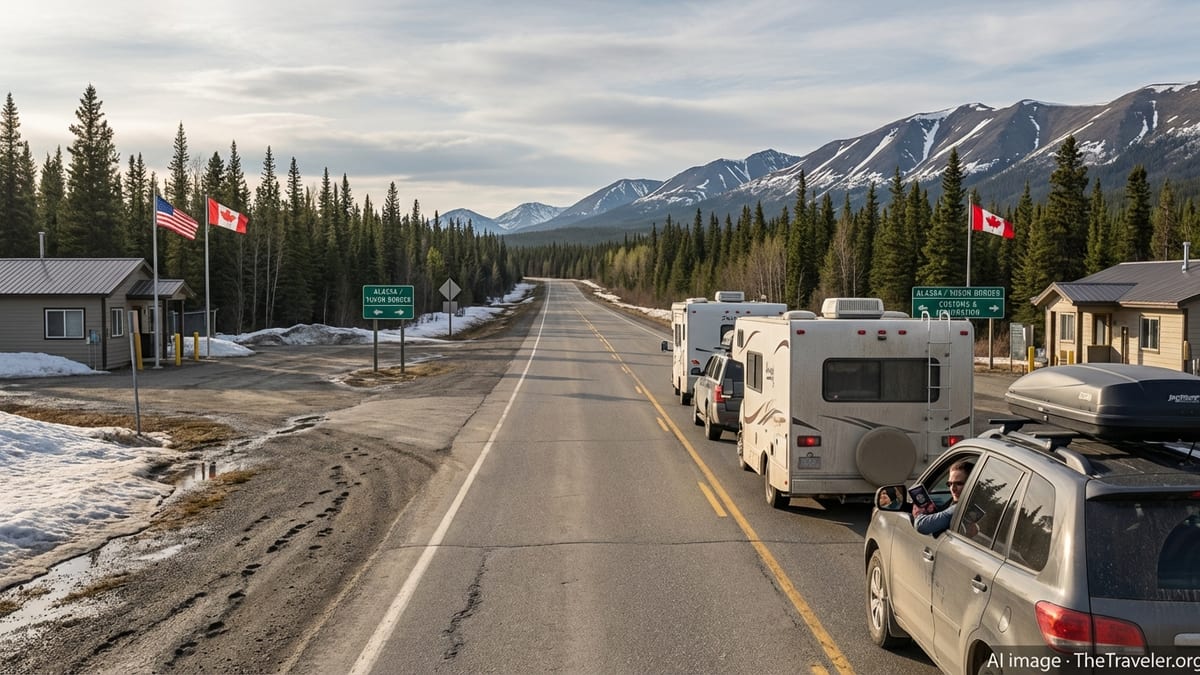
Road trips between the lower 48 states and Alaska are a classic North American adventure. However, they are also one of the biggest sources of confusion about US entry rules, because the route threads across the international border multiple times. Drivers who think of their trip as wholly domestic may forget that Canada is a separate country with its own immigration, customs and public safety rules. Canadian border officers expect US travelers to present proper identity documents, declare goods and meet any admissibility standards, even if motorists only plan to transit to Alaska.
The most common misconception is that a standard US driver’s license is always enough to drive to Alaska. For land travel between the United States and Canada, identification options vary. A regular license without any border designation may not satisfy Canadian entry rules or US return requirements in all cases. Depending on the state of issuance and direction of travel, an enhanced driver’s license, a passport book, a passport card, a trusted traveler card or other Western Hemisphere Travel Initiative compliant document may be necessary. Travelers also sometimes overlook the fact that children need their own proof of citizenship when crossing the border, not just a verbal assurance from parents.
Another point of confusion lies in the difference between entering Canada and re-entering the United States. Even if a Canadian border officer admits a traveler, US authorities at the Alaska border still perform an independent admissibility check when that person returns to US territory. People with past immigration violations, certain criminal records or prior overstays may find that they can transit one direction but face closer scrutiny, or even refusal, when they come back. Misunderstanding this two-step process can lead travelers to incorrectly assume that once Canada says yes, the United States automatically will as well.
Seasonal changes at some ports of entry have added a further layer of complexity. Canada and the United States periodically adjust operating hours at small land crossings to match traffic patterns and align staffing. That can surprise road trippers who rely only on older print guidebooks or word-of-mouth advice. Arriving at a closed crossing in a remote area can mean a lengthy detour to the next open port, a serious disruption in areas where fuel, lodging and food are spread thinly across long distances.
Cruise Itineraries: The Hidden International Segments
Alaska cruises are heavily marketed as an easy way to see glaciers and coastal towns without worrying about logistics. Promotional material often highlights the departure city, the scenery and the onboard amenities, but it may not emphasize that many sailings involve at least one foreign country. Cruises starting or ending in Vancouver or other Canadian ports are frequent, and even so-called closed loop cruises from a US port typically call at Canadian ports like Victoria or Prince Rupert. For immigration purposes, every country on the itinerary matters, even if passengers only set foot ashore for a few hours.
Some US citizens reasonably, but incorrectly, believe that because an Alaska cruise begins and ends in the United States, they will never need a passport. On certain closed loop sailings, cruise lines and US regulations may allow US citizens to board using a birth certificate combined with government-issued photo identification rather than a passport book. That can be acceptable when the trip begins and ends in the same US port. However, this approach leaves no margin for unexpected events. If a medical emergency, weather diversion or family crisis requires a passenger to fly from a Canadian port back to the United States, airline and border officials will require a valid passport book for international air travel. Travelers who opted against a passport to save money or time may then face delays or complicated arrangements.
Non US citizens face a different web of rules and are especially prone to misunderstanding Alaska cruise requirements. Citizens of many countries need a Canadian visitor visa or electronic authorization for even brief technical stops at Canadian ports, in addition to any US visa or travel authorization required for the portion of the cruise in US waters. Holding a valid US visa does not automatically satisfy Canadian authorities, and vice versa. Guests who assume that the cruise line will handle these formalities on their behalf can be surprised at boarding when they are asked to present evidence of both US and Canadian eligibility.
Travelers also sometimes misunderstand how US immigration law applies when a ship returns to a US port after visiting Canada. Re-entry into the United States is treated as a fresh admission, not a simple continuation of domestic travel. That means previous length of stay limits, visa classifications and security checks remain relevant. Visitors who are already close to the maximum time allowed in the United States may find that a short cruise to Alaska and back effectively ends their stay earlier than expected if officers consider the visit to have concluded at disembarkation.
Flying to Alaska: Domestic Tickets, International Rules
Air travel introduces another set of misunderstandings, because ticketing systems and airline marketing often label flights to Anchorage, Juneau or Fairbanks as domestic, especially when passengers connect through a US hub. For many itineraries that is accurate. A traveler who flies from Seattle to Anchorage on a nonstop US carrier, without changing planes in Canada, remains within the US system for border control purposes. Standard Transportation Security Administration checkpoint rules apply, but there is no passport inspection on arrival in Alaska.
Complications arise when the fastest or cheapest route to Alaska connects through a Canadian airport. Some flight search engines and booking sites still display such itineraries alongside purely domestic options without drawing attention to the extra border steps. Passengers may not realize that transiting through a Canadian airport can trigger Canadian entry requirements, even if they do not plan to leave the secure area. Depending on nationality, that can include an electronic authorization or visa, security screening under Canadian rules and the need for a passport book that is valid for international air travel.
Another misconception concerns documentation for re-entering the United States by air at the end of a journey that included Canada. US citizens must present a valid US passport book at international airline check in, regardless of whether the final destination is Alaska or another state. Relying on a passport card, enhanced license or other land border document can cause issues if an airline agent follows global aviation standards and insists on a traditional passport booklet, which remains the most widely accepted travel document.
For foreign visitors, Alaska flights that route through Canada can interact in complicated ways with visas or electronic travel authorizations they hold for the United States. A person traveling under a visa waiver program, for example, still needs valid authorization tied to their passport at the time they re-enter the United States after visiting or transiting Canada. Failing to keep track of validity dates, number of permitted entries and total days in the country can lead to awkward conversations with border officers when returning from a side trip or layover on the way to or from Alaska.
New Registration Rules and Longer US Stays
In recent years, US authorities have introduced additional registration and reporting obligations for some categories of foreign travelers who spend extended time in the United States. These rules do not target Alaska specifically, but they can affect long road trips, seasonal work, extended RV stays and cruise itineraries that use Alaska ports. Under a policy that took effect in 2025, for example, some visitors who cross the land border and stay more than a set number of days are required to complete an electronic registration with US authorities. Travelers who previously treated extended visits as casual, low paperwork experiences may not realize that their stay now comes with more formal tracking.
Several allied countries, including Canada and some European nations, have updated their travel advisories to emphasize that US entry rules are being enforced more strictly. These advisories encourage citizens to learn about any registration or notification requirements before they travel, especially if they plan to remain in the United States for longer than a short holiday. For people heading to Alaska by road or on long cruises, that guidance is particularly relevant, because itineraries can stretch to many weeks or months.
The connection to Alaska becomes clear when looking at common travel patterns. Retirees who spend a summer driving an RV from the lower 48 states through Canada to Alaska and back may cross the border several times and accumulate a long total stay in US territory. Seasonal workers in Alaska’s tourism and fishing industries, many of whom arrive on temporary visas, can also be affected by new registration expectations. Misunderstanding the rules, or assuming that short individual border crossings are invisible to the system, risks placing otherwise law abiding travelers technically out of compliance.
Official guidance emphasizes that these measures do not change the core eligibility criteria for visiting the United States, but they do increase the importance of record keeping and honest communication with border officers. For Alaska bound travelers, the lesson is that the physical remoteness of the destination does not translate into looser oversight. If anything, complex routes and longer itineraries make it more crucial to pay attention to how long one has been in the country and under what status.
Documentation Pitfalls: Small Details, Big Consequences
Many misunderstandings around US entry rules for Alaska stem not from dramatic policy changes but from small details that travelers overlook. One recurring issue is the difference between a passport book and a passport card. The card is limited to certain land and sea crossings in North America and is not valid for international air travel. This distinction can catch out budget conscious travelers who obtain only a passport card for an Alaska cruise or road trip, then discover that a medical diversion, canceled sailing or missed connection forces them to book a flight home from a Canadian or Alaska airport that handles mixed domestic and international traffic.
Another detail involves the validity period of passports and visas. Some countries and carriers follow policies that encourage or require passports to remain valid for a certain number of months beyond the end of the trip. While US border officials have some discretion, airline staff and cruise lines often apply rigid cutoffs to avoid liability. An Alaska itinerary that includes remote ports and few alternative transport options is a poor place to discover that a document will expire too soon. Travelers sometimes assume that because tickets were issued, every document must already be acceptable, when in fact carriers may not recheck until the day of departure.
Parents traveling with children can also encounter surprises. Rules for minors at land borders, on cruises and on flights are not identical. In some scenarios a birth certificate may suffice, while in others a passport is expected. Additional documentation may be requested to prove parental consent when one parent or another adult is traveling alone with a child. Misunderstanding these nuances can be especially stressful when a family is standing at the gangway of a ship or the entrance to a remote border post with limited services nearby.
Finally, travelers often underestimate the seriousness of secondary inspection. If a border or immigration officer at a port serving Alaska asks additional questions, examines luggage or checks electronic devices, that does not necessarily mean a rule has been broken. However, providing inconsistent answers about route, length of stay or purpose of travel can reinforce an impression that the traveler does not understand, or is trying to circumvent, the entry rules. Clear, calm explanations and accurate documentation usually resolve such encounters more quickly and with fewer consequences.
How to Plan an Alaska Trip Without Border Surprises
Avoiding misunderstandings about US entry rules for Alaska begins well before departure. Travelers benefit from looking at their itinerary as a chain of segments, each with its own border implications, rather than as a single block labeled "Alaska vacation." That means checking not only where the trip starts and ends, but also every port of call, airport and land crossing in between. If even one segment leaves US territory, travelers should assume that full international documentation rules may apply unless an official source clearly states otherwise.
Checking requirements directly with official government sources and transportation providers is particularly important because rules can change with relatively little media attention. Border agencies in both the United States and Canada update their guidance and travel tips online, including notes about busy periods, adjusted hours and preferred documents. Cruise lines, airlines and tour operators usually post updated documentation advisories for each itinerary, often highlighting differences between US citizens, citizens of Canada and other foreign nationals.
It is also wise to build extra time into any journey that involves multiple border crossings on the way to or from Alaska. Weather, seasonal traffic and security demands can all lengthen processing times. Trying to make tight connections through Canadian airports or briskly scheduled cruise embarkations leaves little room to resolve paperwork questions. For routes that include small land border crossings in remote areas, travelers should confirm the latest operating hours and identify alternative crossings in case of unexpected closures or congestion.
Finally, carrying more documentation than the bare minimum offers a cushion against the unexpected. Even when a birth certificate or local identification might technically suffice for a particular leg of the trip, a full passport book, printed copies of key reservations and proof of employment or residence in the home country can provide reassurance to both travelers and border officers. The cost and inconvenience of securing those items before departure tend to be small compared with the disruption of a denied boarding or forced itinerary change at the edge of North America.
The Takeaway
Alaska’s remoteness, spectacular scenery and position on the map all contribute to its enduring appeal. Yet those same qualities also mean that reaching it often involves crossing borders under rules that differ from ordinary domestic travel. Misunderstandings arise when travelers assume that because Alaska is part of the United States, every route there will follow simple, familiar procedures, or when they rely on outdated information from before recent shifts in border enforcement and registration practices.
For would-be visitors, the key is to recognize that a trip labeled "Alaska" may actually be a complex international itinerary involving both US and Canadian ports, multiple modes of transport and extended time in the country. Treating border planning as a core part of the journey, not a last-minute detail, significantly reduces the risk of unpleasant surprises. With the right documents and realistic expectations, the entry rules that now trip up some travelers become another manageable element of adventure in the far north.
FAQ
Q1. Do I need a passport to visit Alaska if I am a US citizen?
For purely domestic flights between US cities a passport is not usually required, but any route that involves Canada or other foreign ports can require a valid passport book.
Q2. Can I drive from the lower 48 to Alaska using only my driver’s license?
Not always. You must meet both Canadian and US border requirements, which often means carrying a passport, enhanced license or other approved document for land crossings.
Q3. Are Alaska cruises considered domestic or international travel?
Many Alaska cruises include Canadian ports or start or end in Canada, so they count as international travel even if marketed as Alaska itineraries from a US perspective.
Q4. What is the difference between a passport book and a passport card for Alaska trips?
A passport book works for almost all scenarios, including flights. A passport card is limited to certain land and sea crossings and is not valid for international air travel.
Q5. Do foreign visitors need both US and Canadian visas for some Alaska trips?
Often yes. If your route or cruise includes Canadian ports you may need authorization for both countries, depending on your nationality and mode of travel.
Q6. If my Alaska flight connects through Canada, do I have to clear Canadian immigration?
In many cases connection routes require meeting Canadian entry or transit rules, including valid travel documents, even if you do not leave the secure airport area.
Q7. Are there special US registration rules for long road trips or RV stays that include Alaska?
Some longer visits can trigger additional US registration or reporting requirements for foreign nationals, so extended travelers should review current official guidance before departure.
Q8. Can children travel to Alaska on a cruise without a passport?
On some closed loop US cruises children may board with a birth certificate, but a passport is strongly recommended in case of emergencies or unexpected air travel.
Q9. What happens if my documents are not accepted at a border on the way to Alaska?
You may be delayed, rerouted or denied boarding or entry, and in many cases costs from missed cruises or flights are not refundable by carriers or tour operators.
Q10. How can I make sure I have the right documents for my Alaska itinerary?
Review each segment of your trip, check official US and Canadian government resources and confirm documentation requirements with your airline, cruise line or tour provider before travel.