

More news on this day
Southwest Airlines scrapped 292 flights and delayed at least 368 more across the United States on Monday, as a powerful late‑February winter storm crippled major East Coast hubs and sent disruption rippling through airports from New York City and Baltimore to Orlando, Atlanta and beyond.
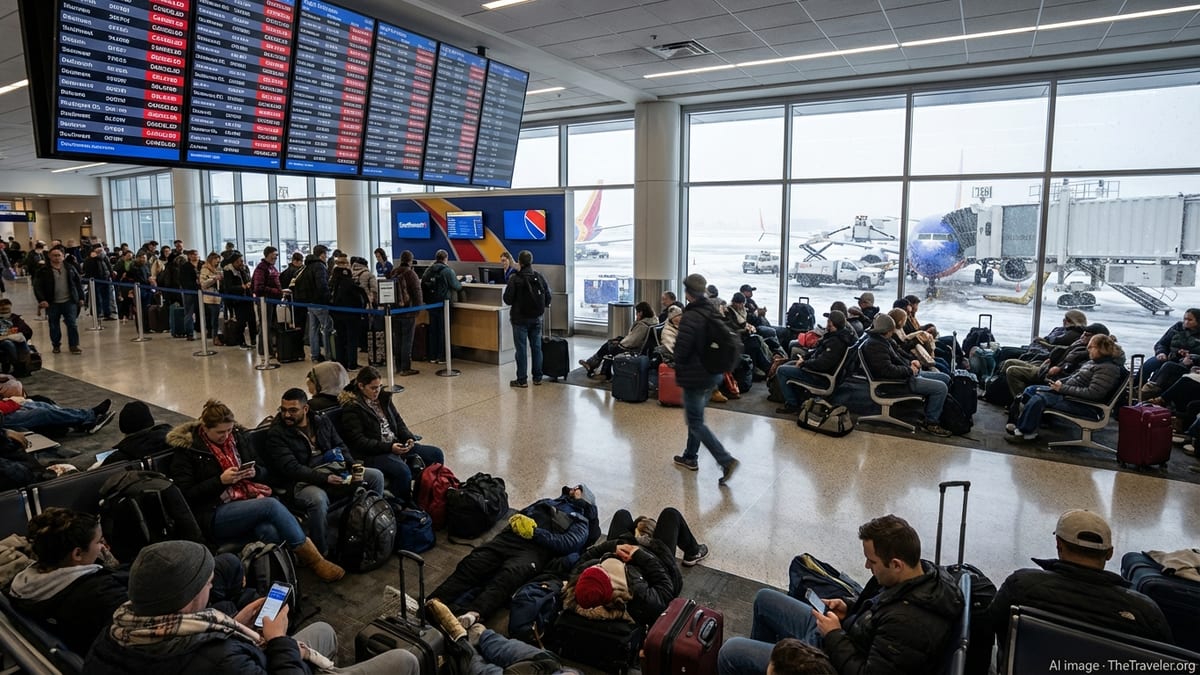
Storm-Driven Disruptions Hit Southwest’s Nationwide Network
The latest disruption comes as a fast-intensifying nor’easter brings blizzard conditions to the Northeast corridor, forcing thousands of cancellations across all major U.S. carriers. Flight-tracking data on Monday showed more than 5,000 flights canceled nationwide, with Southwest’s 292 cancellations and hundreds of delays forming a significant share of the chaos as the carrier contended with grounded operations at key East Coast gateways.
While the worst of the weather is centered on New York, New Jersey, New England and the Mid-Atlantic, the impact on Southwest’s point-to-point network has quickly spread into the Southeast and across the country. Aircraft and crews that were scheduled to rotate through storm-battered airports early in the day have been left out of position, triggering rolling delays in places where the skies are clear but the schedule is no longer intact.
Southwest has issued systemwide travel alerts for customers booked to and through affected cities, urging passengers to check their flight status frequently and take advantage of flexible rebooking options. In many cases, travelers are being allowed to move their trips to later in the week without change fees, though available seats are tightening as the airline works to consolidate operations around the worst of the storm.
New York City And Mid-Atlantic Hubs Bear The Brunt
Nowhere is the pressure on Southwest’s schedule more visible than in the New York metropolitan area, where nearly all departures at LaGuardia, John F. Kennedy and Newark were wiped from Monday’s boards as whiteout conditions, high winds and low visibility made safe operations nearly impossible. Although Southwest’s own footprint in New York is smaller than some rivals, the near shutdown of the region’s airspace has forced widespread rerouting and last-minute cancellations of connecting flights throughout its network.
Further south, Baltimore/Washington International Thurgood Marshall Airport has emerged as one of the hardest-hit Mid-Atlantic hubs, with more than a hundred flights canceled and additional delays rippling through the day. For Southwest, which relies heavily on Baltimore as a connecting point linking the Northeast with Florida, the Midwest and the South, those cancellations have effectively severed a key artery for domestic travel along the East Coast.
Travelers at Baltimore reported crowded terminals, long customer-service lines and departure boards dominated by red cancellation notices. Many Southwest customers arriving from unaffected cities found that their onward flights to New York, Boston or smaller regional airports had already been scrubbed, leaving them scrambling for hotel rooms or alternate routings through less congested hubs in the Midwest and Southeast.
Florida And Southeast Gateways See Knock-On Chaos
Even hundreds of miles from the storm center, airports in Florida and the Southeast have seen a mounting toll of disruptions as the day wears on. Orlando International Airport reported dozens of cancellations tied to the nor’easter, while Tampa, Fort Myers and other regional gateways also recorded double-digit cancellation rates as flights bound for the Northeast were pulled from the schedule.
Southwest, a major player in Florida leisure markets, has been forced to cancel or retime multiple departures to New York, Baltimore, Philadelphia and Boston, leaving vacationers and homebound travelers unexpectedly grounded under sunny skies. Similar patterns have emerged in Atlanta, where a combination of weather-related reroutes and airspace constraints up the coast has added strain to an already busy schedule at one of the country’s primary connecting hubs.
For many passengers, the most frustrating part of Monday’s disruption has been the unpredictability. Flights that initially appeared on time early in the morning slipped into extended delay status before eventually being canceled outright, as crews timed out and aircraft became unavailable. In airport concourses from Orlando to Atlanta, Southwest agents spent the day alternately rebooking travelers onto later departures and advising others that they might not be able to leave until midweek.
Passengers Face Long Waits, Limited Options And Packed Rebookings
The scale of the nor’easter has left stranded Southwest customers with fewer fallback options than they might have during a more localized weather event. With most carriers canceling large portions of their East Coast schedules, alternative flights on other airlines have quickly sold out or ballooned in price, making it difficult for travelers to simply switch carriers and continue their journeys.
Inside terminal buildings, scenes were reminiscent of previous major winter storms, with passengers camping out on the floor near power outlets, families clustered around baggage carts piled high with luggage, and serpentine queues forming at customer-service counters. Some travelers reported holding times of more than an hour to reach Southwest reservations by phone, prompting many to turn to airline apps and airport kiosks in search of faster rebooking options.
Hotel inventory near major airports has also tightened as delayed travelers look for somewhere to stay overnight. In both New York and Baltimore, airport hotels filled rapidly on Sunday night and early Monday, leaving late-arriving passengers to look farther afield for accommodation. With the storm expected to continue affecting operations into Tuesday, Southwest staff have been advising customers to secure lodging early and to keep receipts in case of eligibility for partial reimbursement under the airline’s customer-service policies.
Recovery Could Take Days As Crews And Aircraft Reposition
While the worst of the storm is forecast to move away from the New York region within the next 24 to 36 hours, aviation analysts warn that the operational hangover for airlines like Southwest could linger well into the week. With hundreds of aircraft and crews scattered away from their planned positions, Monday’s cancellations and delays are likely to cascade into Tuesday and potentially Wednesday as the airline works through the backlog.
Southwest will have to balance the need to restore its schedule quickly with ongoing weather and air-traffic constraints along the East Coast. Even as conditions improve on the ground, it can take time for the Federal Aviation Administration to lift flow restrictions and for airlines to clear the accumulation of displaced aircraft and out-of-hours crews. In practice, that often means further short-notice cancellations of lightly booked flights so that resources can be concentrated on the busiest routes.
For travelers, the message from airline and airport officials is to build flexibility into their plans. Passengers with nonessential trips have been encouraged to consider postponing travel until later in the week, when operations are expected to be more stable, and to make full use of fee-free change options. Those who must travel on affected days are being urged to monitor their flights closely, arrive early at the airport and be prepared for possible last-minute gate changes or rolling delays as Southwest and other carriers navigate one of the most disruptive winter weather events of the season.