


Spain and Germany are two of the most discussed European destinations for remote workers. Both offer advanced digital infrastructure and large cities with established coworking ecosystems, but their regulatory approaches, work culture and everyday conditions for location‑independent professionals differ significantly. This briefing compares Spain and Germany specifically through the lens of remote work practicality, to support relocation decisions for employees and self‑employed professionals whose work is primarily online.
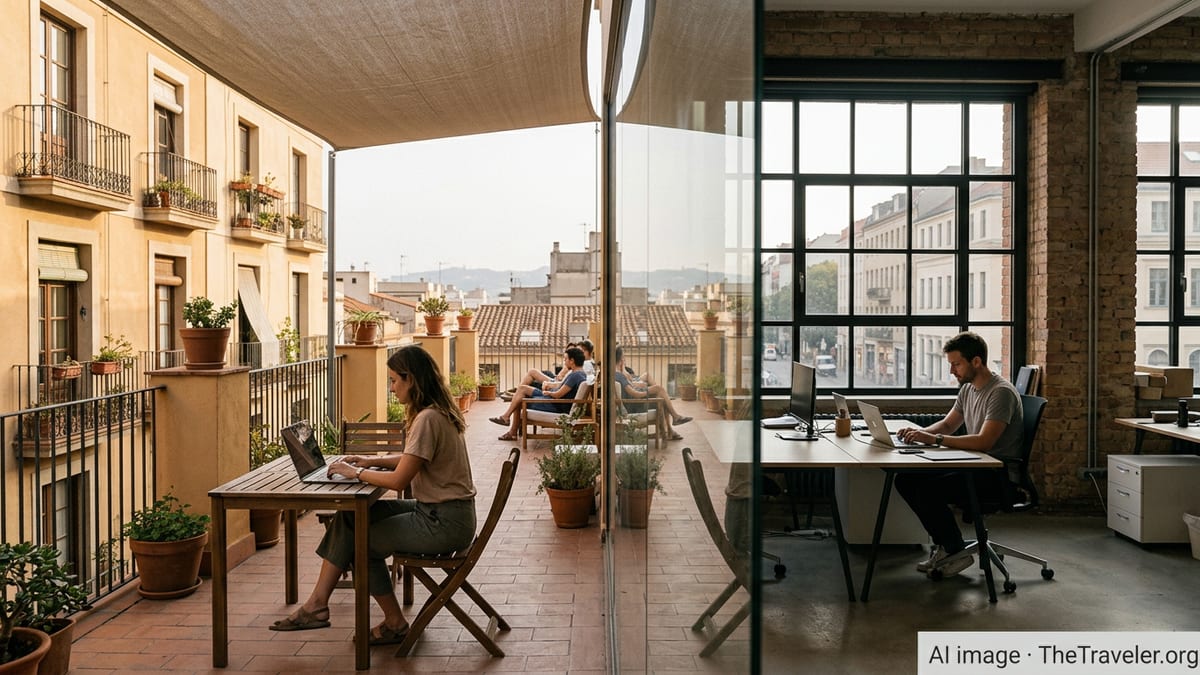
Overall Remote Work Environment
Both Spain and Germany are mature, high‑income economies where remote work is widely recognized and supported by employers, especially in knowledge‑intensive industries. In both countries, remote work expanded rapidly during the pandemic and has since stabilized into hybrid models for many organizations. Major urban centers such as Madrid, Barcelona, Berlin and Munich now support substantial populations of remote workers and digital professionals.
Spain has gone further in branding itself as a destination for remote workers, with national and regional initiatives aimed at attracting digital professionals and improving connectivity even in smaller cities. This has led to visible growth in coworking spaces, coliving projects and remote work hubs in secondary locations. Germany has been more cautious and company‑centric, focusing on employer regulation rather than actively marketing itself to international remote workers, but its strong corporate sector provides stable demand for hybrid and home‑office arrangements.
For a typical remote worker whose productivity depends on reliable connectivity and access to professional workspaces, both countries can provide an adequate environment in major cities. The main differences emerge in legal protection for remote work, flexibility of employer policies, and the quality and availability of infrastructure outside the largest metropolitan areas.
When evaluating overall suitability, Spain tends to favor flexibility and lifestyle‑oriented remote work ecosystems, while Germany offers a more conservative but highly structured corporate environment where remote work exists primarily within formal employer frameworks.
Digital Infrastructure and Connectivity
Spain currently ranks among the European leaders in fiber‑to‑the‑home coverage, with very high penetration in urban and many semi‑urban areas. Industry analyses consistently place Spain near the top of EU charts for fiber deployment, reflecting years of targeted investment by telecom operators. This means that in most Spanish cities, remote workers can expect high‑bandwidth fixed connections with sufficient speeds for video conferencing, cloud work and heavy data usage, often via widely available FTTH services.
Germany offers robust overall connectivity, but its fixed broadband infrastructure is more uneven. While large cities and prosperous regions generally have strong broadband and growing fiber availability, parts of the country still rely on slower DSL connections. Reports from Germany’s federal agencies and think tanks highlight a persistent urban‑rural divide, where smaller towns and rural areas lag behind in high‑speed fixed internet deployment. For remote workers who expect to base themselves outside major cities, this variability in German infrastructure requires more granular location‑specific due diligence.
In mobile connectivity, both countries provide extensive 4G coverage and expanding 5G networks through major carriers. For urban remote workers who rely on mobile hotspots or tethering as a backup, the practical experience in major Spanish and German cities is largely comparable, with strong coverage and adequate speeds in most built‑up areas. However, anecdotal and survey data indicate that Spain’s combination of strong fiber in homes and good mobile networks is particularly attractive for remote workers who may frequently move between apartments, coworking spaces and public venues.
From a risk management perspective, Spain currently offers a more consistently high standard of fixed connectivity across a broad range of urban locations, while Germany provides high quality in key cities but requires more careful selection of neighborhood or town to guarantee comparable speeds.
Coworking Ecosystems and Workspaces
Both Spain and Germany host dense coworking ecosystems in their major urban centers, but their structure and distribution differ. Spain’s largest cities feature a mix of international brands and local operators, supplemented by a growing number of regional hubs in smaller coastal and inland cities. The growth of Spain’s remote work positioning has encouraged development of coworking and coliving spaces in mid‑sized cities and even in some rural areas, giving remote workers a broader geographic choice while retaining access to professional office infrastructure.
Germany’s coworking market is heavily concentrated in major metropolitan regions such as Berlin, Munich, Hamburg and Frankfurt. These cities host extensive coworking options provided by global chains and local operators, often targeting startups and corporate innovation teams. Outside these hubs, coworking facilities exist but are less dense, and remote workers are more likely to rely on home offices or employer‑provided satellite spaces rather than open community coworking centers.
In practical terms, remote workers in Spain may find it easier to combine professional workspace access with residential options in a wider range of cities, as coworking has been leveraged as part of local development strategies. In Germany, the coworking offer is excellent in core cities but more limited in smaller locations, which can affect remote workers who are considering living in quieter areas while still wanting shared office facilities and networking.
For individuals who depend heavily on coworking not only for infrastructure but also for community and collaboration, Spain’s broader geographic distribution of such spaces offers additional flexibility. Germany, by contrast, remains strongest for remote workers who choose to base themselves in a small number of high‑density business hubs where coworking markets are fully developed.
Legal and Regulatory Framework for Remote Work
Spain has enacted a detailed statutory framework regulating remote work. Royal Decree‑Law 28/2020 and subsequent Law 10/2021 on remote work define what constitutes regular remote activity, set thresholds for when the law applies, and establish rights and obligations for both employers and employees. The legislation generally applies when at least around one third of working hours are performed remotely over a reference period, and it covers issues such as written remote work agreements, provision and maintenance of equipment, cost reimbursement, equal treatment and health and safety obligations in the remote workspace.
Spanish law also incorporates a clearly defined right to digital disconnection, developed through data protection legislation and labor law. Employers must establish internal policies that protect workers from expectation of availability outside agreed working hours, particularly in remote work contexts where boundaries can blur. Recent updates have reinforced enforcement possibilities if companies fail to implement meaningful disconnection policies. For remote workers, this framework can provide a degree of protection against perpetual connectivity and over‑extension of working time, especially in formal employment relationships.
Germany, in contrast, does not yet provide a single, comprehensive statute specifically guaranteeing a general right to work remotely. German law distinguishes between telework arrangements and more flexible mobile work, with detailed occupational health and safety rules applying to formal teleworkstations set up in private homes. For mobile work or informal home office arrangements, regulation is more fragmented, relying on general working time rules and individual or collective agreements. There is ongoing policy discussion regarding potential statutory rights to request home office, but as of early 2026 no universal legal entitlement has been fully implemented.
This difference means that Spain offers a more codified and worker‑protective remote work regime at the national level, while Germany’s framework is more dependent on individual contracts, company policies and works council agreements. Remote workers in Spain can typically rely on statutory rights regarding written agreements, expense compensation and digital disconnection, whereas remote workers in Germany may need to negotiate such conditions directly with employers or rely on sectoral agreements where they exist.
Employer Practices, Flexibility and Culture
Employer approaches to remote work differ in line with each country’s broader labor culture. In Spain, the legal framework makes remote work a voluntary arrangement that usually requires mutual agreement between employer and employee, but in practice many knowledge‑sector employers remain open to hybrid models, particularly in technology, consulting and international services. At the same time, some Spanish organizations are gradually encouraging more office presence, reflecting concerns about team cohesion and management oversight, but statutory rights around telework and disconnection give employees a firm reference point for negotiation.
In Germany, employer practices are strongly shaped by traditional expectations of presence and by detailed internal policy frameworks. Many large firms have structured hybrid work programs that define how many days per week staff can work from home, often in consultation with works councils. However, anecdotal evidence and practitioner commentary indicate that employers can and do adjust these arrangements over time, and workers may have limited legal recourse if a company decides to reduce or revoke home office options, unless a contractual right has been explicitly agreed.
For remote workers who prioritize long‑term certainty that their role can remain largely location‑independent, Spain’s combination of statutory protections and widespread acceptance of remote arrangements can be attractive, particularly when roles are designed as remote from the outset. Germany can offer highly structured arrangements with clear expectations, but the ultimate level of flexibility tends to be more employer‑driven and may be narrowed if strategic priorities shift.
Overall, Spain may provide a more accommodating environment for workers who want to anchor their careers in explicitly remote or hybrid roles, whereas Germany is better suited to individuals comfortable operating within large organizations where remote work is one tool among many and may be subject to periodic revision.
Daily Working Conditions for Remote Professionals
Daily working conditions for remote professionals in both countries are influenced by time zone alignment, availability of quiet residential workspaces and the prevalence of public places designed to accommodate laptop workers. Spain’s position in Central European Time, with some corporate operations informally tending toward later working hours, can align well with global teams that need overlap with both European and some American time zones. Cafes and coworking spaces in major Spanish cities are often arranged to welcome laptop workers for sustained periods, supported by good Wi‑Fi and flexible seating.
Germany offers a more standardized business schedule with earlier starts and clearer separation between working and non‑working time, reflecting strongly enforced working time regulations. For remote workers who prefer predictability and clear boundaries, this environment can be advantageous. However, remote workers relying on cafes and informal public workspaces may find somewhat stricter norms regarding laptop use in certain venues, compared with the more visibly remote‑work‑oriented environments in Spanish urban centers.
Housing conditions also interact with remote work feasibility, as adequate home office space and acoustic separation are essential for productivity. In both Spain and Germany, apartment quality and layout vary widely by city and price segment, but Germany’s housing stock often includes well‑insulated units with reliable heating and soundproofing, which can be beneficial for phone and video calls. In Spain, especially in older buildings, remote workers may need to pay particular attention to climate control and sound conditions when assessing potential apartments for full‑time home office use.
For remote workers whose success depends on a mix of home office reliability and access to third‑party workspaces, Spain’s more visibly remote‑worker‑oriented urban environment and extensive fiber coverage provide strong advantages, while Germany offers robust, structured working norms and generally high housing standards that can support a dedicated home office, particularly for those who secure suitable accommodation.
The Takeaway
Remote workers assessing Spain versus Germany should focus on how each country’s infrastructure, legal framework and employer culture align with their specific working style and risk tolerance. Spain currently offers a more explicit and protective statutory regime for remote work, very strong fiber connectivity in most urban locations, and a widely distributed coworking ecosystem, making it particularly attractive for individuals who want formal recognition of remote work rights and flexibility to choose among several cities or regions.
Germany provides excellent digital and physical infrastructure in its main urban centers, a strong corporate environment and clear general labor regulations, but it has not yet embedded remote work into law to the same degree as Spain. Remote work conditions in Germany are therefore more dependent on company policy and individual contracts, and the quality of fixed broadband can vary more sharply between urban and rural areas.
For remote workers who prioritize legal protections around remote work, broad geographic choice of well‑connected locations and a visible ecosystem built around location‑independent professionals, Spain has a relative edge. For those who value structured corporate environments, stable large‑employer careers and are willing to base themselves in major cities where connectivity and coworking options are strongest, Germany remains a solid, if more traditionally oriented, base.
FAQ
Q1. Which country offers stronger legal protection specifically for remote workers, Spain or Germany?
Spain currently offers stronger and more explicit legal protection for remote workers, through national legislation that regulates telework, requires written agreements and enforces the right to digital disconnection.
Q2. Is home internet connectivity generally more reliable for remote work in Spain or Germany?
In major cities both countries are reliable, but Spain has broader fiber‑to‑the‑home coverage across many urban areas, giving it a relative advantage in consistent high‑speed fixed connectivity.
Q3. Where will I find a denser network of coworking spaces as a remote worker?
Both Spain and Germany have extensive coworking in their largest cities, but Spain has a more widely distributed network that also covers many mid‑sized cities and some smaller hubs.
Q4. Does either country guarantee a legal right to work from home?
Spain regulates telework in detail but still treats it as voluntary and based on agreement; Germany does not yet provide a universal legal entitlement to work from home and leaves much to employer policy and collective agreements.
Q5. Which country is better for remote workers who need to live outside major cities?
Spain may be more practical for remote workers in smaller cities due to stronger fiber coverage and intentional development of regional coworking hubs, whereas Germany’s infrastructure is more uneven outside core metropolitan areas.
Q6. How do employer attitudes toward remote work differ between Spain and Germany?
Spanish employers in knowledge sectors often integrate remote work as a standard option supported by national law, while German employers typically offer structured hybrid models that can be more conservative and subject to change based on company strategy.
Q7. Are there significant differences in daily working patterns for remote workers?
Spain often operates with somewhat later working hours and a high level of informal support for laptop work in public venues, while Germany emphasizes earlier, more standardized schedules and clearer separation of work and private time.
Q8. Which country offers a more established community of international remote workers?
Both have sizable international communities, but Spain has positioned itself more directly as a remote worker destination, resulting in a particularly visible presence of international remote professionals in several cities.
Q9. How important is the legal right to digital disconnection for remote workers choosing between these countries?
For remote employees concerned about overwork and constant availability, Spain’s codified right to digital disconnection can provide additional security compared with Germany, where such protections are less specifically tied to remote work.
Q10. If my work is fully location‑independent, which country generally offers more flexibility for choosing where to live?
Spain generally offers more flexibility due to widespread high‑speed connectivity and coworking options in a wide range of cities, allowing remote workers to choose locations based more on personal preference without sacrificing work infrastructure.