

More news on this day
With spring break 2026 colliding with record passenger volumes, a partial government shutdown and severe TSA staffing shortages, travelers across the United States are confronting some of the longest airport security lines in recent memory.
Get the latest news straight to your inbox!
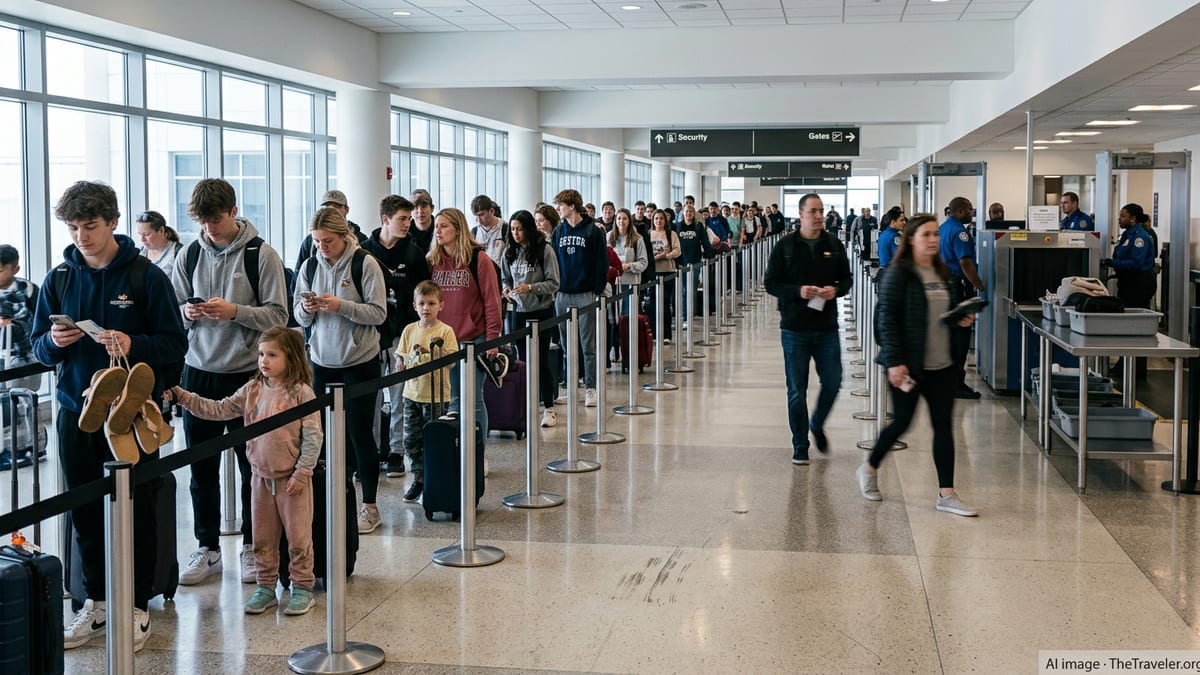
Record Crowds Meet Uncertain Airport Operations
Airlines and airport operators are preparing for what industry groups describe as a record spring travel season, with U.S. carriers expecting more than 170 million passengers over the broader spring period. That surge is now intersecting with TSA staffing shortfalls tied to the federal funding impasse, creating unpredictable wait times that can jump from single digits to hours over the course of a day.
Recent coverage from major hubs including Atlanta, Chicago and Houston describes early morning waits at checkpoints stretching beyond an hour, with some travelers missing flights despite arriving well before departure. In some cities, storms and flight disruptions have pushed even more passengers into already strained terminals, compounding the pressure on security lanes.
At the same time, not every airport is seeing the same level of disruption. Regional airports and certain secondary hubs report more manageable lines, even as nearby major hubs struggle. For travelers, that patchwork pattern means traditional rules of thumb about when to arrive at the airport are less reliable, making advance planning and real-time information more important than in previous spring break seasons.
Airport operators are responding with temporary queue expansions, additional signage and adjusted staffing where possible, but many emphasize that security screening capacity has hard limits when large numbers of officers are absent. The result is a spring break environment in which passengers play a larger role in keeping their own itineraries on track.
Timing Your Airport Arrival in a Volatile Season
Advice on when to arrive at the airport has grown more nuanced this spring. Some large hubs continue to recommend that domestic passengers plan to be in the security line at least three hours before departure during peak spring break days, especially in the early morning bank of flights. In contrast, other airports report that travelers arriving excessively early are contributing to crowding at choke points.
For passengers, this means treating the standard two-hour rule as a baseline and then layering on local information. Checking an airport’s social feeds and media coverage on the day of travel can provide clues about current wait times, closures of specific checkpoints or shifts in peak periods. If a hub is reporting hour-long lines or temporary lane closures, adding extra buffer time becomes a sensible precaution.
Departure time also matters. Reports suggest that the longest lines this spring often form in the early morning when many flights depart in quick succession, and again in late afternoon when irregular operations and rolling delays bring more people into the terminal at once. Travelers who have flexibility may find that mid-morning or mid-afternoon departures are less congested, particularly at airports where airlines have more evenly spread their schedules.
Families and groups should factor in their own pace when deciding when to arrive. Traveling with young children, mobility devices, sports equipment or large amounts of carry-on luggage can add minutes at each step of the journey, from parking shuttles to document checks, making extra time at the front end a practical form of insurance.
Using Technology to Track TSA Lines in Real Time
As line lengths fluctuate from hour to hour, real-time tools have become central to navigating security checkpoints. The MyTSA app and similar airport-specific services provide crowd-sourced or sensor-based estimates of current wait times, often broken down by checkpoint and by standard versus expedited screening. Travel coverage this month has highlighted examples where these tools showed double-digit waits at one checkpoint while another entrance in the same terminal moved much faster.
Major airports also publish security updates through terminal displays and public address announcements, directing travelers toward underused lanes. Some facilities now use dynamic signage just outside checkpoints to show approximate waits, giving passengers one last chance to choose a shorter line before committing.
Frequent flyers and travel analysts recommend checking these tools before leaving home and again en route, since conditions can change quickly when flights are delayed or officers call out at the start of a shift. For those connecting through large hubs, pulling up security wait data during descent or on the jet bridge can inform decisions about whether to move quickly to the next checkpoint or stop first at concessions.
At airports where security technology is in transition, travelers may notice new scanners or identification systems that can slightly alter the pace of lines. Reports indicate that some checkpoints with upgraded equipment process passengers more quickly once travelers are familiar with procedures, while others may slow temporarily during the adjustment period. Paying attention to on-site instructions can help keep these new systems flowing smoothly.
Maximizing the Value of Expedited Screening Programs
In a season of long lines, programs such as TSA PreCheck and CLEAR+ are under renewed scrutiny from travelers. Publicly available guidance suggests that while these options do not entirely eliminate delays during major disruptions, they often reduce them significantly by providing access to shorter, separate lanes or streamlined identity checks.
Recent travel reporting notes, however, that even expedited lines can back up at peak times in busy hubs, particularly when staffing is stretched. In some cases, CLEAR+ members have faced queues approaching the length of standard lines as large numbers of travelers converge on a small number of dedicated kiosks. As a result, experts describe these programs as useful time-savers, but not guarantees.
For families considering signing up during spring break itself, travel outlets caution that enrollment centers at airports have also experienced crowds, and the benefits may not be immediate for those who are not pre-approved. Enrolling at an off-airport location before the trip, or scheduling an appointment well ahead of peak travel days, can increase the likelihood that credentials are active in time.
Passengers who already hold TSA PreCheck or similar trusted traveler status can increase their advantage by packing with those lanes in mind, keeping laptops and travel-sized liquids accessible and wearing footwear and outer layers that are easy to remove if required. Coordinating within a group so that all eligible travelers enter the same lane avoids last-minute reshuffling in front of the conveyor belts.
Packing, Routing and Mindset Strategies to Reduce Stress
Beyond line management, small strategic choices can make crowded airports feel more manageable. Travel advisories this spring emphasize the value of traveling with carry-on luggage only when possible, since checked bags can introduce additional waits at ticket counters and carousels, particularly when weather disruptions or staffing shortages affect baggage handling.
Routing also plays a role. With some smaller airports reporting steadier operations than nearby mega-hubs, travelers booking future spring break trips may find it worthwhile to compare itineraries that originate or connect through alternative airports, even if that adds a short drive at one end of the journey. The trade-off between ground travel time and a more predictable security experience can be attractive during periods of chronic congestion.
Inside the terminal, snacks, refillable water bottles and entertainment for children help reduce the impact of slow-moving queues. While these comforts do not shorten lines, they can make long waits more tolerable and reduce the need to leave a queue in search of concessions at critical moments. Keeping essential medications and travel documents in a small, easily accessible bag can prevent last-minute delays at the front of the checkpoint.
Mental preparation is another recurring theme in airport messaging this season. Phrases like “pack your patience” have surfaced repeatedly in public statements and local coverage as officials and travel experts attempt to reset expectations for the spring. Approaching the airport with a flexible mindset, building extra time into connections, and having a backup plan for missed flights or last-minute gate changes can convert an unpredictable environment into a challenging but manageable part of the journey.