

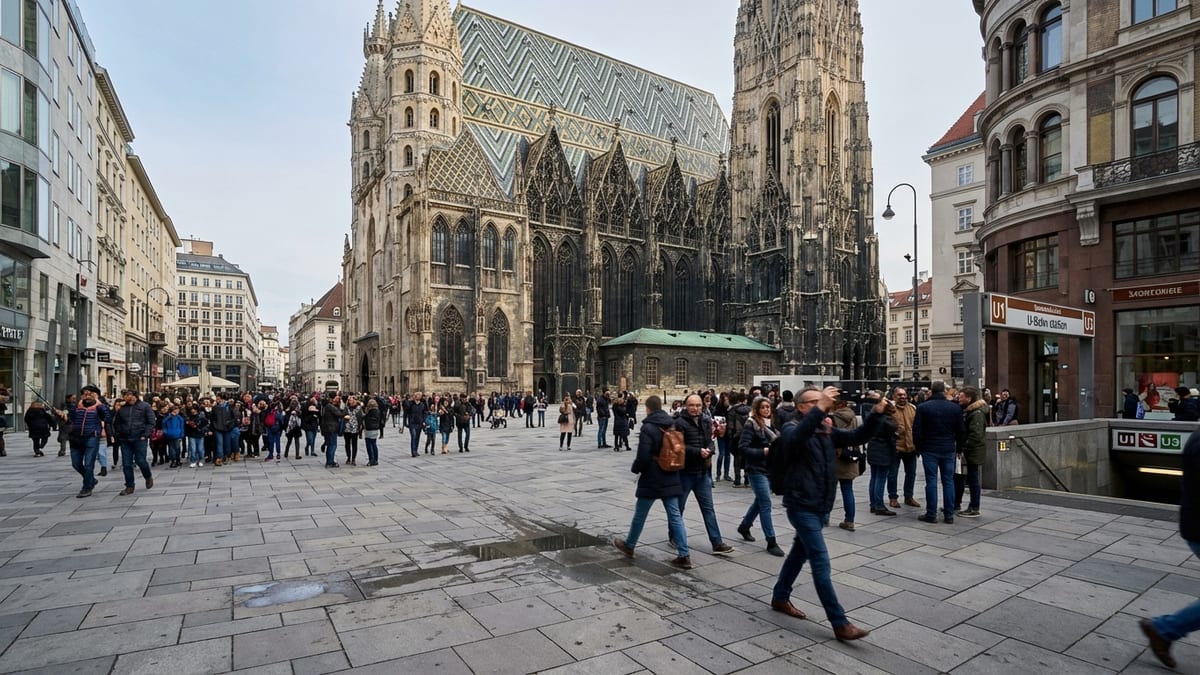
I had seen so many photos of St Stephen’s Cathedral in Vienna before I actually stood in front of it that I almost felt I had already been there. The dark Gothic stone, the tiled roof, the spire that pierces the skyline: it is on every postcard, every tourism brochure, every “48 hours in Vienna” article. When I finally visited, I made a point of doing it properly.
I went inside, paid for the main nave and audio guide, climbed the South Tower, took the elevator to the North Tower to see the Pummerin bell, and joined a catacombs tour. It was a full half day of my Vienna trip. Was it worth it? Yes, but with real caveats and a few frustrations I wish I had understood in advance.
What I Actually Found When I Arrived
The cathedral dominates Stephansplatz in a way that no photograph fully captures. As I walked up from the Stephansplatz U-Bahn station (U1 and U3 lines stop right underneath), the first thing I noticed was the sheer contrast between the dark, soot-stained Gothic stone and the glittering luxury shops around it. On a weekday morning, the square was already heaving with tour groups, school classes and people holding up phones and selfie sticks. It felt less like arriving at a place of worship and more like entering a very ornate, very crowded transit hub.
Practicalities first: the cathedral itself is open long hours, roughly from 6:00 to 22:00 on weekdays and from 7:00 to 22:00 on Sundays and holidays. You can walk into the front part of the nave for free at almost any time, which I appreciated. It meant I did not have to line up just to get a first impression. However, what surprised me was that the “free” experience is quite limited. A roped-off barrier keeps you in the front section, and the most interesting parts of the interior lie beyond that line. To go further into the nave and get access to the main sanctuary area with an audio guide, you need to buy a ticket at a desk just inside the main doors on the left.
The ticketing system was more confusing than I expected. There are separate fees for the cathedral interior with audio guide, for the South Tower, for the North Tower and Pummerin bell, and for the catacombs. There is also an “all-inclusive” ticket that bundles everything. At the time of my visit, individual tickets for each element were in the mid single-digit euro range, and the all-inclusive adult ticket was around 25 euros. Prices are reasonable by big-city standards, but it adds up quickly if you are a family or if you do everything separately. A small but important detail: inside the cathedral itself, the ticket desks strongly favored cash payment. I was glad I had some euros on me and would not count on being able to tap a card everywhere.
Once I had figured out the ticket options and accepted that this was not going to be a quick, free wander, I decided to treat it as a structured visit rather than a casual drop-in. That mental shift helped a lot. St Stephen’s is not a quiet, contemplative surprise. It is a major tourist machine that happens to be a functioning cathedral. Going in with that mindset kept my expectations realistic.
The Interior: Beauty, Barriers and Background Noise
Stepping past the roped barrier into the main nave does make a difference. The atmosphere becomes a little calmer, and you can finally see the side chapels, altars and details that are completely lost if you stay at the front. I took the audio guide, which is included with the paid central area ticket. It turned out to be one of the better decisions of the visit. The guide walked me through the symbolism of the pulpit, the tombs, the different architectural layers and the war damage the building has survived. Without it, I suspect I would have just drifted through, thinking “this is pretty” without really understanding what I was looking at.
The interior itself is undeniably impressive but not conventionally “pretty” in the way some Baroque churches in Vienna are. It is dark, almost smoky, and visually dense. Columns and altars crowd the space, and there is a lot of visual information competing for attention. Personally, I found it atmospheric and moody, especially when a shaft of light cut through the incense haze. At the same time, it felt cluttered and slightly chaotic. If you are looking for clean lines and bright frescoes, this is not that kind of building.
One thing that bothered me more than I expected was the constant background noise. Officially, this is a consecrated church. In reality, the soundscape is tour groups speaking in multiple languages, audio guides chirping away, and phones clicking. Even during my visit in the late morning, there was no real moment of silence. There are side chapels reserved for prayer, and those are noticeably quieter, but the main space feels more like a monument than a living place of worship. That hybrid identity is understandable for such a landmark, yet if you are seeking a spiritual experience, you may not find it here unless you attend Mass.
On the practical side, I appreciated that the cathedral’s open hours gave me lots of flexibility. I could have come early in the morning or late in the evening when it is much less crowded. I chose the middle of the day and paid the price in terms of sheer numbers of people. Looking back, I would absolutely come before 9:00 or after 19:00 next time just to experience the interior with fewer distractions and to take photos without feeling like part of a human conveyor belt.
Climbing the South Tower: The View You Work For
The South Tower is the iconic spire of St Stephen’s, rising to around 136 meters, and its viewing gallery is the classic “I climbed Stephansdom” brag point. Access is via a narrow stone spiral staircase of 343 steps. There is no elevator. I went up in the early afternoon, which was not the smartest choice given the number of people doing the same thing. You buy a separate ticket at the little kiosk by the tower entrance, and then you are committed.
The climb itself is exactly what you might expect from a medieval staircase that was not designed for modern tourism. It is tight, it is repetitive, and there are a lot of people. At several points, I found myself pressed against the inside wall to let descending visitors squeeze past, or doing the awkward sideways shuffle you do when two people realize too late they are both too wide for the stair at the same time. If you have even mild claustrophobia, mobility issues or knee problems, this is not a pleasant experience. There are a few small windows along the way, which were more psychological relief than actual viewpoints.
When I finally emerged at the viewing level, I did get that satisfying feeling of having earned the view. From up there, the tiled roof in green, white, yellow and black is almost at eye level, and the city spreads out in every direction. It is not the highest viewpoint in Vienna, but because you are so close to the historical core, you get a very intimate sense of the old town’s rooftops and narrow streets. I could pick out the Hofburg, the Graben and even some of the ring road. The platform itself, however, is smaller and more enclosed than I expected. It is not a big open terrace but a series of narrow corridors punctuated by windows and grills. Photography requires patience and a bit of elbow room.
Was it worth the climb? For me, yes, but with reservations. I enjoyed the sense of history and the closeness to the cathedral’s roof more than the city panorama itself. If you are short on time or physically not up for 343 tight steps in each direction, I would not feel guilty about skipping it. Vienna has other viewpoints that are easier to reach and more comfortable once you get there. I was glad I did it once, but I would not repeat the climb on a future trip.
North Tower & Pummerin: The Easy Way Up
After the South Tower, the North Tower almost feels like cheating, and that is exactly why many people prefer it. Access is via an elevator that runs daily from around 9:00 to late afternoon or early evening, depending on the season. The ticket for the North Tower is separate, or included if you have the all-inclusive pass. Compared to the staircase ordeal, stepping into the lift felt almost luxurious.
The North Tower is lower than the South Tower, and that simple fact shapes the experience. You do not get a full 360-degree panorama. Instead, the viewing platform is oriented mostly toward the north and east. That might sound like a serious disadvantage, but in practice I did not miss the missing quadrants as much as I thought I would. The angle over Stephansplatz and the immediate old town is still excellent, and you are closer to the famous Pummerin bell, which you can see at near eye level. Seeing the bell up close, with its inscriptions and size, grounded all the stories you hear about it during the audio guide inside the cathedral.
The real selling point of the North Tower for me was comfort. There was still a line for the elevator, but once on the platform I had room to move around, take photos and just stand still without being jostled. The fencing around the platform is high, which can be slightly frustrating for photography, but I would trade a few awkward angles for not climbing 343 steps any day.
If I had to choose between towers on a return visit, I would honestly pick the North Tower over the South. The view is good enough, the bell is an interesting extra, and the experience is neither physically demanding nor especially stressful. For visitors with limited time, limited mobility or kids in tow, this is the more realistic way to get a rooftop perspective on the cathedral and city.
The Catacombs: Sobering and Slightly Rushed
The catacombs under St Stephen’s are only accessible on a guided tour, with fixed times throughout the day. During my visit, tours in German and English ran at roughly half-hour intervals, with separate times on Sundays and public holidays. Tickets are bought in the cathedral, and the meeting point is at a staircase entrance inside the nave. The groups were reasonably sized but still felt full, and there was no need to book in advance as an individual. Groups of 15 or more, however, are asked to arrange ahead of time.
Descending into the catacombs is a shift in tone. The air cools, the sound of the square disappears, and the storytelling pivots from art and architecture to mortality and war. Our guide was efficient and informative, if not especially empathetic. We passed crypts with sarcophagi of bishops and nobles, then older ossuaries with neatly stacked bones, and finally the more unsettling sections where bodies from plague times were interred. It is not sensationalized, and photography is usually not allowed, which I appreciated.
The downside is that the tour felt more rushed than reflective. With fixed time slots and a constant stream of groups, there is pressure to keep moving. I often found myself walking away from something interesting before I had really processed it, simply because the group needed to clear space for the people behind us. If you are used to slow, contemplative visits to historic burial sites, this will feel more like a conveyor belt than a meditative experience.
Timing, Crowds and Practical Headaches
Logistically, St Stephen’s is almost too easy to reach. With the Stephansplatz station directly underneath and several tram and bus lines feeding into the area, it naturally becomes a crossroads for almost every visitor to Vienna. That convenience is a blessing if you are trying to fit it into a packed itinerary, but it also means it is rarely quiet. Even in shoulder seasons like April or October, the square can feel busy from mid-morning to late afternoon. In peak summer and before Christmas, it is simply crowded most of the day.
After my visit, I realized how much timing matters for the overall experience. If I were planning the day again, I would do it differently. I would either visit the interior right when it opens, then do a tower in the late morning, or come for an evening visit inside after most buses have left and reserve a tower for the next day. Trying to do everything in one intense midday block made each part feel more rushed and less special. The optimal stay, in my view, is around two to three hours spread strategically rather than jammed together.
Another mild frustration was the layering of ticket checks and access points. You buy one ticket for the central nave, another for the South Tower, another for the North Tower or an all-inclusive, and you show them at different doors or stairs. Staff were generally efficient, but the system itself feels slightly piecemeal and old-fashioned. Combined with a general preference for cash, it created small queues at multiple bottlenecks. None of this is disastrous, but it chips away at the sense of awe when you are repeatedly digging in your bag for coins and paper slips.
Accessibility is also worth addressing honestly. The main entrance is step-free and the North Tower is reached by elevator, which helps. But the South Tower, the catacombs and many side areas involve stairs and narrow passageways that are simply not wheelchair accessible. For visitors with mobility challenges, the experience will naturally be more limited. The cathedral does publish some accessibility information, but on the ground I still saw people struggling, particularly on the spiral staircase where there is no easy way to turn back once you realize it is too much.
Beyond the Checks: Atmosphere, Worship and Concerts
St Stephen’s is not just a museum of stone; it remains an active Catholic cathedral with regular Masses and liturgical events. During my visit, I arrived between services, but I caught the tail end of an organ practice that sent deep sound rolling through the nave. For a few minutes, the constant murmur of tourists receded and the building felt aligned with its original purpose. If I return, I would make a conscious effort to attend a Mass or at least plan a visit around a scheduled organ recital or choral event, which often take place on Sundays and some evenings.
There are also paid concerts held in the cathedral that feature organ music, choirs and orchestral performances. These are marketed quite heavily to tourists, and the quality can vary. Personally, I did not book one because I was wary of turning what should be a musical experience into another crowded box to tick. That said, if you are a classical music enthusiast and pick your program carefully, hearing an organ in this space could be spectacular.
What I missed, and somewhat regretted later, was the cathedral treasury and the associated museum, which are separate from the main nave. They hold many of the valuable objects associated with the cathedral’s history. By the time I had done the towers and the catacombs, I was simply saturated and opted to skip it rather than glaze over precious artifacts. This is one of those situations where more is not always better. On a second visit, I would likely choose two or three elements, not all of them, to keep my attention fresh.
Emotionally, the overall atmosphere I took away from St Stephen’s was mixed. I admired the endurance of the building and the craftsmanship that went into it. I appreciated the layers of history, from medieval foundations to wartime reconstruction. But I also felt a certain fatigue with the unrelenting tourist churn. It felt like a sacred space caught in a perpetual performance, never quite allowed to rest. That tension is not unique to Vienna, but it is very present here.
Is It Actually Worth Visiting? A Honest Verdict
When I strip away the hype and postcard perfection, my answer is that St Stephen’s Cathedral is worth visiting, but it may not be worth experiencing in the maximalist way I did. You do not need to climb every tower, enter every chamber and pay for every add-on to appreciate it. In fact, trying to do so can dilute the impact rather than deepen it. The core value of a visit, in my view, lies in taking time with the interior and choosing one or two additional experiences that match your interests and energy level.
If you are passionate about Gothic architecture or European religious history, St Stephen’s is an essential stop. You will forgive the crowds because you will be absorbed in the details: the ribbed vaulting, the pulpit carvings, the worn steps that speak of centuries of feet. If you are a casual visitor who just wants a sense of central Vienna’s atmosphere, a shorter, more focused visit might be enough: a walk through the free section, perhaps an audio guide walk through the nave, and then coffee at one of the nearby cafés while you admire the exterior from a distance.
Where I think expectations often get misaligned is with the towers and catacombs. Many people arrive imagining a grand, serene moment at the top or a haunting, quiet wander underground. The reality is more regimented and busier. The towers are cramped and popular; the catacombs are guided and time-bound. If you go in understanding that, you are less likely to feel shortchanged. If you imagine cinematic solitude, you may come away disappointed.
In budget terms, the cathedral can be either a free quick look or a 25-euro attraction, depending on your choices. For a multi-day Vienna trip, that price does not feel outrageous compared to museums and palaces, but it is not trivial either. I would not prioritize the all-inclusive ticket over, say, an afternoon at the Kunsthistorisches Museum unless you are particularly drawn to church architecture and ecclesiastical history.
The Takeaway
Looking back on my visit to St Stephen’s Cathedral, I am glad I went and I am glad I invested a solid chunk of time, but I would plan it more deliberately if I were doing it again. The building is undeniably one of Vienna’s defining landmarks, and seeing it only from the outside would feel like reading a book’s cover and skipping the pages. At the same time, the intensity of the tourist traffic, the fragmented ticketing and the sometimes cramped spaces turned parts of the experience into a mild endurance test.
I would recommend St Stephen’s wholeheartedly to travelers who enjoy architecture, history and city views, on the condition that they manage expectations. Choose either the South Tower for the satisfaction of the climb or the North Tower for comfort, not both, unless you are particularly tower-obsessed. Do the catacombs if you are curious about the city’s more somber stories and do not mind a structured group tour. Most importantly, give yourself time in the nave with an audio guide or a detailed printed guide so that the building can speak for itself rather than being just a backdrop to your photos.
If your Vienna stay is very short or your interests lean more toward art museums, cafés and music, you might treat the cathedral more lightly: admire the exterior, step inside the free zone, perhaps return for an evening organ recital, and let that be enough. There is no law that says you must conquer all 343 steps to have “done” Stephansdom.
In the end, St Stephen’s is worth visiting for what it truly is: a magnificent, sometimes overwhelming, always busy intersection of faith, history and tourism. It rewards curiosity and patience more than bucket-list urgency. Go with a clear idea of what you want from it, accept the compromises that come with visiting such a famous place, and you are likely to walk away with a richer sense of Vienna’s soul, even if your legs are sore and your camera roll is full.
FAQ
Q1. Is St Stephen’s Cathedral free to visit?
You can enter the front section of the cathedral for free, which allows a basic look at the interior. To access the main nave with an audio guide, the towers, the catacombs or the museum areas, you need to buy tickets, either individually or as part of an all-inclusive pass.
Q2. How much time should I plan for a visit?
If you only want a quick look inside, 20 to 30 minutes is enough. For a fuller experience that includes the nave with audio guide plus one tower or the catacombs, plan around 2 hours. If you intend to do both towers, the catacombs and spend time in the treasury or museum, you can easily fill 3 to 4 hours.
Q3. Which is better: the South Tower or the North Tower?
The South Tower is higher and offers a more complete city panorama, but it involves climbing 343 narrow steps with no elevator. The North Tower is lower and has a more limited view, but you reach it by elevator and can see the Pummerin bell up close. If you value the climb and the sense of achievement, choose the South Tower. If you prefer comfort and accessibility, choose the North Tower.
Q4. Are the catacombs too scary or upsetting?
The catacombs are sobering rather than terrifying. You see burial chambers, bone stacks and some plague-era remains, but the tour is factual and respectful, not theatrical. It can be emotionally intense for some visitors, but children and adults were both on my tour and most seemed more curious than frightened.
Q5. When is the best time of day to visit to avoid crowds?
Early morning shortly after opening and later in the evening are the quietest inside the nave. Midday to mid-afternoon is the busiest, especially in peak season and around Christmas. For towers, expect short lines throughout the day, but they tend to be slightly shorter earlier in the morning.
Q6. Is the cathedral suitable for visitors with limited mobility?
The main entrance and front part of the cathedral are step-free, and the North Tower is reached by elevator, though the platform itself still has some steps and narrow spaces. The South Tower and catacombs require stairs and are not wheelchair accessible. If mobility is a concern, focus on the main interior and consider the North Tower only if the few additional steps are manageable.
Q7. Do I need to book tickets in advance?
For the basic cathedral interior, towers and standard catacombs tours, you can usually buy tickets on site without advance booking, especially outside peak holiday periods. Large groups are asked to arrange catacombs tours ahead of time. Special concerts or evening tours may require advance reservations, so it is wise to check schedules before you go.
Q8. Is it worth getting the all-inclusive ticket?
The all-inclusive ticket is good value if you are sure you want to do the main interior, both towers, the catacombs and the museum or treasury in a single day. If you are unsure or have limited time, you might be better off paying individually for one tower, the nave and possibly the catacombs, which lets you tailor the cost to your actual interests.
Q9. Can I attend a church service as a visitor?
Yes, regular Masses are held daily, and visitors are generally welcome as long as they behave respectfully and do not treat the service as a photo opportunity. During services, some parts of the cathedral may be closed to tourist access, and you should avoid walking around with cameras or audio guides while worship is in progress.
Q10. What should I wear and bring with me?
There is no extremely strict dress code, but modest clothing that covers shoulders and knees is considerate in an active place of worship. Comfortable shoes are essential if you plan to climb the South Tower or do a lot of walking. Bringing some cash is practical for on-site ticket desks, and a light jacket can be useful, as the interior and catacombs can feel cool even in warmer months.