

More news on this day
On a recent domestic flight, logging on to the onboard Wi-Fi felt less like a compromise and more like stepping into a fast, reliable home connection at 35,000 feet, highlighting how Starlink’s satellite network is rapidly changing expectations in the air.
Get the latest news straight to your inbox!
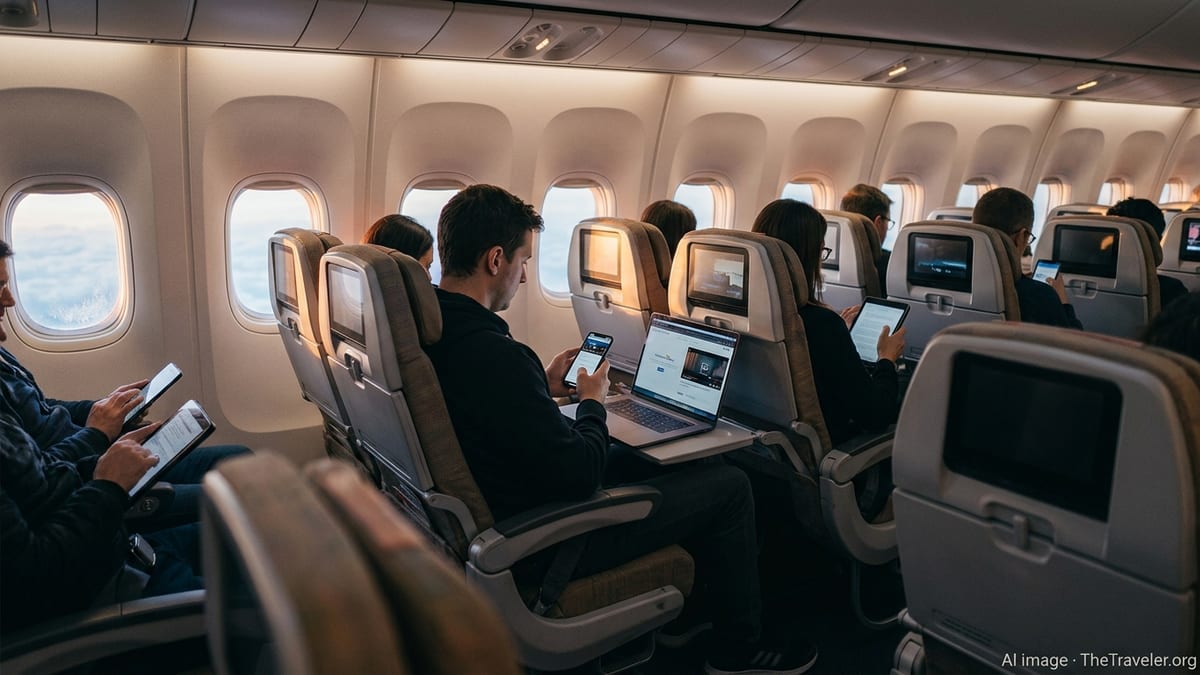
A Passenger’s First Taste of Low-Orbit Wi-Fi
For many travelers, onboard internet has long been synonymous with slow page loads, frozen apps and carefully rationed usage. On this particular Starlink-enabled flight, the experience unfolded very differently. The connection portal appeared within seconds of enabling airplane mode and Wi-Fi, and multiple devices joined the network without time limits, usage caps or complex tiers. From the passenger’s perspective, the system simply worked in the background, without requiring constant attention or troubleshooting.
Streaming video, refreshing live maps and syncing cloud documents all proceeded with little noticeable delay. Reports from early test flights on major carriers describe passengers watching high-definition video, participating in video conferences and even uploading large files, activities that previously pushed legacy inflight systems to their limits. The overall impression aligns closely with those accounts, with the connection behaving more like a strong home broadband service than a fragile link shared by a full cabin.
Equally striking was the stability of the signal. Traditional inflight services often suffer from dead zones, especially over oceans or remote regions, as aircraft hand off between ground stations or higher-orbit satellites. According to published coverage and airline statements, Starlink’s low Earth orbit constellation has been engineered to minimize these interruptions, and the observed session maintained a consistent connection from taxi to descent with only minor fluctuations.
How Starlink Is Reshaping Inflight Connectivity
Starlink’s inflight performance rests on a rapidly expanding network of low Earth orbit satellites operating at altitudes far below conventional geostationary systems. Publicly available technical data shows that this architecture shortens the distance signals must travel, lowering latency and allowing aircraft to access bandwidth that rivals fixed-line broadband. For passengers, this typically translates into faster page loads, smoother video and shorter delays in real-time communications.
Recent progress reports indicate that hundreds of commercial aircraft worldwide have already been equipped with Starlink hardware, with more than two dozen airlines either flying with the service or announcing firm rollout plans. These include carriers in North America, Europe, the Middle East and the Pacific, each tailoring pricing and access policies but generally emphasizing high speeds and reduced congestion compared with older systems.
Because the network is being designed as a unified global constellation, the inflight product benefits from the same ongoing satellite launches that support residential and enterprise Starlink services. Space industry coverage notes that new clusters of satellites are added regularly, expanding coverage footprints and capacity. For travelers, the effect is subtle but concrete: routes that once saw patchy coverage are increasingly able to maintain stronger, more consistent links across long distances.
Airlines Race to Turn Starlink Into a Competitive Edge
The first-hand experience of near-ground-like connectivity reflects a broader strategic shift in the airline industry. Carriers now treat reliable Wi-Fi less as a premium add-on and more as a core part of the onboard product, alongside seat comfort and inflight entertainment. Several airlines, including Hawaiian Airlines and Qatar Airways, publicly highlight Starlink as a differentiator on key long-haul and transoceanic routes, particularly where older ground-based networks cannot reach.
Hawaiian Airlines, for example, has reported that Starlink-based internet is now available across its Airbus widebody and narrowbody fleet, providing free connectivity on flights linking Hawaii with the mainland United States and international destinations. According to information on the carrier’s website and in prior announcements, passengers can connect personal devices directly to the onboard network and access high-speed service at no additional cost, with the airline emphasizing the ability to stay productive or entertained during long Pacific crossings.
Qatar Airways has similarly detailed a rapid rollout program, describing more than one hundred widebody aircraft equipped with Starlink hardware. Travel industry reports characterize this as one of the largest deployments of low-orbit satellite connectivity on long-haul jets, bringing high-speed internet to routes linking Doha with major cities in Europe, Asia and the Americas. For premium and business travelers in particular, this level of access can influence airline choice, as it supports heavy data use such as remote work and real-time collaboration.
In North America, United Airlines has announced accelerated plans to fit its mainline and regional fleets with Starlink, framing the move as part of a broader effort to offer free, fast and reliable connectivity to loyalty program members. Industry analysis suggests that such commitments by large carriers are pushing inflight Wi-Fi toward a new baseline, where paying by the hour for limited, slow access becomes increasingly difficult to justify.
From Patchy Perk to Everyday Utility
For the traveler on that first Starlink flight, the most notable change may have been psychological. Instead of budgeting time online and carefully choosing which apps to open, the connection felt reliable enough to fade into the background. Work platforms that rely on constant syncing behaved as they do on the ground, cloud storage updated without manual intervention and streaming services remained usable throughout the flight. The Wi-Fi shifted from being a contingency option to an integral part of the journey.
Published comparisons between Starlink and older inflight systems often highlight latency as a key factor in this shift. Lower delay is especially important for interactive uses such as messaging, collaborative documents and video calls. While some airlines still prohibit voice and video calls to preserve cabin comfort, the underlying network is increasingly capable of supporting them, alongside data-heavy entertainment for large numbers of passengers.
This transition is not uniform across all carriers or aircraft types. Industry surveys note that some airlines are still installing or upgrading traditional satellite and air-to-ground systems, and coverage can vary substantially by route and fleet. Nevertheless, Starlink’s rapid expansion has set new expectations for what is technically possible, putting pressure on competing providers to improve performance and on airlines to communicate clearly about what passengers can expect on any given flight.
What This Means for the Future of Flying
As more travelers experience flights with Starlink Wi-Fi, the gap between connected and unconnected aircraft is likely to feel increasingly stark. Business passengers may come to view high-speed, low-latency internet as non-negotiable, especially on routes where workdays stretch across time zones. Leisure travelers, meanwhile, are already using the improved bandwidth to share real-time travel updates, upload media and stream long-form entertainment that previously felt out of reach at cruising altitude.
Analysts point out that as aircraft become better connected, airlines can also use the bandwidth for operational purposes, from real-time telemetry and predictive maintenance data to dynamic flight planning and updated cabin services. Although these changes are less visible to passengers, they can influence everything from punctuality to onboard inventory, indirectly enhancing the overall travel experience.
For now, the passenger perspective is straightforward. On a Starlink-equipped jet, the familiar frustrations of inflight Wi-Fi largely recede. A traveler can open a laptop or unlock a smartphone and continue their digital life with minimal compromise, a shift that many early users describe as nothing short of a game changer. As airlines expand deployments and refine pricing models, that once-rare experience is poised to become an increasingly common feature of modern air travel.