

More news on this day
STARLUX Airlines has vaulted into the ranks of the world’s top five carriers, according to recent Skytrax-based rankings cited in corporate disclosures, underscoring the rapid ascent of Taiwan’s youngest full-service airline and its growing role in driving the island’s tourism recovery.
Get the latest news straight to your inbox!
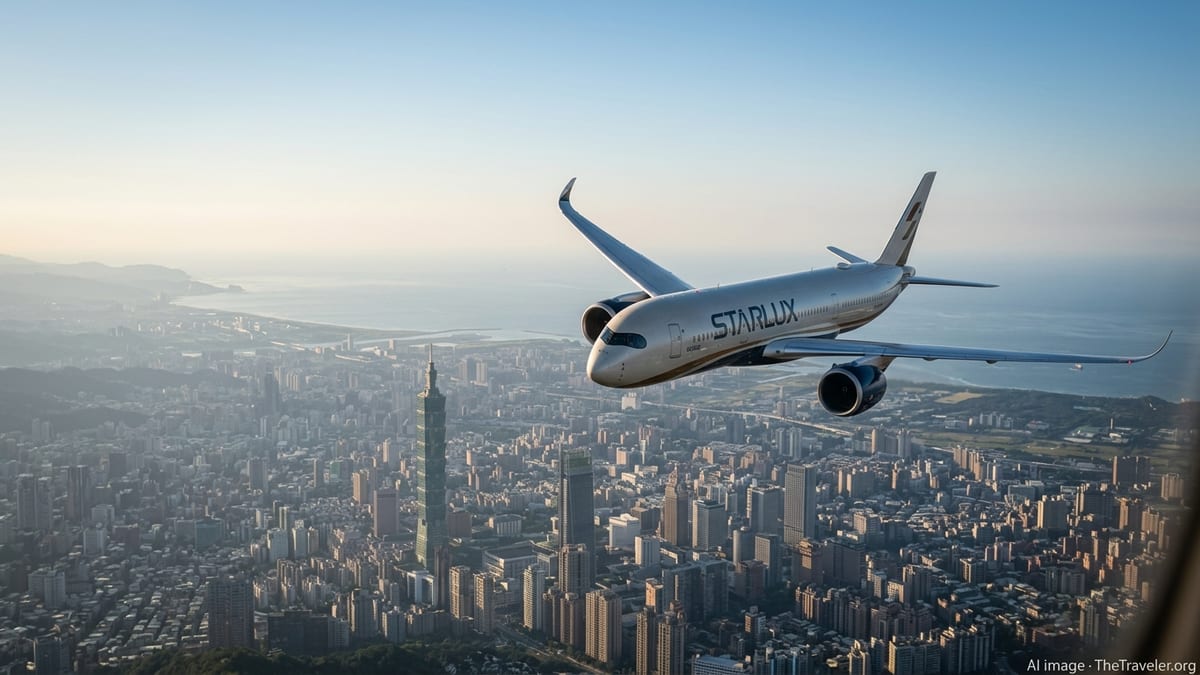
A Fast-Rising Premium Carrier From Taipei
Founded in 2018 and operating its first flights in 2020, STARLUX Airlines has quickly positioned itself as a boutique premium carrier centered on Taiwan Taoyuan International Airport. Publicly available corporate presentations show that the airline has moved into the upper tier of global rankings, including a top five position in overall airline lists and recognition among the world’s leading economy cabins. Those same materials highlight a five-star rating from Skytrax, placing STARLUX alongside a small group of carriers considered global benchmarks for service quality.
Analysts note that this trajectory is unusual for a relatively new airline, particularly one that began long-haul operations only in 2023. Industry coverage points to STARLUX’s focus on consistent hard-product quality, with a uniform Airbus fleet and long-haul Airbus A350 aircraft, as well as an emphasis on onboard service and design aimed at differentiating it from larger regional competitors.
While international rankings are based on traveler surveys and expert assessments rather than financial performance alone, STARLUX’s climb into the world’s top five has drawn attention from airport authorities, tourism boards, and travel planners. For Taiwan, it signals that the island’s flag carriers now compete not only on network breadth, but also on perceived quality in premium and leisure segments.
New Long-Haul Routes Strengthen Taiwan’s Global Links
STARLUX’s upgraded global standing coincides with an aggressive expansion of its long-haul network, especially to North America. The airline launched its first transpacific route between Taipei and Los Angeles in April 2023, followed by nonstop service to San Francisco and Seattle and, more recently, a route to Ontario International Airport in California’s Inland Empire. Aviation analyses describe these flights as part of a deliberate strategy to tap secondary U.S. gateways with strong Asian diaspora and technology, logistics, and higher education ties.
In early 2026, STARLUX added Phoenix to its U.S. portfolio, creating the first nonstop link between Arizona’s capital and Taipei. Local reports characterize the service as closing a long-standing gap in Phoenix’s Asia connectivity and turning the city into a more substantive gateway for the U.S. Southwest. The Phoenix flights, operating several times weekly, connect through Taipei to STARLUX’s wider Asian network, giving both business and leisure travelers one-stop access to destinations across Northeast and Southeast Asia.
Beyond North America, the airline is preparing its first European route. Announced plans outline a new Taipei–Prague service beginning in August 2026, initially three to four times per week. Coverage of the route notes that it will be STARLUX’s debut in Europe and is expected to support both tourism and business travel links between Taiwan, Central Europe, and onward points via connecting flights in Prague.
Tourism Rebound Puts Taiwan Back on the Map
Taiwan’s tourism sector has been rebounding strongly from the pandemic, and the expansion of international air links is seen as a central driver. Data from Taiwan’s Tourism Administration and recent press materials show that foreign arrivals surpassed 7 million by December 2024, with updated figures indicating more than 7.8 million international visitors for the full year. Japan, Hong Kong and Macau, and South Korea led inbound markets, with Southeast Asia providing the largest regional share.
Officials expect inbound tourism revenue to continue rising at a projected annual rate of roughly 2 to 4 percent, helped by long-haul travelers who typically stay longer and spend more. Tourism authorities have emphasized that increased seat capacity, new long-haul routes, and more convenient connections are allowing Taiwan to compete more effectively with other Asian hubs for visitors from North America and Europe.
At the same time, outbound travel from Taiwan remains strong. Recent statistics indicate that overseas trips by Taiwanese residents in 2025 reached fresh highs, continuing a long-term trend in which outbound travelers outnumber foreign visitors. This imbalance has historically favored domestic airlines, and STARLUX’s widened network gives Taiwanese travelers more premium options for holidays and business trips while also attracting foreign tourists into Taiwan as a hub and destination.
STARLUX’s Role in Taiwan’s Tourism and Hub Strategy
The rise of STARLUX aligns with Taiwan’s broader strategy to solidify Taoyuan as a regional transfer hub. Reports from trade and tourism agencies note that the airline’s focus on long-haul, premium-heavy routes complements the existing networks of China Airlines and EVA Air, collectively increasing Taiwan’s appeal as a stopover between North America, Asia, and, eventually, Europe.
By flying directly into cities such as Ontario and Phoenix, STARLUX connects Taiwanese and Asian travelers with high-growth metropolitan areas that were previously reliant on indirect routings through larger West Coast hubs. Travel industry commentators say this not only shortens journey times but also encourages new tourism flows, as travelers can more easily pair visits to Taiwan with side trips across the American Southwest or interior California.
Code-sharing and interline arrangements have further extended STARLUX’s reach. Partnerships with major U.S. and Middle Eastern carriers, along with ongoing discussions around joining the Oneworld global alliance, allow passengers to book through itineraries that combine STARLUX’s transpacific or regional legs with partner networks. Public information on these tie-ups suggests they are improving load factors on long-haul services while helping to position Taiwan as a convenient transfer point.
Competitive Landscape and Outlook
STARLUX’s emergence among the world’s top five airlines places additional competitive pressure on regional rivals. Long-established carriers in East Asia and the Gulf remain larger by fleet size and network breadth, but the Taiwanese airline’s rapid rise in quality rankings has drawn attention from frequent flyers who weigh onboard experience and schedule convenience alongside price.
Industry commentary points out that sustaining a premium-focused model can be challenging, particularly when long-haul markets are vulnerable to economic cycles and fuel price volatility. However, STARLUX’s early performance suggests that there is demand for a differentiated product connecting North America and, soon, Europe to a wide array of secondary Asian destinations via Taipei.
For Taiwan’s tourism sector, the airline’s global recognition and expanding route map function as a high-visibility advertisement. Each new international gateway where STARLUX appears on departure boards effectively promotes Taiwan as both a destination and a connecting hub. If current trends in visitor numbers and route growth continue, analysts expect the carrier’s world top-five status to reinforce Taiwan’s profile among travelers seeking new Asian city breaks, culinary tourism, and multi-country itineraries that begin or end in Taipei.