

Pulling off Highway 1 into Wolseley, Saskatchewan, you do not feel like you are entering a conventional roadside stop. The Trans Canada roars just beyond the trees, but within a few minutes you are circling a small lake, easing past brick heritage buildings and watching locals stroll toward a narrow suspension bridge that sways just enough to remind you this is a town with its own rhythm. Wolseley is a place many travellers simply pass by between Regina and the Manitoba border, yet a short stop here reveals how a small prairie town can feel unexpectedly graceful, textured and lived in.
First Impressions From the Trans Canada
Wolseley sits roughly an hour east of Regina on the Trans Canada Highway, and the exit appears almost without fanfare. Grain fields stretch in every direction until, quite suddenly, there is a fringe of mature trees and the shimmer of water that gives the town its nickname, the Town Around a Lake. For drivers who have been watching an almost unbroken horizon, the sudden presence of a sheltered basin, a low brick main street and clusters of historic houses immediately alters the mood.
Once you turn off the highway and curl toward downtown, the pace drops quickly. The streets around Fairly Lake are compact, the blocks walkable within a few minutes, and there is usually an easy parking space near the visitor information centre or along Front Street. The town feels both tidy and unhurried, with well kept lawns, neat gardens and a quiet that is broken more often by birdsong and conversation than traffic.
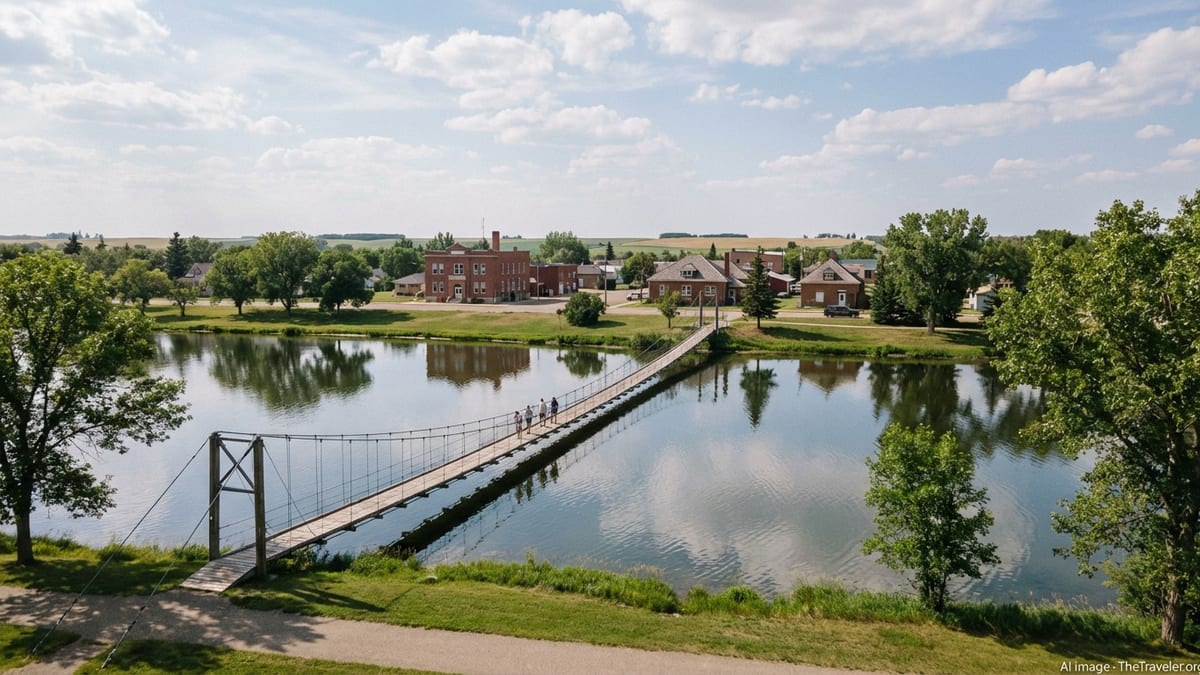
What stands out first is how close everything is to the water. Fairly Lake almost encircles the core of town, so that many first views are framed by reeds, low shoreline and the distinctive silhouette of the swinging bridge. On still days the surface mirrors the brick of the courthouse and the soft prairie sky, giving the centre of Wolseley an almost park like quality that you do not expect from a community of a few hundred people on a major highway.
A Lakeside Town With Railway Roots
The lake that shapes Wolseley is not a natural feature but a byproduct of the railway age. In the early 1900s the Canadian Pacific Railway dammed a small creek to create a reliable water source for steam locomotives. That practical project left behind a broad pond ringed by trees and open banks, which gradually became the town’s defining feature as homes, churches and civic buildings clustered around it.
Today Fairly Lake is central to how a visit feels. The town’s beach and swimming area sit along the shore, and in summer you will see families setting up with towels and coolers while teenagers cut across the floating dock. The narrow roads that trace the waterfront make it easy to drive slowly around the entire basin, but the best way to experience it is on foot, lingering at benches and lookout spots that break up the path.
Because Wolseley is small, the water remains close even when you head inland a block or two. You can stand near the courthouse or town hall and still hear geese on the lake or watch reflections move on nearby windows. The result is a town centre that feels unusually cohesive. Rather than a strip of highway businesses set apart from residential streets, Wolseley wraps itself around a shared landscape feature that locals and visitors use in much the same way.
Crossing the Swinging Bridge
The structure most travellers remember from a stop in Wolseley is the swinging bridge stretched across Fairly Lake. The original footbridge was built in the early 1900s to give residents a shortcut between opposite shores. Over the decades it has been blown down and rebuilt more than once, and the current version is a long, narrow span that moves gently underfoot while remaining solid enough for the thousands of crossings it sees each year.
Walking out onto the bridge is a small ritual for visitors. The boards creak faintly, the cables rise into shallow arcs above you, and the view opens out to the curve of the lake, treed banks and, in the distance, the low rooflines of the town. On calm evenings the water reflects the bridge and sky so clearly that the sensation of floating just above the surface is hard to shake. Children tend to test how much they can make it bounce, while locals stride across with the ease of long familiarity.
The bridge also functions as a social space. In the early morning there are often solo walkers or joggers cutting across as part of a loop around the lake. Midday brings families, cyclists pausing from a longer ride along the highway, and travellers who have pulled off for a quick break. Late in the day, when the light softens and the air cools, it can become a place for unhurried conversations, with people pausing halfway to lean on the rail and talk while the water shifts below.
Heritage Buildings and a Prairie Streetscape
For a town of its size, Wolseley holds a remarkable number of historic buildings. As you walk the compact downtown, you pass brick and stone structures that date back more than a century, survivors from a period when rail lines drew settlers and trade across the region. Locals often mention that national magazines have named Wolseley among Canada’s prettiest small towns, and the streetscape helps explain why.
The town hall and opera house is one of the most striking landmarks. Completed in the early 1900s, this two storey brick and fieldstone building was designed to serve many functions at once, from municipal offices and fire hall to performance venue. Today it still anchors community life, operating as a gathering place for events, concerts and meetings. The exterior, with its arched windows, stone detailing and tall facade, offers one of the most photographable corners in town, especially when the evening sun catches the brick.
Nearby stand other reminders of Wolseley’s early days. The provincial courthouse, dating from the 1890s, is noted as the oldest surviving courthouse building in Saskatchewan and sits with its restrained brickwork and simple lines overlooking the town. Scattered along the surrounding streets are heritage homes tied to early business owners and civic leaders, as well as the modest structure that once housed the first Beaver Lumber store in the country. None of this feels like a museum district. The buildings are folded into daily life, still used, cared for and quietly integrated into a functioning small town.
Slow Walks, Local Stops and Everyday Life
Stopping in Wolseley is less about ticking off a list of attractions and more about leaning into the everyday rhythm of a prairie town. A typical visit might begin at the tourist information centre near the highway, where staff can offer a simple map pointing out attractions, campgrounds and a self guided heritage walking route. From there it is only a few minutes by car or on foot to the lake and central streets.
Strolling around Fairly Lake, you notice small details: hand painted signs, tidy backyards sloping toward the water, benches placed by community groups, flower baskets along the streets near the town hall. On weekday mornings there may be a school group out for a walk or residents heading to the post office. In the peak of summer, the beach area livens up, but even then the overall mood is unhurried.
There are cafes, small shops and services that cater both to locals and to highway travellers who need fuel, a snack or a stretch. Nothing feels overly curated for visitors. You are unlikely to find a busy souvenir strip or aggressively branded attractions. Instead, you step into a grocery, diner or bakery that serves the people who live here year round, and you are treated much the same way they are. That ordinariness, in the best sense of the word, is a significant part of what a Wolseley visit feels like.
Seasonal Shifts on the Prairie
Because Wolseley sits squarely in the continental climate of southern Saskatchewan, what you experience depends sharply on the season. Summer brings long days, warm temperatures and a steady flow of people breaking up road trips between the provincial capital and the Manitoba line. In July and August, Fairly Lake becomes the focus of activity, with the beach open, children in the water and the bridge busy with walkers well into the evening.
Spring and autumn can be particularly atmospheric. In May and June the town shakes off winter, trees leaf out around the lake and migratory birds make brief, noisy stops. By late September, the foliage around Fairly Lake takes on yellow and amber tones that glow in low afternoon light. The air cools quickly after sunset, and the contrast between the calm of the water and the distant rush of highway traffic can feel almost cinematic, even though the town itself remains quiet.
Winter in Wolseley is a different experience entirely. Temperatures can drop sharply, snow banks pile along the streets and the lake typically freezes, transforming the central feature into a white expanse. Not every traveller chooses to linger in such conditions, but for those who do, the town takes on a stripped down beauty: plumes of exhaust from chimneys in the clear air, the outline of the swinging bridge against snow, and the orderly geometry of streets in frost.
Planning a Stop: Practical Notes
From a practical point of view, Wolseley is easy to fold into a longer journey across the prairies. The town lies just off Highway 1, and the main turnoff is clearly signposted from both directions. Many visitors plan for a short break of thirty to ninety minutes, enough time to walk the bridge, circle part of the lake and have a coffee or light meal before continuing east or west.
Services in town reflect its size, so expectations should be modest. There are fuel stations, basic groceries, places to eat and several forms of accommodation, including small motels, guesthouses and bed and breakfast style stays in historic homes. In summer, nearby campgrounds cater to both RV travellers and tent campers, and the local visitor information centre operates seasonally with washrooms, wireless access and maps available.
Because business hours in small towns can change with little notice, it is sensible to keep plans flexible. Travellers who arrive late in the evening or in the off season may find fewer dining options open, while those who show up on a sunny weekend during peak summer might encounter local events, weddings at nearby halls or modest festivals that add energy to the streets. The town rewards curiosity and a willingness to adjust your schedule by an hour or two.
The Takeaway
Spending even a short time in Wolseley offers a reminder that not every stop on a cross country journey needs to be spectacular or intense to be worthwhile. Here the appeal lies in proportion: a compact town wrapped around a man made lake, a handful of well preserved historic buildings, a gently swaying bridge and the ongoing routines of residents who live at a scale that feels human and manageable.
For travellers used to planning around big city attractions or national parks, Wolseley represents a different kind of experience. It is a chance to pause, walk slowly, notice the texture of brick and water and sky, and recognize how much character can be contained in a town of a few hundred people. The memory you carry away is unlikely to be of a single must see sight. Instead, it will be of light on the lake, the feel of the bridge underfoot and the simple satisfaction of having stepped briefly into the life of a small Saskatchewan community.
FAQ
Q1. Where is Wolseley located in Saskatchewan?
Wolseley is in southeastern Saskatchewan, roughly an hour east of Regina along the Trans Canada Highway, making it an easy stop on a prairie road trip.
Q2. How much time should I plan to spend in Wolseley?
Many travellers spend between thirty minutes and two hours, which allows time to walk the swinging bridge, circle part of Fairly Lake and enjoy a snack or coffee.
Q3. What is Wolseley best known for?
The town is best known for Fairly Lake, the long pedestrian swinging bridge across it, and a collection of well preserved heritage buildings around the compact downtown.
Q4. Is the swinging bridge in Wolseley safe for children?
The bridge is designed for pedestrian use and feels secure, though it moves slightly. Children should be supervised, and those nervous about heights may prefer to hold a hand.
Q5. Can you swim in Fairly Lake?
Yes. In summer the town maintains a small public beach and designated swimming area on the shore of Fairly Lake, where local families and visitors often gather.
Q6. Are there places to stay overnight in Wolseley?
Accommodation options include small motels, guesthouses and bed and breakfast style stays in or near historic homes, along with nearby campgrounds for RVs and tents.
Q7. What services are available for road trippers?
Travellers will find fuel stations, basic groceries, casual dining, a seasonal visitor information centre with washrooms and wireless access, and spots to stretch their legs by the lake.
Q8. Is Wolseley a good stop in winter?
Winter visits are quieter and colder, but those prepared for prairie weather can appreciate a stark beauty around the frozen lake and snow lined streets, often with very few crowds.
Q9. Do I need to book activities in advance?
Most experiences in Wolseley, such as walking the heritage streets or visiting the lake and swinging bridge, are self guided and do not require reservations, though lodging may.
Q10. Is Wolseley suitable for a family stop with young kids?
Yes. The town’s small size, lakeside setting, beach area and swinging bridge make it an easy and engaging break for families, provided parents supervise children near water and on the bridge.