

More news on this day
An official investigation has detailed how a Ryanair Boeing 737-800 from Pisa to Scotland landed in Manchester with only minutes of fuel remaining after battling hurricane-force gusts from Storm Amy, triggering renewed scrutiny of fuel planning and diversion decisions in extreme weather.
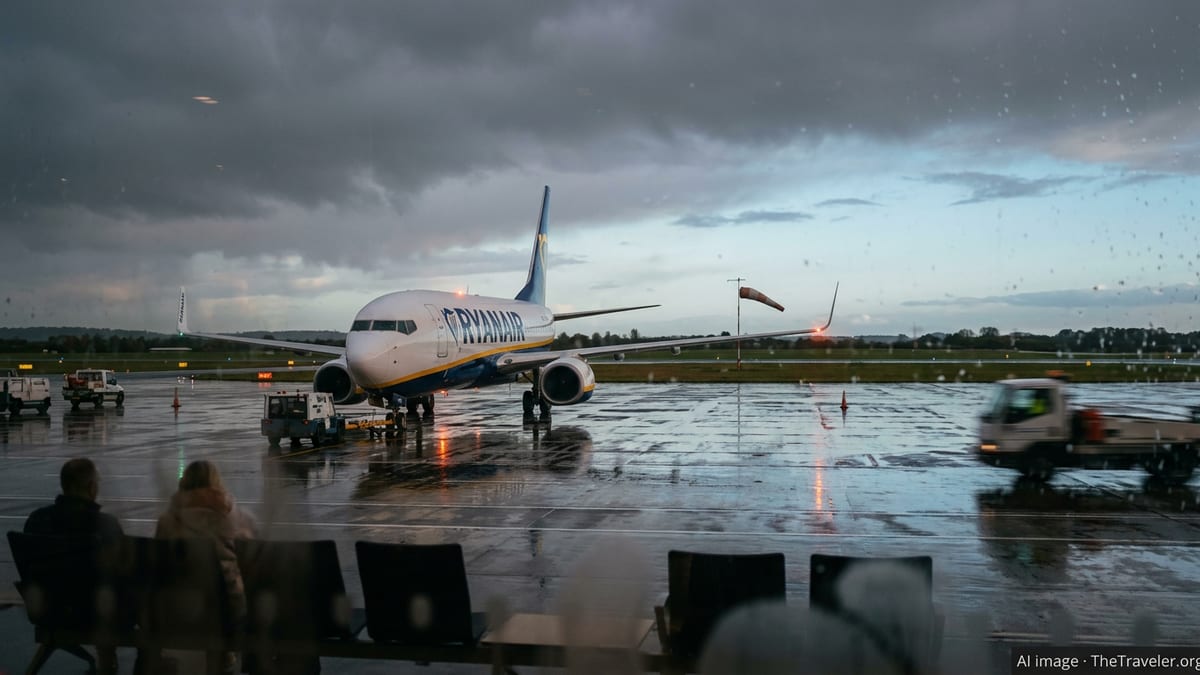
From Tuscany to Turbulence: How a Routine Flight Turned Critical
Ryanair flight FR3418 departed Pisa’s Galileo Galilei Airport on 3 October 2025 bound for Glasgow Prestwick, carrying holidaymakers and returning workers on what was scheduled as a straightforward evening sector to Scotland. Forecasts had warned of Storm Amy’s approach, but at departure time operations across much of Europe were still functioning, with airlines planning around strong winds and heavy showers rather than outright closures.
As the Boeing 737-800 approached western Scotland, conditions rapidly deteriorated. Storm Amy drove gusts close to 100 miles per hour across exposed parts of the country, with severe wind shear and turbulence reported around major Scottish airports. Controllers began spacing arriving traffic further apart as flight crews encountered unstable approaches, while several aircraft diverted early to avoid the worst of the weather.
For FR3418, the situation escalated after its first attempt to land at Prestwick. Strong, shifting crosswinds forced the pilots to abort the approach and climb away, entering a holding pattern in the hope of a temporary lull. When conditions failed to improve sufficiently, a second approach also had to be broken off, consuming more of the fuel the crew had planned as reserve.
The flight then headed for Edinburgh, which was experiencing marginally better conditions, but Storm Amy’s powerful bands of wind reached the capital’s airspace as well. A third approach again ended in a go-around due to wind shear warnings, leaving the crew facing a narrowing set of options as fuel levels continued to fall.
Emergency Diversion to Manchester With Minutes of Fuel Left
With Scottish airports battered by Storm Amy and three go-arounds already behind them, the Ryanair crew turned south towards Manchester, where winds, though strong, were notably less extreme. According to flight log data and investigators’ analysis, the aircraft by this stage had already used much of the extra fuel carried to accommodate possible delays and diversions.
As the 737-800 neared Manchester, the crew declared a fuel emergency, using the internationally recognised “Mayday fuel” call to signal that the aircraft’s remaining fuel had fallen below its final reserve level. This is the threshold at which pilots must be given priority to land, as any further delay could compromise safety margins.
Investigators found that when FR3418 touched down at Manchester, approximately 220 kilograms of fuel remained in the tanks, equating to around five to six minutes of flying time for that aircraft type. While the landing itself was routine and no injuries were reported, the razor-thin margin has since become a focal point in debates over airline fuel policies and decision-making under severe weather pressure.
Passengers described a tense final phase of the flight, with the cabin crew remaining calm as the aircraft encountered turbulence on descent into Manchester but offering little detail beyond assurances that the diversion was weather-related. Many only learned afterwards from media reports how little fuel remained when the aircraft reached the stand.
What Investigators Found About Fuel Planning and Decision-Making
The official inquiry, led by the UK’s Air Accidents Investigation Branch, concluded that the aircraft departed Pisa with fuel that met regulatory requirements, including contingency and diversion reserves. The report stresses that the problem was not a simple case of under-fuelling, but a combination of extreme meteorological conditions, multiple go-arounds and the timing of diversion choices.
According to the findings, the crew initially planned Prestwick as both destination and primary diversion option, with Edinburgh available as another alternate. In normal circumstances this configuration would have been adequate. Storm Amy’s intensity, however, meant that both Scottish airports were subject to rapidly changing crosswinds and wind shear, which led to the succession of unstable approaches.
Investigators noted that each go-around significantly increased fuel burn, especially in the turbulent climb segments and holding patterns. The decision to make a third attempted landing in Scotland, rather than divert to a less affected English airport after the second go-around, was identified as a key point where options began to narrow.
The report stops short of criticising individual pilots, instead framing their decisions within a broader context of operational pressure, evolving forecasts and a desire to complete the flight as planned for passengers. Nonetheless, it highlights the need for clearer guidance on when to abandon repeated approaches in favour of a more distant but meteorologically safer diversion.
Ryanair and Regulators Respond to the Storm Amy Incident
Ryanair has said that safety was never compromised and that the crew followed approved procedures, emphasizing that the aircraft landed safely and that the fuel emergency declaration functioned exactly as intended to secure priority. In a statement responding to the investigation, the airline reiterated that it complies with European fuel planning regulations on every flight and that captains may request additional fuel beyond the calculated minimums.
The carrier has, however, accepted several of the AAIB’s safety recommendations. These include enhanced simulator training focused on fuel management in rapidly deteriorating weather and scenarios involving multiple go-arounds, as well as refined decision-making tools to help crews more quickly identify when conditions at both a destination and its nearby alternates are likely to remain below acceptable limits.
Regulators have also used the incident to revisit guidance on alternate airport selection during named storms. Aviation authorities are encouraging airlines to consider more geographically separated diversion options when major weather systems are forecast to impact an entire region, even if that means planning for longer possible diversion legs and higher initial fuel loads.
Air traffic control agencies in the UK are reviewing internal protocols on how quickly flights that declare minimum or emergency fuel are sequenced to land, particularly on days when widespread disruption and heavy holding patterns increase the risk of fuel margins eroding across multiple aircraft.
What the Case Means for Passengers and Future Operations
For passengers, the Storm Amy Ryanair incident underscores how fast a routine European flight can become operationally complex once major weather systems move in. While fuel rules are designed to cope with one or two unexpected events, such as a single go-around or short diversion, the combination of three failed approaches and a regional storm pushed FR3418 close to the edge of its planning envelope.
Industry experts point out that cases like this remain rare and that commercial aviation continues to maintain an exceptionally strong safety record. The fact that the crew declared a fuel emergency, received priority handling and landed without injury is cited as evidence that safety systems, when used assertively, still work as intended.
Nonetheless, the flight has prompted renewed debate about the balance between efficiency and resilience in modern airline operations. Additional fuel adds cost and weight, but it also buys time and options when conditions deteriorate faster than forecast. In a climate where extreme weather events such as Storm Amy are expected to become more frequent, that trade-off is likely to remain under close scrutiny from regulators, airlines and the travelling public.
As winter storm seasons return to northern Europe, the lessons drawn from FR3418’s fraught journey from Pisa to a last-minute landing in Manchester are already being fed into training and planning. For travellers, the episode is a reminder that diversions and delays in storms are not an inconvenience to be resented, but a visible sign of the aviation system cautiously bending to keep flights safe long before margins reach those final few minutes of fuel.