

More news on this day
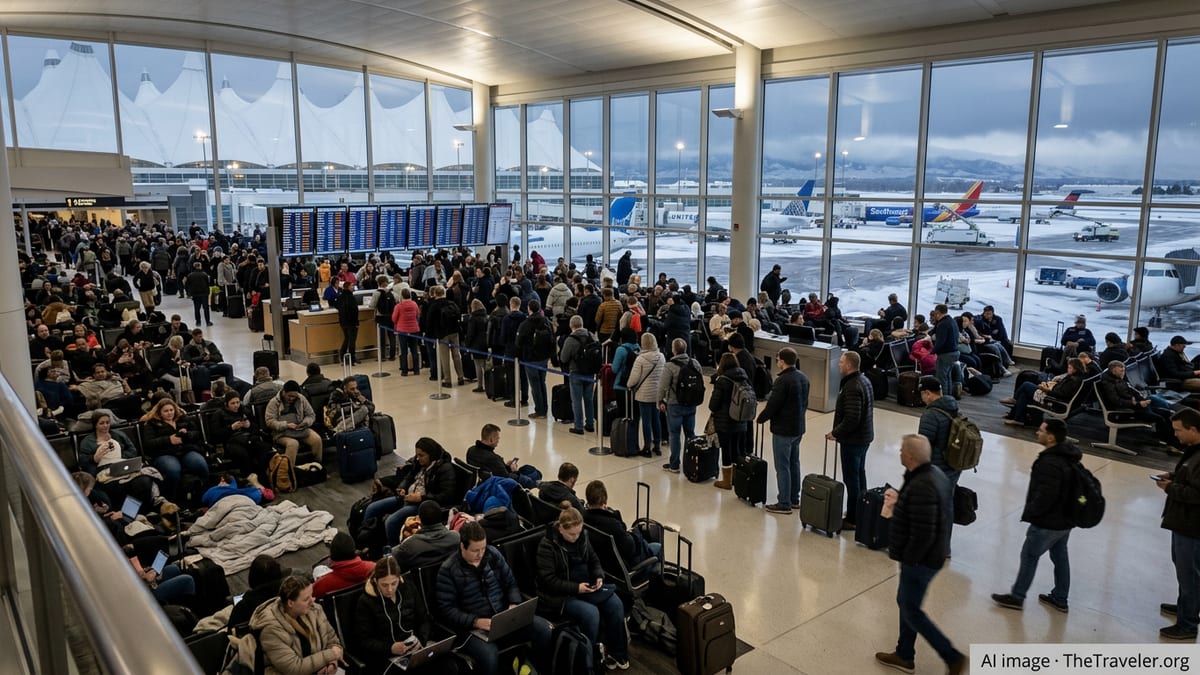
Hundreds of travelers remained stranded at Denver International Airport on March 17 as a powerful late-winter storm and ensuing operational disruptions triggered 258 flight delays and 31 cancellations, snarling connections to Los Angeles, Dallas, Chicago, and a string of other U.S. destinations.
Get the latest news straight to your inbox!
Storm System Turns Denver Into a Chokepoint
Publicly available weather and aviation data for March 16 and 17 indicate that a sprawling storm system over the central United States reduced arrival and departure rates at Denver International Airport, one of the country’s busiest connecting hubs. Strong crosswinds, low visibility, and bands of snow and mixed precipitation limited runway configurations and slowed the flow of traffic into and out of the airport.
Denver’s role as a major connecting point for both regional and long-haul routes meant that even modest capacity reductions had outsized consequences. Aircraft arriving late from other storm-affected cities cascaded into missed departure slots, triggering rolling delays that built through the morning and afternoon. As delays stacked, gate availability tightened, magnifying congestion on the ground.
Operational data tracking services showed that by early evening, 258 flights involving Denver had been reported delayed, alongside 31 outright cancellations. Many of these flights were scheduled to or from Los Angeles, Dallas, Chicago, Phoenix, Las Vegas, and other large domestic markets, turning what began as a regional weather issue into a nationwide disruption.
Airport webcams, social media posts, and traveler reports described crowded concourses, long customer service queues, and ad hoc sleeping areas forming near the ends of terminals as travelers tried to rebook itineraries or find space on increasingly full later departures.
Regional Carriers and Major Airlines Hit Hard
Among the airlines most affected were SkyWest, United Airlines, Southwest Airlines, and Delta Air Lines, which collectively operate a large share of Denver’s daily schedule. SkyWest, which flies as a regional partner under brands such as United Express and Delta Connection, encountered particular difficulty repositioning aircraft and crews once the storm disrupted its tightly timed regional network.
Tracking data showed numerous SkyWest-operated regional jets arriving behind schedule, then turning late or being withdrawn from rotation entirely as duty-time limits and crew availability became binding constraints. With regional flights feeding major hubs like Los Angeles, Dallas, and Chicago, these delays curtailed options for passengers hoping to salvage same-day connections.
United, Denver’s largest carrier by market share, faced mounting delays on trunk routes to hubs such as Chicago O’Hare, Houston, Newark, and San Francisco. Southwest Airlines, which relies on rapid aircraft turnarounds for its point-to-point network, saw flights to cities including Dallas, Phoenix, and Las Vegas pushed back repeatedly as aircraft arrived late and ramp operations slowed in deteriorating conditions.
Delta, which has a smaller but strategically important presence at Denver linking to its hubs in Salt Lake City, Minneapolis, and Atlanta, also recorded a series of delays and a smaller number of cancellations. Passengers on these flights frequently faced not just a single disruption but a domino effect, as missed connections upstream and downstream narrowed rebooking options.
Passengers Face Isolation, Overnight Stays, and Limited Options
For many travelers, the disruption translated into hours or even an entire night inside Denver’s terminals. Reports from social media platforms described passengers sleeping in gate areas, lining up at customer service counters that stretched down concourses, and struggling to secure hotel rooms as nearby properties quickly filled.
Families traveling with children, elderly passengers, and those with tight international or cruise connections reported particular difficulties. With 31 cancellations concentrated around key evening departure banks, a significant number of travelers found themselves effectively isolated in Denver, unable to continue to Los Angeles, Dallas, Chicago, or onward destinations until seats opened up the following day.
Standard airline policies for meal and lodging assistance varied by carrier and by the classification of each disruption, leaving some passengers with food vouchers or hotel arrangements while others were advised to seek accommodations independently. Long phone and chat wait times for airline support channels compounded the challenge for those attempting to rearrange multi-leg itineraries.
Some passengers reported opting to rent cars and drive to nearby cities such as Colorado Springs or Cheyenne to access alternative flights, while others gave up on air travel entirely and arranged long-distance drives to reach locations in neighboring states.
Ripple Effects Stretch to Major U.S. Hubs
The flight disruptions at Denver resonated across the national network, with downstream delays noted at Los Angeles International Airport, Dallas-area airports, and Chicago’s O’Hare and Midway. Aircraft and crews scheduled to depart from Denver arrived late into these hubs, in turn delaying subsequent departures on routes that did not directly touch Colorado.
According to live departure boards and airline status pages, passengers in Los Angeles experienced delays on Denver-bound flights that extended well beyond the original departure times, narrowing or eliminating onward connection windows. Similar patterns emerged in Dallas, where evening banks to Midwest and East Coast cities departed behind schedule after aircraft originated late from Denver.
In Chicago, travel disruption was compounded by localized weather and congestion, with Denver-linked flights contributing to broader schedule instability. This created a loop in which Denver-bound aircraft departed Chicago late, then arrived back in Colorado behind schedule, further tightening capacity the following day.
Analysts who monitor air traffic performance noted that such hub-driven disruptions often linger for 24 to 48 hours as airlines work to restore aircraft and crew rotations. Even after conditions at Denver improved, scattered delays persisted on certain routes as carriers gradually realigned their networks.
Spotlight on Resilience of U.S. Air Travel Network
The episode at Denver International highlighted how quickly the U.S. air travel network can become strained when a major connecting hub is disrupted by weather and operational challenges. Although cancellations remained well below the levels seen during major nationwide meltdowns in recent years, the combination of 258 delays and 31 cancellations in a single day still translated into thousands of missed connections and rebookings.
Publicly available performance data from the U.S. Department of Transportation shows that carriers such as SkyWest, United, Southwest, and Delta already operate with relatively tight schedules designed to maximize aircraft utilization. When a weather event reduces runway capacity or slows ground operations at a hub, these efficiencies can quickly turn into vulnerabilities.
Travel experts and consumer advocates frequently recommend that passengers traveling through high-altitude, weather-sensitive hubs like Denver build in longer connection times during late-winter and early-spring months. The events of March 17 are likely to reinforce that advice, particularly for travelers connecting to time-sensitive events such as cruises, international departures, or major conferences.
As airlines and airport operators review the latest disruption, attention is expected to focus on the adequacy of staffing, deicing resources, and contingency planning for storms that may grow more volatile as climate patterns shift. For the hundreds who spent the night in Denver’s concourses, the priority remained more immediate: finding a seat on the next available flight out, wherever it might be headed.