

More news on this day
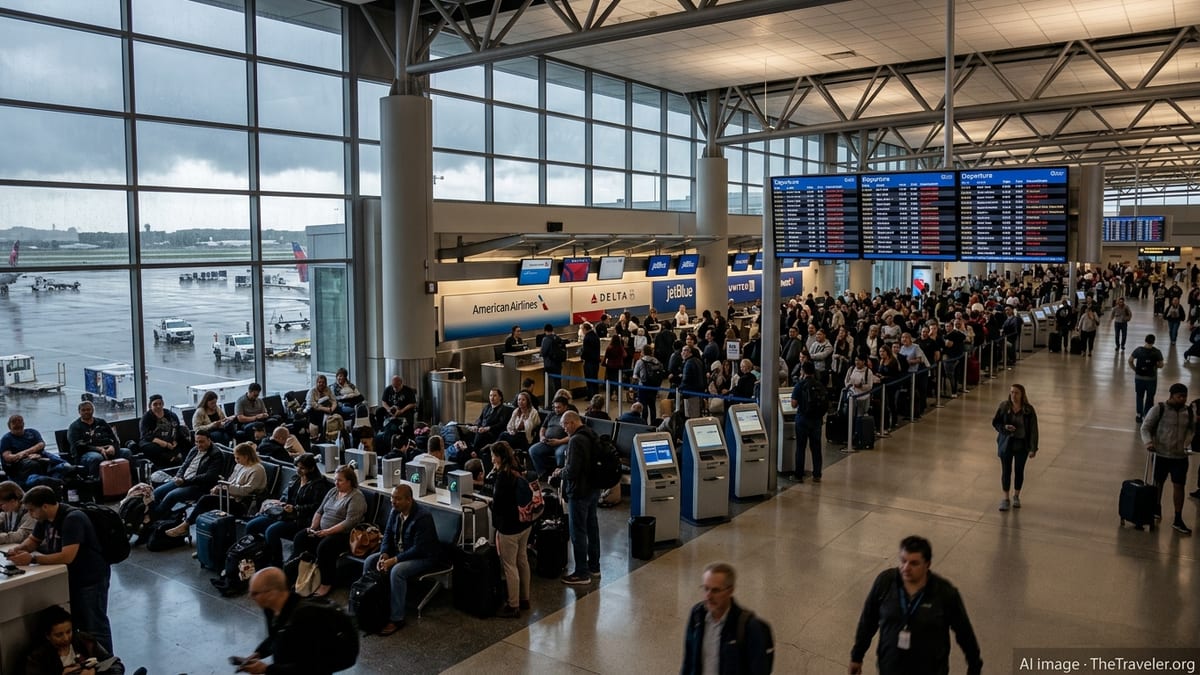
Hundreds of passengers were left stranded at Boston Logan International Airport as nearly 200 flights were delayed and dozens cancelled, with ripple effects disrupting major U.S. airlines and air links between Boston and New York.
Get the latest news straight to your inbox!
Severe Weather Triggers Widespread Flight Disruptions
Publicly available flight-tracking data and news coverage indicate that a band of powerful late-winter storms crossing the Northeast has triggered significant operational disruption at Boston Logan International Airport. At the height of the disruption period, 198 flights were reported delayed and 32 cancelled, affecting departures and arrivals across multiple terminals.
The latest disturbance comes as the wider northeastern United States continues to grapple with a turbulent March weather pattern that has already produced damaging winds, heavy rain, and localized coastal flooding in parts of New England. According to published coverage of recent storms, strong gusts and saturated ground conditions have repeatedly challenged airport operations in the region, from Boston to New York’s major hubs.
While Boston Logan has experienced far larger shutdowns during historic blizzards and major winter storms earlier in the season, the current wave of delays and cancellations is notable because it coincides with a busy mid-March travel window. Many affected passengers are leisure travelers returning from school holidays or short business trips between Boston and New York, contributing to heavy concentrations of crowds in concourses and at rebooking desks.
Major U.S. Airlines See Schedules Upended
The disruption has rippled across the networks of American Airlines, Delta Air Lines, JetBlue Airways, United Airlines, and Southwest Airlines, all of which operate multiple daily flights in and out of Boston Logan. Publicly accessible flight status boards show delays spreading through key domestic routes, particularly the high-frequency shuttle-style services connecting Boston with New York’s LaGuardia and John F. Kennedy airports, as well as Newark Liberty International Airport.
Reports indicate that JetBlue, which maintains a substantial presence at Boston Logan, has seen a succession of delayed departures on Boston–New York and Boston–Florida routes as aircraft and crews fall out of position. Delta and American, which compete heavily on the Boston–New York corridor, have also faced rolling delays and select cancellations, especially during the morning and evening peaks when weather-related congestion tends to be most acute.
United and Southwest have not been spared. United’s Boston services into Newark and other Midwestern and West Coast hubs have experienced knock-on schedule issues as weather and air traffic constraints compound. Southwest, which relies on quick aircraft turnarounds to maintain dense schedules, has faced added pressure to manage gate availability and crew duty-time limits as delays build through the day.
According to historical data compiled by federal transportation agencies, such clusters of delays can quickly spread through airline networks. When a bank of flights is disrupted at a hub like Boston or New York, aircraft and crews arriving late are often scheduled to operate onward legs, forcing airlines to juggle rotations or cancel flights outright to reset their operations.
Impact on Passengers Across Boston and New York
Inside Boston Logan, the operational strain has translated into long queues at check-in counters, customer service desks, and rebooking kiosks, according to descriptions shared in public forums and local coverage. Travelers bound for New York have reported extended waits as they try to secure alternative departures, or in many cases, completely different routings via other hubs to reach their final destinations.
The high-density corridor between Boston and New York is particularly sensitive to disruptions, as it is served by multiple daily flights on several carriers and also sits beneath some of the busiest airspace in the United States. When storms or high winds constrain takeoff and landing slots at either end, even minor delays can accumulate into multi-hour disruptions as each subsequent flight loses its scheduled place in the traffic flow.
Some travelers have turned to Amtrak and intercity buses as backup options between Boston and New York when flight cancellations mount, a familiar pattern during major weather events in the Northeast. However, with many passengers already in the airport system and checked baggage in airline custody, switching modes of transport can be complicated, leaving large numbers of people in limbo while they wait for updated departure times.
Families with children, elderly travelers, and international passengers making onward connections appear to be among the most affected, as they face uncertainty not only in reaching New York but also in protecting longer-haul itineraries that depend on timely arrivals into major hubs.
Operational Challenges at Boston Logan During Storm Season
Boston Logan International Airport occupies a constrained waterfront site, with multiple intersecting runways and tightly packed terminals. Aviation analysts note that this configuration, while efficient during normal operations, can become challenging when strong crosswinds or low visibility limit which runways can be used. When runway capacity is reduced, air traffic controllers must space out arrivals and departures more widely, leading to congestion and cascading delays.
Published analyses of recent winter storms show that New England airports are particularly vulnerable to combinations of heavy precipitation and high winds. Even when snow totals are modest, gusts off Boston Harbor can force aircraft to taxi more slowly and increase the time needed between takeoffs and landings. De-icing operations, which require specialized equipment and precise sequencing, can add further minutes to each departure cycle during mixed precipitation or rapidly changing temperatures.
Once delays surpass a certain threshold, airlines may opt to preemptively cancel selected flights at Boston in order to preserve the integrity of their broader networks. These decisions are typically weighted against aircraft availability, crew work-hour rules, and the relative importance of connecting traffic at downline hubs. The result for travelers, however, is often the same: fewer seats available on remaining flights and longer waits for rebooking.
In recent years, airport operators and airlines have invested in improved forecasting tools and coordination procedures to manage such events. Nevertheless, the latest disruption underscores how quickly a dynamic weather pattern can overpower even robust contingency plans at a major northeastern gateway.
What Travelers Can Expect in the Coming Days
With forecasters signaling that unsettled conditions may persist over parts of the Northeast, travelers planning to fly through Boston Logan and New York area airports in the short term are likely to encounter residual delays. Airline network recovery often lags behind the weather itself, as aircraft and crews need time to return to their planned positions.
Publicly available advisories from carriers generally encourage passengers to monitor their flight status frequently on official channels and to allow extra time at the airport, particularly during early morning and late afternoon banks when schedules are densest. Same-day travel flexibility policies, which are sometimes activated during disruptive weather, may provide options for customers to move to earlier or later flights when seats permit.
For those already stranded at Boston Logan, the immediate focus remains on securing seats on departing flights, arranging overnight accommodation where necessary, and managing missed connections into and out of New York. As operations gradually stabilize, attention is likely to turn to questions around compensation, travel credits, and how airlines communicate with passengers during rapidly evolving situations.
The latest episode at Boston Logan reinforces a broader pattern seen throughout this stormy season. Even on days with far fewer cancellations than the largest winter events, a combination of marginal weather, congested airspace, and tightly timed airline schedules can leave hundreds of travelers unexpectedly grounded at one of New England’s most important gateways.