

More news on this day
Severe winter weather sweeping the U.S. East Coast has triggered a fresh wave of travel disruptions for passengers flying to and from South Korea, as Korean Air and Philippine Airlines cancel multiple long-haul services on key routes linking Seoul with New York, Boston, Manila and other destinations.
Blizzard Conditions in the U.S. Ripple Across Transpacific Routes
A powerful blizzard affecting much of the northeastern United States has rapidly escalated into a global aviation problem, with South Korea’s main gateway at Incheon International Airport now feeling the impact. Airlines across the region are preemptively trimming schedules, citing safety concerns and mounting congestion at already strained East Coast hubs.
New York and Boston, two of the hardest hit cities, have seen the bulk of the schedule cuts as visibility plunges, winds strengthen and snow accumulation intensifies. These airports serve as critical anchors for transpacific traffic from Seoul, meaning any prolonged disruption quickly cascades through the network and strands passengers across multiple continents.
Flight-tracking data and airline statements on Monday indicated thousands of flights canceled or delayed into and out of major northeastern airports over the past 24 to 48 hours, with more disruptions expected as the storm system lingers. For Korean carriers and their partners, the timing is particularly painful, coming during a busy period for both business travelers and winter holidaymakers.
South Korean aviation officials have urged travelers holding tickets to New York, Boston and other affected East Coast cities to check their flight status frequently and to consider deferring nonessential travel until the system passes and schedules stabilize.
Korean Air Scraps Multiple New York and Boston Departures
Korean Air, South Korea’s flag carrier, moved early to pull several of its high-profile U.S. East Coast services rather than risk airborne diversions or lengthy tarmac delays. The airline has canceled multiple Incheon to New York flights, including services operating under flight numbers KE081, KE082 and KE085, along with the corresponding New York to Incheon service KE086.
The carrier has also halted at least two Boston rotations, suspending KE091 and KE092 between Incheon and Boston as conditions at Boston Logan deteriorated. The cancellations effectively pause Korean Air’s nonstop Seoul links to Boston for the duration of the storm window, forcing passengers to seek rerouting options through other hubs or postpone trips altogether.
Operational planners at Korean Air are contending with a familiar winter dilemma: whether to launch long-haul departures from Incheon when the conditions at destination airports are changing by the hour. With flying times of roughly 13 to 15 hours between Seoul and the U.S. East Coast, any misjudgment can leave aircraft in holding patterns, diverted to secondary airports or returning to origin, each scenario adding significant cost and complexity.
In a brief statement, the airline said it would focus on “minimizing inconvenience” by offering alternative itineraries and expanding capacity on subsequent days once the storm clears. Additional widebody aircraft and upgauged flights are expected to be deployed on the Seoul to U.S. routes later in the week to accommodate displaced travelers.
Philippine Airlines Adjusts Seoul–Manila and Beyond Amid Knock-on Delays
Philippine Airlines has also joined the growing list of Asian carriers trimming schedules as a result of the winter system, canceling or retiming a number of services touching Seoul. The airline uses Incheon as a key spoke in its wider network, feeding passengers from South Korea into its Manila hub for onward connections throughout Southeast Asia, Australia and the Pacific.
With long-haul aircraft and crews delayed or out of position due to East Coast weather-related disruptions and congestion at intermediate stops, Philippine Airlines has canceled select Seoul–Manila rotations and reduced capacity on others. These tactical cuts are designed to give the carrier breathing room to reset schedules, ensure crew rest compliance and avoid further knock-on delays spreading across its network.
Passengers traveling between Incheon and Manila, including those holding through-tickets onward to destinations such as Cebu, Davao or Sydney, are being offered rebooking options on later flights or alternative routings where available. However, high seasonal demand and limited spare capacity mean that not all travelers can be accommodated on their preferred dates.
Airport agents in both Seoul and Manila reported unusually long queues at transfer desks on Monday as customers sought updated itineraries, refunds or travel credits. Some passengers have opted to remain in South Korea until operations stabilize, while others with urgent travel needs are piecing together multi-stop journeys via Tokyo, Taipei or Singapore.
Five Major Flights Canceled and Thousands of Passengers Affected
Between Korean Air’s New York and Boston cancellations and Philippine Airlines’ Seoul-linked adjustments, at least five major long-haul and regional flights were scrapped or heavily curtailed in a single 24-hour period. Industry analysts say the true reach of the disruption is far greater than that raw number suggests, given the complex web of connections and code-share agreements attached to each departure.
A typical nonstop from Seoul to New York or Boston carries not only point-to-point travelers but also passengers originating in cities across Asia, including Tokyo, Shanghai, Bangkok and Manila, who connect through Incheon. When such flights are canceled, these customers must often be rebooked from their origin city, unraveling carefully timed itineraries spanning multiple carriers and time zones.
The current wave of cancellations also interacts with earlier schedule shifts in the Korean market, where carriers have been adjusting winter frequencies to North America and Southeast Asia amid changing demand patterns and capacity constraints. As a result, there is less slack in the system to absorb unexpected shocks, leaving airlines with fewer spare seats and aircraft to deploy at short notice.
Travel agents in Seoul report that some passengers on canceled services are being pushed back several days, particularly those in economy cabins or traveling on discounted fares with limited flexibility. Premium cabin travelers, by contrast, are seeing somewhat better odds of finding space on near-term departures as airlines seek to preserve high-yield revenue.
Scenes on the Ground at Incheon and Affected Airports
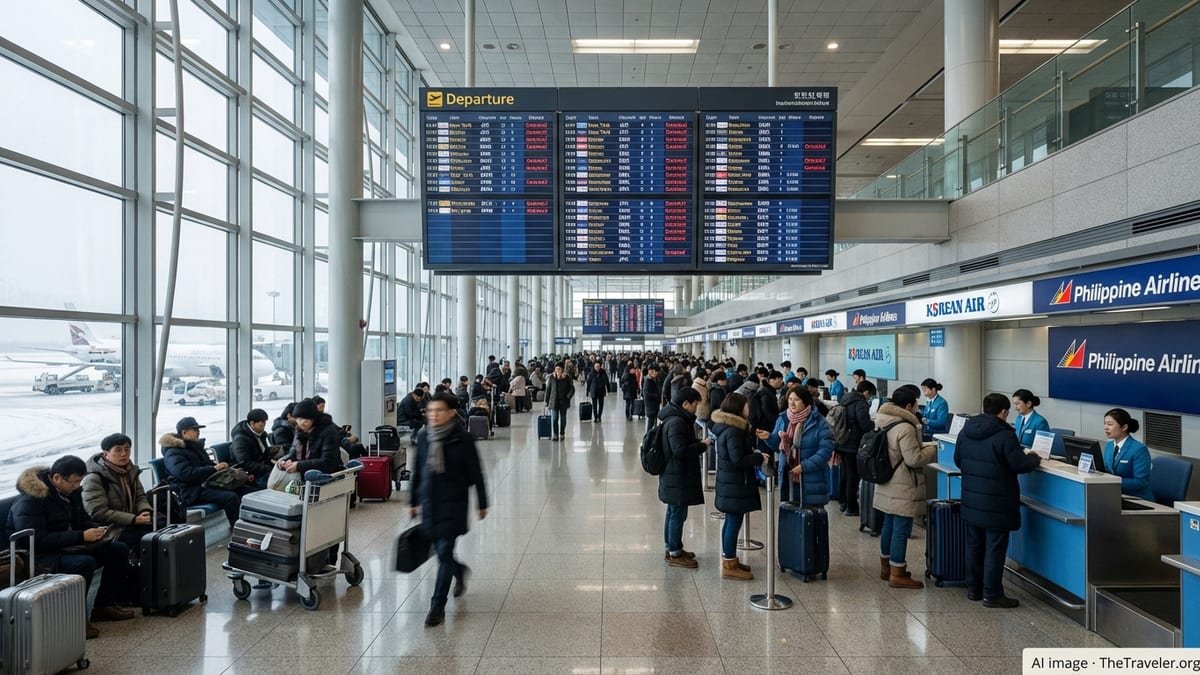
At Incheon International Airport, one of Asia’s busiest hubs, departure boards on Monday showed a growing cluster of red “canceled” and “delayed” notices against flights bound for New York, Boston and connecting destinations. While overall operations remained orderly, the mood among travelers was tense as news of the East Coast blizzard filtered in via television screens and airline announcements.
Check-in counters for Korean Air and Philippine Airlines saw surges of passengers seeking clarification on whether their flights would still operate. Airline staff handed out meal vouchers, hotel information and rebooking instructions, while urging customers to make use of mobile apps and call centers where possible to reduce congestion at airport desks.
Reports from New York’s John F. Kennedy and LaGuardia airports, as well as Boston Logan, described snow-covered ramps, plow convoys working around the clock and long lines at customer service counters. Many arriving transpacific passengers found that their onward domestic connections along the East Coast had already been canceled, forcing overnight stays or long rail and bus journeys to reach final destinations.
Despite the widespread frustration, most travelers interviewed at Incheon acknowledged that safety must take precedence over punctuality, especially on long-haul flights. Several noted that the early cancellations at least gave them time to adjust plans rather than face last-minute turnbacks after boarding.
Airlines Activate Waivers, Rebooking and Protection Measures
Both Korean Air and Philippine Airlines have activated flexible rebooking policies in response to the winter storm, echoing similar travel waivers introduced by major U.S. carriers. Affected passengers can, in most cases, change their travel dates without penalty, and in some scenarios reroute through alternative gateways where capacity allows.
Travel advisors urge customers to read the fine print of these waivers, which typically specify eligible ticketing dates, travel periods and origin and destination points. In many cases, fare differences are still payable if travelers choose to reroute to or from a different city, or to shift peak-day flights to more desirable midweek departures once operations normalize.
For those whose plans are no longer viable, refund options vary by fare class and airline. Fully flexible tickets can often be refunded in cash, while many discounted economy fares may be refunded only in travel credits or vouchers. Some passengers who booked through online travel agencies report longer processing times for changes or refunds compared with working directly with the airline.
Insurers say the episode is a reminder of the value of travel insurance policies that cover weather-related interruption. However, coverage limits and exclusions differ widely, and travelers are being encouraged to review policy terms carefully before filing claims related to hotel stays, missed tours or nonrefundable ground arrangements.
Broader Impact on Tourism Between South Korea and the U.S. and Philippines
The latest storm-driven disruptions come at a time of gradually strengthening tourism flows between South Korea, the United States and the Philippines. Seoul’s role as a major connecting gateway makes it particularly sensitive to operational shocks at partner airports across the Pacific, including in North America and Southeast Asia.
Tour operators handling U.S. travelers bound for South Korea say they are working overtime to rearrange itineraries, especially for those with tightly packed schedules that include ski trips, cultural tours or business meetings timed around fixed events. Some groups have opted to shorten stays in Seoul or adjust plans in the Philippines to accommodate the loss of a travel day at the beginning or end of their journeys.
Philippine carriers and tourism officials are watching seat capacity closely, as cancellations on the Seoul–Manila corridor can affect inbound arrivals from South Korea, historically one of the Philippines’ largest tourism source markets. Any prolonged reduction in frequencies could weigh on hotel occupancy and tour bookings in popular destinations such as Boracay and Palawan.
At the same time, some industry voices note that demand tends to rebound quickly once weather systems pass and flight schedules stabilize. Airlines often respond by adding temporary extra sections or deploying larger aircraft, allowing many travelers to complete postponed trips within a matter of days.
What Travelers Should Do Now
With conditions along the U.S. East Coast still evolving, travelers scheduled to fly between Seoul and cities such as New York, Boston and Manila in the coming days are being advised to take proactive steps. Checking flight status directly through airline websites or mobile apps on the day of travel remains essential, as schedules can change multiple times within a short period.
Passengers who have not yet commenced their journeys and whose trips are not time-critical may want to take advantage of fee-free changes to shift their travel to later in the week, once the storm has moved offshore and airport operations have recovered. Those with urgent travel requirements may find more options if they are flexible about routing, including accepting connections through West Coast hubs like Los Angeles or San Francisco rather than flying directly into the storm-affected Northeast.
At the airport, experts recommend arriving earlier than usual to accommodate longer lines at security, check-in and customer service desks. Keeping essential items such as medications, chargers and a change of clothes in carry-on bags can ease the strain of unexpected overnight stays or extended layovers.
For now, airlines in South Korea and across the region are watching the weather maps and revising flight plans hour by hour. While the current wave of cancellations has clearly upset travel plans for many, carriers insist that conservative decisions made today should help them restart their transpacific networks more smoothly once the skies over the East Coast finally clear.