

More news on this day
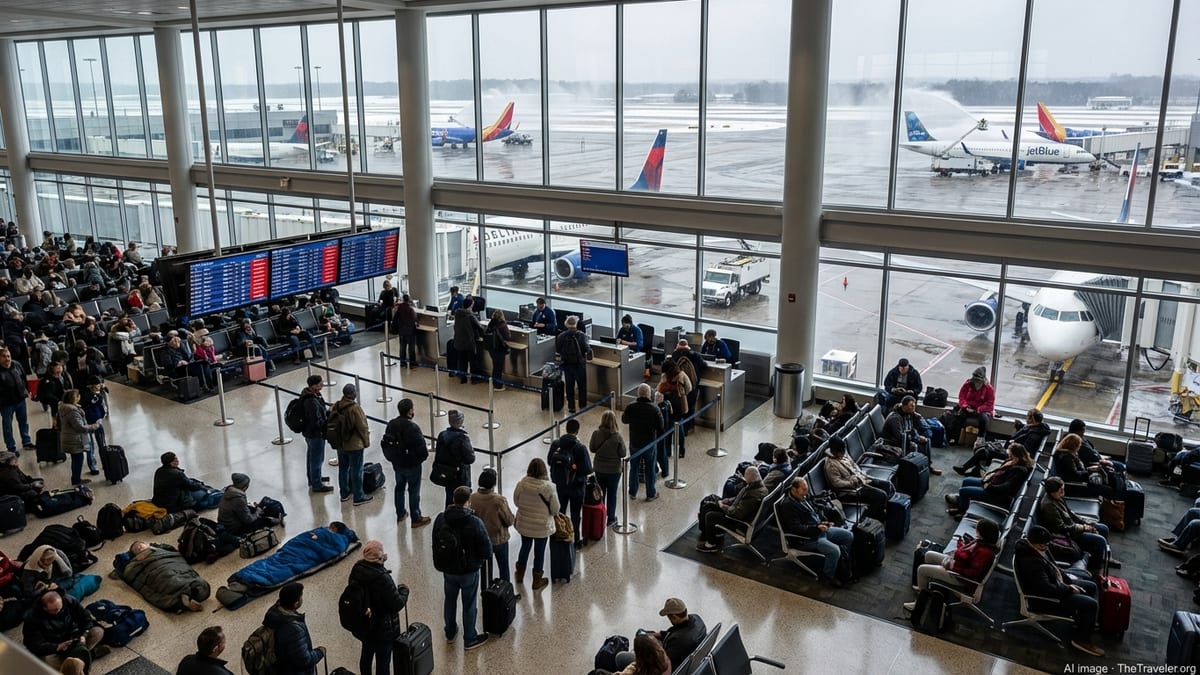
Bad weather tied to powerful Winter Storm Hernando left hundreds of travelers stranded at Hartsfield-Jackson Atlanta International Airport on Sunday, as Delta, Southwest, Frontier, JetBlue, Republic and other carriers faced at least 122 cancellations and 649 delays nationwide, snarling major U.S. routes to Philadelphia, Newark Liberty, Boston, Nashville, Charleston and a growing list of cities across the East Coast and beyond.
Atlanta Feels the Ripple Effect of a Northeast Blizzard
Hartsfield-Jackson Atlanta International Airport, typically a model of efficiency and the world’s busiest passenger hub, found itself at the center of a fresh wave of disruption on February 22 as a fast-intensifying nor’easter in the Northeast sent shockwaves through airline schedules. While conditions above Atlanta itself remained largely flyable for much of the morning, the cascading impact of Winter Storm Hernando on the broader U.S. network meant that aircraft, crews and connections could not reach the city on time.
By midday, flight-tracking data showed at least 122 cancellations and 649 delays across the U.S. tied to the sprawling weather system, with Atlanta emerging as a key chokepoint for travelers attempting to connect between the South and storm-battered cities including Philadelphia, Newark, Boston, Nashville and Charleston. Delta Air Lines, Atlanta’s dominant carrier, along with Southwest, Frontier, JetBlue, regional operator Republic and several smaller airlines all reported schedule adjustments as they struggled to reposition planes and protect crews.
For passengers on the ground, the distinction between local and remote weather quickly blurred. Gate areas filled with travelers camped out on the floor or clustered around power outlets, staring at departure screens that flipped with a steady march of delay notifications. In many cases, flights technically departing Atlanta were held back or scrubbed entirely because their destination airports were facing ground delays, deicing backlogs or arrival flow restrictions triggered by snow and strong winds.
Airport officials said core operations at Hartsfield-Jackson remained open, but acknowledged that the volume and reach of the nor’easter meant there was little they could do to shield customers from the broader gridlock sweeping the national system. “When our major Northeast partners slow down, the networks that connect through Atlanta are going to feel it,” one official noted.
Winter Storm Hernando Slams the Northeast Corridor
The immediate culprit behind Sunday’s travel misery is Winter Storm Hernando, a powerful nor’easter tracking up the Eastern Seaboard and forecast to deliver blizzard conditions to portions of the Mid-Atlantic and New England. Meteorologists warned that the storm, which began consolidating off the Southeast coast late Saturday, would rapidly intensify as it curved north, drawing moisture from the Atlantic and cold air from the interior to create heavy, wind-driven snow.
Blizzard and winter storm warnings blanketed a wide swath of the Interstate 95 corridor, with forecasters calling for more than a foot of snow in some metropolitan areas between Philadelphia and Boston. New York City, northern New Jersey and coastal New England faced some of the highest snow totals and strongest wind gusts, prompting state and local officials to declare emergencies, restrict nonessential travel and warn residents to expect whiteout conditions and power outages.
The National Weather Service described the storm as having “significant impacts” across highly populated regions, with near-zero visibility and dangerous wind chills expected at the height of the system. By late morning Sunday, airlines had canceled thousands of flights systemwide for the day and preemptively scrubbed additional services for Monday, reflecting the expectation that digging out runways, restarting deicing operations and recalling crews would take time even after the snow subsides.
For Atlanta-based travelers, many of whom had already endured a winter punctuated by smaller disruptive weather systems, Hernando represented a worst-case scenario: a major coastal storm striking precisely the airports that anchor their domestic and transatlantic journeys. The result was an abrupt halt in the flow of aircraft between key Northeast hubs and the South, with Atlanta bearing much of the resulting congestion.
Delta and U.S. Carriers Scale Back Schedules and Issue Waivers
Delta Air Lines, headquartered in Atlanta and heavily reliant on Hartsfield-Jackson as its primary hub, moved aggressively to thin its schedule to and from the Northeast in anticipation of worsening conditions. The airline extended weather waivers for customers traveling through affected airports, allowing passengers to rebook without change fees and, in many cases, fare differences if they shifted their trips outside the storm window.
In a statement, Delta said it expected to suspend operations at its New York LaGuardia, New York JFK and Boston Logan hubs into February 24 due to the severity of the winter weather, with additional knock-on disruptions likely at Philadelphia, Newark and smaller regional airports throughout New England and the Mid-Atlantic. That preemptive scaling-back meant that a significant number of flights connecting via Atlanta were either canceled outright or retimed into already congested windows later in the week.
Southwest, Frontier, JetBlue, Spirit, Republic and other carriers that rely on Atlanta for point-to-point and connecting traffic also implemented their own weather waivers and network adjustments. Several low-cost airlines trimmed schedules into the Philadelphia and Boston markets, while regional operators that feed larger carriers reduced frequencies to secondary cities as crews timed out and aircraft faced lengthy deicing queues.
Industry analysts noted that such proactive cancellations, while frustrating in the short term, are often designed to prevent even worse operational meltdowns once a storm is fully underway. By pulling down the schedule, airlines can concentrate their resources on a more manageable number of flights, reducing the likelihood of aircraft stranded out of position and crews scattered away from their primary bases for days.
Major Routes to Philadelphia, Newark, Boston, Nashville and Charleston Hit Hard
Among the routes hardest hit on Sunday were those linking Atlanta with Philadelphia, Newark Liberty and Boston Logan, three Northeast gateways firmly within the storm’s crosshairs. Flights that did operate often departed with lengthy ground delays as destination airports cycled through runway plowing, deicing and air traffic flow restrictions. Arrival banks into Atlanta were similarly choppy, with aircraft sometimes holding for extended periods or diverting when local weather deteriorated faster than expected.
Travelers bound for Nashville and Charleston also saw disruptions, though in many cases the issue was not direct snowfall but the wider network impact of aircraft and crews coming from or heading to storm-affected regions. Several Nashville-bound flights were canceled after planes scheduled to operate them failed to arrive from Philadelphia or New York. In Charleston, a mix of coastal winds, rain and low clouds complicated operations, further slowing the recovery for carriers trying to keep at least some of their Southeastern routes intact.
The ripple effects extended far beyond the immediate storm zone. Routes from Atlanta to Florida, Texas and the West Coast recorded elevated delay levels as airlines attempted to consolidate passengers from multiple canceled flights onto a smaller number of departures. For many travelers, even flights between cities with clear skies ended up delayed or canceled because their aircraft had been trapped somewhere along the snarled Northeast corridor earlier in the day.
“It’s like a traffic jam that starts in one part of the highway but eventually backs up miles and miles beyond the original crash,” said one aviation consultant. “Atlanta is one of the key interchanges in that system, so you see the knock-on effects very quickly when the Northeast goes down.”
Inside the Terminal: Long Lines, Frayed Tempers and Creative Workarounds
Inside Hartsfield-Jackson’s sprawling concourses, the human impact of the statistics was immediately visible. Check-in zones and customer service counters saw lines stretching deep into the terminal as frustrated passengers tried to secure new itineraries, hotel vouchers or meal credits. Airline employees repeatedly urged travelers to use mobile apps and websites for rebooking where possible, but cell networks and booking platforms slowed at points under the surge in demand.
Some travelers reported having to wait several hours to speak to an agent in person, particularly those with complex international itineraries connected to early-week departures from New York, Newark or Boston that had already been canceled. Families with small children sprawled on the floor near windows, with makeshift picnic setups of airport snacks and phone chargers. Business travelers hunted for quiet corners to take calls as they rearranged meetings and presentations that had been planned around now-impossible arrival times.
Amid the frustration, airport volunteers and airline staff distributed basic supplies such as bottled water and snack packs in the busiest concourses, while local concessions extended hours to cope with the crowd. Many hotels near the airport filled up quickly as carriers issued overnight vouchers for passengers stranded by late-day cancellations, sending shuttle buses looping continuously between the terminals and nearby properties.
Security operations remained steady, with the Transportation Security Administration reporting manageable wait times in most checkpoints despite the crowds. Officials explained that while the volume of people inside the building was higher than usual for a Sunday, the actual number of flights attempting to depart was lower because of the cancellations, easing some pressure on the security lanes.
How Weather Ground Stops and Flow Controls Compound Disruption
Behind the scenes, a complex web of weather-related restrictions and air traffic management tools played a central role in Sunday’s disruptions. As snow, low visibility and strong winds reduced the operational capacity of airports in the Northeast, the Federal Aviation Administration implemented a series of ground delays and, in some cases, temporary ground stops for flights bound for affected hubs. These measures are designed to prevent excessive holding patterns and congestion in the skies by effectively slowing the arrival rate into constrained airports.
For Atlanta-bound and Atlanta-originating flights, these controls meant departure times were frequently pushed back while dispatchers and air traffic controllers waited for updated slots into saturated arrival banks. In some instances, airlines opted to cancel flights altogether rather than risk extended tarmac waits that could run afoul of federal rules limiting how long passengers may remain on board without access to the terminal.
Deicing was another major factor, particularly at northern airports where heavy, wet snow and gusty winds forced repeated treatment of aircraft surfaces and runways. Each deicing cycle can add significant time to a flight’s pre-departure sequence, and when multiplied across dozens or hundreds of aircraft in a storm, the cumulative delays become substantial. Even flights operating between relatively clear-weather airports can be affected if their aircraft previously passed through a snowbelt city the same day.
Aviation experts emphasized that while such delays are disruptive, they reflect a safety-first approach. Aircraft performance can be severely compromised by ice accumulation, and high crosswinds or blowing snow on runways can exceed the safe operating limits for certain types of planes. Airlines and regulators therefore tend to set conservative thresholds during major winter storms, prioritizing safe though limited operations over attempting to maintain a normal schedule.
What Stranded Passengers Can Do Now
For travelers caught in Sunday’s tangle at Atlanta and other U.S. airports, the immediate priority was rebooking and securing basic needs such as meals and accommodations. Airlines urged customers to use mobile apps and official call centers before heading to the airport if their flights were not scheduled for the same day, noting that standing in line at a counter would not necessarily yield faster results in the current environment.
Passengers were also encouraged to stay flexible about routings and even destination airports where possible. With Philadelphia and Newark facing some of the most challenging conditions, for example, some travelers were rebooked into Washington, Baltimore or alternative New England airports with the expectation of continuing the last leg of their journey by rail or rental car once roads reopened. Others opted to push their travel several days forward to avoid the tail of the storm and the early stages of the systemwide recovery.
Consumer advocates reminded affected passengers to familiarize themselves with each airline’s policies on meal vouchers, hotel accommodations and refunds, which can vary depending on whether a disruption is classified as weather-related or within the carrier’s control. While U.S. regulations do not uniformly mandate compensation for weather disruptions, airlines often offer goodwill gestures on a case-by-case basis, particularly for travelers facing overnight delays or repeated cancellations.
In the meantime, travel experts advised anyone with flights scheduled into or out of the Northeast through at least Tuesday to monitor their itineraries closely, sign up for text or app notifications and be prepared for further schedule changes as Winter Storm Hernando continues its march up the coast.
Lingering Effects Expected Even After the Snow Stops
Although forecasters expect the heaviest snow and strongest winds from Hernando to ease by late Monday in many areas, the aviation industry is bracing for residual impacts that could stretch well into the week. Clearing runways and taxiways, digging out gate areas and restoring full staffing levels will take time at major hubs that have seen more than a foot of accumulation, especially if strong winds cause additional drifting and periodic runway closures.
Airlines will then face the complex task of rebalancing their fleets and crew rosters after several days of widespread schedule disruption. Aircraft that ended up on the wrong side of the storm must be ferried back into position, and pilots and flight attendants who reached their federally mandated duty limits during the height of the disruption will require rest before returning to service. These operational realities often result in pockets of cancellations and delays even under clear skies as the system resets.
For Atlanta, that recovery process will be closely watched. As the primary Southern link in many coast-to-coast itineraries, the airport’s ability to handle a surge of rebooked passengers and repositioned aircraft will be critical to restoring normalcy across multiple domestic and international networks. Airline planners are expected to add extra capacity on select routes, including those to and from Philadelphia, Newark, Boston, Nashville and Charleston, to clear backlogs once conditions permit.
Until then, travelers are being urged to build extra margin into their plans, avoid nonessential trips through the hardest-hit regions and treat published airline schedules as provisional during what is shaping up to be one of the most consequential winter storms of the season.