

More news on this day
Storm Pedro’s unrelenting rain and widespread flooding have pushed France’s transport network into fresh turmoil, with major hubs in Paris and Nice reporting dozens of flight cancellations, hundreds of delays and mounting frustration among stranded passengers.
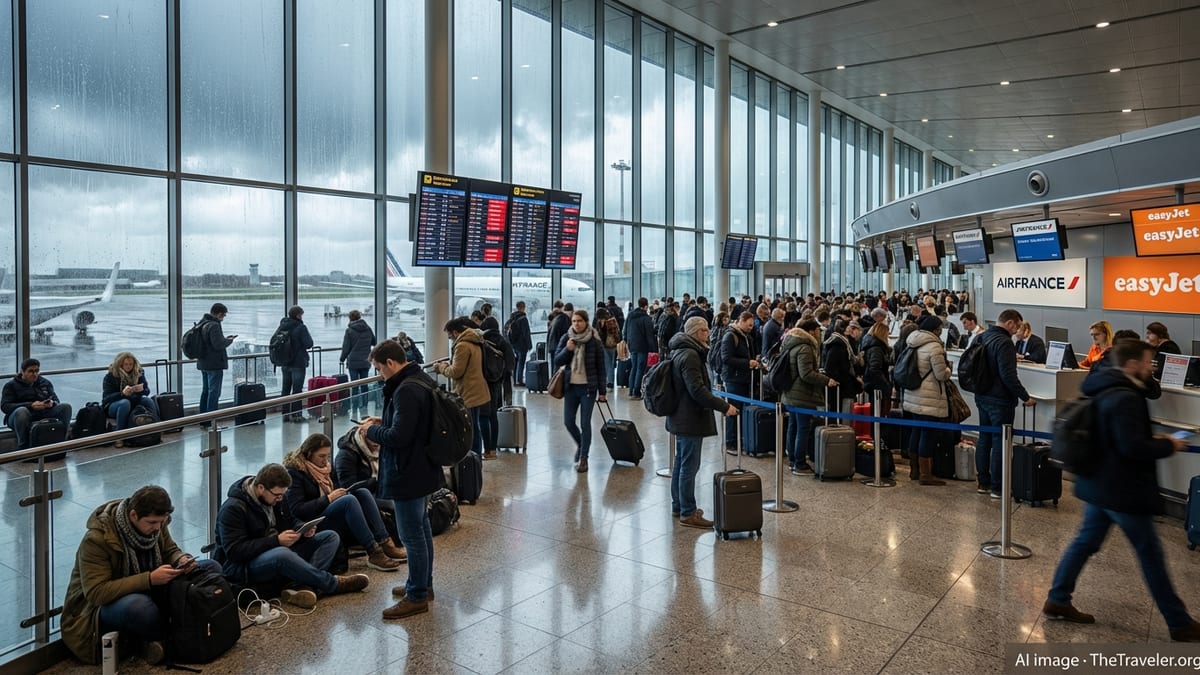
Storm Pedro Batters a Rain-Soaked France
As Storm Pedro sweeps across southwestern and western France, authorities are warning of a prolonged period of disruption on the ground and in the air. The weather system has arrived on top of what forecasters describe as an exceptional stretch of wet weather, with France enduring more than a month of almost continuous rain and river levels at historic highs. The result is a country struggling to keep its key infrastructure functioning while emergency services respond to rising waters and renewed flood risks.
Météo-France has kept several departments along the Atlantic seaboard on heightened alert as successive bands of heavy rain move inland. In Gironde, Lot-et-Garonne, Maine-et-Loire and Charente-Maritime, flood warnings remain at their highest level as swollen rivers threaten levees and low-lying districts. Farther north and east, a broad swathe of the country sits under secondary alerts for strong winds, coastal storm surges and further downpours on already saturated soil.
The national flood-monitoring service reports that soil moisture readings are at their highest since records began in the late 1950s, reducing the ground’s capacity to absorb new rainfall. Against this backdrop, Pedro’s arrival has quickly translated into surface flooding, road closures, rail disruption and mounting pressure on airports attempting to maintain safe operations in the face of shifting wind patterns and poor visibility.
While meteorologists describe Pedro as a typical winter storm in terms of intensity, it is the timing and the cumulative impact of successive systems that have made this episode so disruptive. With rivers already overtopping in parts of the southwest and coastal communities braced for powerful Atlantic swells, even moderate increases in rainfall and wind speeds are enough to push infrastructure past its limits.
Paris and Nice Airports Grapple With Cancellations and Delays
Air travel has quickly emerged as one of the most visible casualties of the latest bout of extreme weather, with Paris Charles de Gaulle, Paris Orly and Nice Côte d’Azur among the hardest-hit airports. As Storm Pedro’s rain bands moved across the country, operators reported a fresh wave of cancellations and rolling delays, compounding existing challenges from this turbulent winter season.
At Charles de Gaulle, France’s main long-haul hub, air-traffic controllers and ground operations teams have had to manage shifting wind conditions, reduced visibility in heavy rain and knock-on congestion in the airspace above northern France. Airlines implemented precautionary schedule cuts, trimming marginal flights and reducing peak-hour operations to ensure that the flights which do operate can do so safely and with available crews and de-icing capacity.
Nice Côte d’Azur, exposed to turbulent coastal winds and low cloud sweeping in from the Mediterranean, has also seen a noticeable impact. A mix of domestic and European services have been cancelled or delayed, with passengers reporting lengthy queues at customer-service desks and crowded departure halls as airlines race to rebook disrupted travelers. Even short weather-related holds have turned into hours-long waits due to the tightly packed schedules typical of low-cost and regional operations.
Although the total number of flights affected at each airport shifts throughout the day as conditions evolve, aviation data shows that the combined effect at Paris and Nice runs to dozens of cancellations and many hundreds of delays over a relatively short period. For passengers, the distinction between a minor schedule adjustment and a complete cancellation has often become academic, as missed connections and crew shortages ripple through timetables.
Major Airlines Hit: Air France, easyJet, KLM and Partners
The latest disruption has landed squarely on the shoulders of Europe’s biggest carriers, with Air France, easyJet and KLM all reporting significant operational challenges on routes touching France. As the national flag carrier and principal operator at Charles de Gaulle and Orly, Air France has shouldered a large share of the cancellations and delays, including services linking Paris with key European cities such as Florence, Amsterdam and Frankfurt, as well as long-haul connections to North America and Africa.
Low-cost giant easyJet, which operates a dense network of flights in and out of Paris and Nice, has likewise been forced to trim rotations and accept prolonged ground delays. Its point-to-point model, designed for tight turnaround times, is particularly vulnerable when adverse weather disrupts a single leg, often forcing multiple subsequent flights on the same aircraft to depart late or be cancelled altogether.
KLM, Air France’s Dutch partner within the Air France-KLM group, is experiencing its own challenges as Pedro’s influence overlaps with broader winter weather patterns across northwestern Europe. Amsterdam Schiphol, a key hub for KLM and an important gateway for connecting traffic between Europe and intercontinental destinations, has taken a series of weather-related hits in recent weeks. Cancellations and extended ground times in Amsterdam quickly cascade into disruption for flights to and from Paris and Nice, as shared fleets and joint schedules struggle to recover.
Other carriers, including European network airlines and regional operators, have also been forced to adjust their French schedules. Lufthansa, British Airways and several Mediterranean and North African airlines have reported weather-related changes on services touching Paris, Marseille, Toulouse and Nice. Although some of these carriers operate only a handful of daily flights to France, the cancellation of even one or two rotations can leave passengers without same-day alternatives.
Knock-On Effects Across European and Long-Haul Networks
The immediate impact of Storm Pedro is most visible on departure and arrival boards in France, but the disruption has quickly spread far beyond the country’s borders. Delays and cancellations at Paris and Nice have triggered missed connections for passengers en route to destinations in Italy, Germany, the Netherlands, the United States and beyond, with hubs such as Amsterdam, Florence and Chicago among those seeing knock-on effects.
For many travelers, the problem is not merely a delayed departure from France but the unraveling of complex itineraries stitched together across multiple carriers and alliances. A late or cancelled feeder flight into Paris can mean missed long-haul departures, re-routing through alternative hubs and last-minute overnight stays. Airline call centers and online rebooking systems have been inundated as customers search for remaining seats on already busy winter services.
The strain is particularly acute on transatlantic and Africa-bound routes, where frequencies are lower than on short-haul European sectors and spare capacity is limited. Flights that do operate are often departing with a heavy load of rebooked passengers, leaving little room for those whose travel plans are still being finalized or who face new disruptions later in the day. In some cases, travelers have been offered re-routing via third countries or alternative alliance hubs, adding hours to journeys and increasing the logistical challenges of baggage handling and immigration formalities.
Within Europe, rail services that might otherwise absorb some of the pressure have themselves been hampered by flooding and infrastructure damage in western France. That has left fewer options for passengers hoping to switch from air to rail at short notice, especially on busy corridors linking Paris with Bordeaux, Toulouse and coastal destinations. The combined stress on air and rail systems underscores how a single, persistent weather system can test the resilience of interconnected transport networks.
Passenger Experiences: Stranded Crowds and Staffing Strains
At terminals from Charles de Gaulle to Nice, the human impact of Storm Pedro has been immediate and highly visible. Travellers have described crowded check-in halls, long lines snaking around rebooking counters and departure lounges filled with passengers hunched over phones, refreshing airline apps for updates. Airport public-address systems have carried a steady stream of announcements about delayed boarding, gate changes and sudden cancellations.
Families on school-holiday trips, business travellers with tight schedules and tourists at the end of winter getaways have all found themselves unexpectedly stuck. Many have been forced to arrange last-minute accommodation or spend the night on terminal benches as local hotels fill up near major hubs. For inbound passengers, the disruption has meant unplanned extra nights in France, while outbound travellers face uncertainty over when they will be able to depart.
The situation has also highlighted the operational constraints facing airlines and airports during extended weather events. Even when rain and winds temporarily ease, restarted operations are limited by crew working-time regulations, aircraft positioning and the need to clear backlogs of delayed flights. Ground-handling teams must work in difficult conditions, with waterlogged aprons, gusting winds around jet bridges and persistent rain reducing visibility.
Staffing shortages that have lingered across the aviation sector since the pandemic are adding to the pressure. With many airlines and airports still rebuilding their workforce capacity, there is little spare manpower to absorb unexpected surges in workload caused by large-scale disruption. Front-line staff, from check-in agents to pilots, have been left to manage passenger frustrations while adhering to strict safety and operational rules.
Official Warnings, Flood Alerts and Transport Advisories
French authorities have sought to strike a balance between reassuring the public and emphasizing the seriousness of the situation. National and local officials continue to warn that river levels may remain elevated or even rise further as Storm Pedro moves through, particularly in southwestern departments already under the highest flood-alert category. Residents in riverine communities have been urged to remain vigilant, avoid non-essential travel and follow evacuation orders where necessary.
Transport and interior ministry officials are collaborating with Météo-France, the national flood-monitoring service and regional prefectures to coordinate responses across multiple modes of transport. Real-time advisories have called on motorists to avoid driving through flooded roads, on rail passengers to check timetables before leaving home and on air travellers to confirm the status of flights before heading to airports. Emergency shelters have been opened in some municipalities to assist those displaced by flooding or stranded due to transport closures.
At the airport level, operators at Charles de Gaulle, Orly and Nice have urged passengers to arrive early, allow extra time for security checks and be prepared for last-minute gate changes. They have also reminded travellers that, during periods of severe weather, departure boards can change quickly as air-traffic control adjusts capacity and airlines modify schedules to maintain safety margins.
Regional authorities along the Atlantic coast and in flood-affected inland departments are also monitoring coastal storm surges and the impact of high tides on already swollen rivers. With additional rainfall forecast in the short term, officials caution that localized flash flooding and further infrastructure disruption remain likely even after the most intense winds have passed.
Airlines’ Flex Policies and Advice for Travellers
In response to the mounting disruption, airlines operating in and out of France have rolled out a patchwork of flexible rebooking and refund policies. Air France and KLM have encouraged passengers whose itineraries are not time-critical to voluntarily postpone trips or reroute via alternative dates, often without change fees. easyJet and other low-cost carriers have likewise advised customers to switch flights or routes through their apps and websites where possible, in an effort to reduce pressure on airport desks and call centers.
Carriers are also reminding travellers of their rights under European air-passenger regulations, including the potential for refunds or compensation when delays or cancellations meet particular criteria and are not solely attributable to extraordinary circumstances. At the same time, they stress that safety considerations and severe weather can limit the scope for compensation in certain cases, even as they work to provide meals, hotel vouchers and alternative transport where required.
Travel industry experts suggest that passengers affected by Storm Pedro take a proactive approach: checking flight status repeatedly in the hours before departure, ensuring contact details are up to date with airlines and, where possible, managing changes digitally rather than waiting in airport queues. They also recommend that travellers build additional buffer time into itineraries involving connections, especially when transferring between different airlines or transport modes.
For those yet to depart, the advice is clear. Unless travel is urgent, postponing journeys to or via the most affected French airports may be the safest and least stressful option until weather conditions stabilize and airlines have time to work through backlogs. With forecasts pointing to continued unsettled conditions, the path back to a fully normalized flight schedule could stretch over several days, leaving passengers and the industry alike braced for further turbulence.