

More news on this day
Hundreds of U.S. travelers faced major disruption at Chicago O’Hare International Airport on Tuesday as at least 49 flights were canceled and more than 270 delayed, snarling connections on United, American, Delta, Southwest and other carriers and rippling across routes to the United Kingdom, Canada and beyond.
Weather Turbulence Triggers Day of Disruption
The latest wave of disruption followed a run of stormy, unseasonably warm weather that has periodically slowed operations across the Chicago area in recent days. Ground delay programs and shifting wind and visibility conditions have forced airlines and air traffic controllers to reduce the rate at which planes can safely land and depart at O’Hare, one of the world’s busiest hubs.
By midday Tuesday, flight-status boards at O’Hare showed a mounting tally of cancellations and rolling delays across the country’s largest carriers. While the airport itself remained open and operating, the combination of weather-related spacing requirements, congested airspace and knock-on crew and aircraft positioning problems left many flights running significantly behind schedule.
Travel-disruption tracking services indicated that U.S. passengers connecting through Chicago on popular long-haul routes, including services to London Heathrow, London Gatwick and key Canadian gateways such as Toronto and Vancouver, were among those most affected. Many travelers found that even if their own departure remained on time, inbound aircraft or connecting passengers were delayed elsewhere in the system.
Chicago’s role as a critical mid-continent hub amplified the impact beyond Illinois. With O’Hare serving as a linchpin for transatlantic and transborder connections, delays in the Midwest quickly translated into missed onward flights and cascading schedule adjustments for passengers originating in cities across the United States.
Major U.S. Carriers Scramble to Rebook Passengers
United Airlines and American Airlines, which operate large hub complexes at O’Hare, were among the hardest hit as they worked to rebook passengers on later departures and reroute some through alternative hubs. Delta Air Lines, Southwest Airlines and a mix of domestic and international carriers also reported scattered cancellations and extended delays tied to the slowdown in Chicago operations.
Airline call centers and mobile apps saw a surge in activity as travelers sought to salvage business trips and vacations. Passengers reported spending long stretches in customer-service queues and struggling to secure seats on remaining flights, particularly on high-demand transatlantic departures to the U.K. and peak northbound runs into Canada at the start of the busy spring travel period.
Airlines deployed standard disruption playbooks, waiving some change fees, authorizing agents to use alternate routings and, in limited cases, adding larger aircraft on key routes to absorb stranded passengers. However, with aircraft and crews tightly scheduled, there was limited slack in the system to fully recover during the peak of the disruption.
Some travelers arriving from Europe and Canada were advised that their onward U.S. domestic connections from Chicago would be automatically rebooked onto later flights. Others were encouraged to accept routings through other airline hubs including Dallas, Atlanta, Newark and Denver in order to reach their final destinations before nightfall.
Long Lines and Frayed Nerves in Terminals
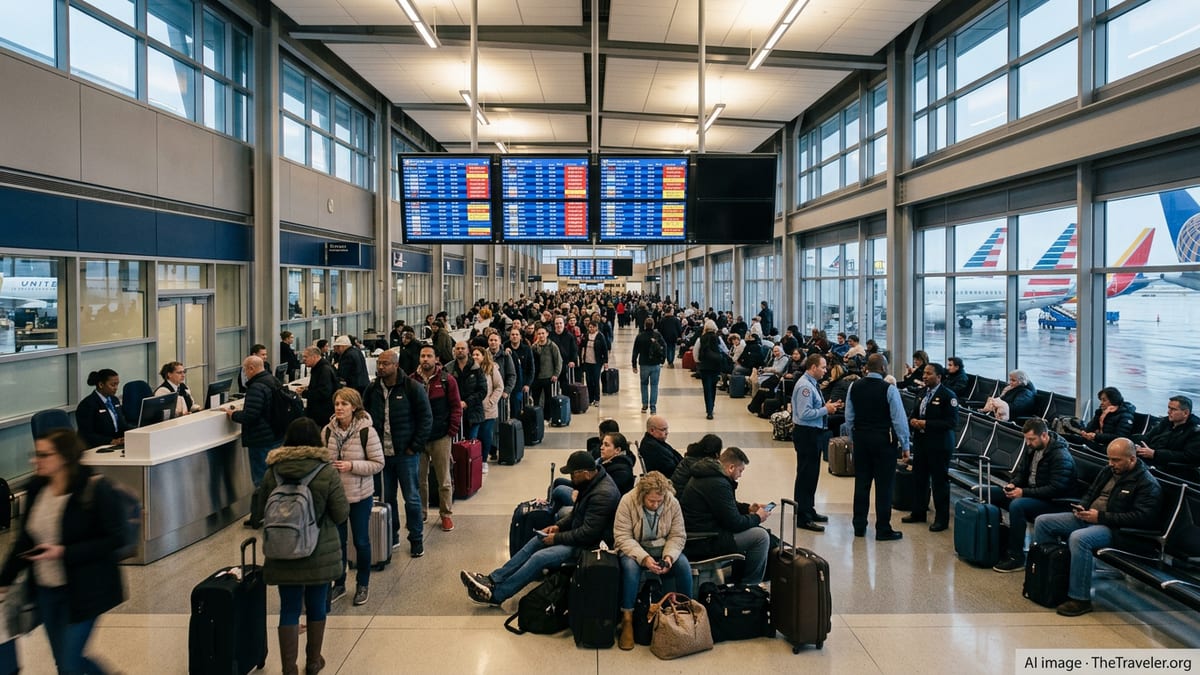
Inside O’Hare’s sprawling terminals, the operational challenges translated into crowded gate areas, long lines at service desks and packed food courts as passengers waited out new departure times. Families returning from school-holiday trips, business travelers racing to make meetings and international visitors connecting through Chicago all contended with uncertain plans.
Airport staff moved additional personnel into key pinch points, including check-in halls and security lanes, to help manage the swell of affected travelers. Digital displays and public address announcements were updated frequently as airlines adjusted departure times and reallocated gates in response to shifting operational constraints.
Despite the frustrations, most services at the airport continued to function normally, with train links to downtown Chicago, parking operations and concessions remaining open. Still, for many passengers facing missed events, lost workdays or disrupted vacations, the day’s disruptions underscored how quickly weather and congestion at a single major hub can upend carefully laid plans.
Several passengers arriving from the United Kingdom reported that their transatlantic segments had arrived close to schedule, only to face hours-long waits for onward flights to U.S. and Canadian cities. Others found their return journeys cut short by cancellations at the Chicago end, forcing overnight stays or last-minute changes to routing.
Ripple Effects Felt on UK and Canada Routes
With O’Hare serving as a key connecting point for transatlantic flights, disruptions quickly radiated onto services linking the United States with major airports in the United Kingdom, including London Heathrow, London Gatwick and Edinburgh. Even modest delays on feeder flights into Chicago left some passengers with too little time to clear security checks and reach their departing long-haul gates.
On Canada-bound routes, travelers saw a mix of outright cancellations and rolling delays to cities such as Toronto, Montreal and Vancouver, as airlines worked to realign aircraft and crews affected by the conditions in Chicago. For some, that meant being rebooked via alternate U.S. hubs or even rerouted through other Canadian gateways in order to reach smaller regional destinations.
Travel agents said the latest disruptions highlight the vulnerability of complex hub-and-spoke networks to localized weather events at central connecting points. O’Hare’s position as a primary gateway for both U.S. domestic traffic and international services means irregular operations there can have outsized effects far beyond the Midwest.
For U.K. and Canadian travelers visiting the United States, the day’s events were a reminder of the value of longer connection times, flexible tickets and up-to-date contact details with airlines to ensure timely rebooking messages reach them when plans change unexpectedly.
Advice for Travelers Moving Through Chicago
Travel experts urged passengers with upcoming itineraries through Chicago to monitor their flight status closely and build in extra time for connections, particularly during periods of active weather across the Great Lakes region. Many recommended downloading airline apps, which often provide the earliest updates on gate changes, crew issues and rolling delays.
For those whose flights are canceled, specialists advise acting quickly to secure alternative arrangements, as available seats on later flights or through alternate hubs can disappear rapidly during widespread disruption. Passengers are also encouraged to check whether their tickets qualify for fee-free changes or travel credits when delays or cancellations are linked to weather and airspace constraints.
Ongoing weather patterns in the Midwest mean that sporadic delays at Chicago’s airports are likely to continue over the coming days, even as airlines work to restore normal schedules. Travelers with time-sensitive commitments, such as international cruises, important business meetings or events, may wish to consider earlier departures or routings that avoid tight connections through Chicago.
While Tuesday’s total of dozens of cancellations and hundreds of delays represents only a fraction of O’Hare’s overall daily traffic, the disruption served as a pointed reminder that when a major hub stumbles, the shock waves can be felt by U.S. travelers and their international counterparts on both sides of the Atlantic and across the Canadian border.