

More news on this day
Escalating tensions around the Strait of Hormuz are rippling through the global cruise industry, as European operator TUI and other major lines cancel Middle East sailings while ships remain trapped in ports across the United Arab Emirates and Qatar.
Get the latest news straight to your inbox!
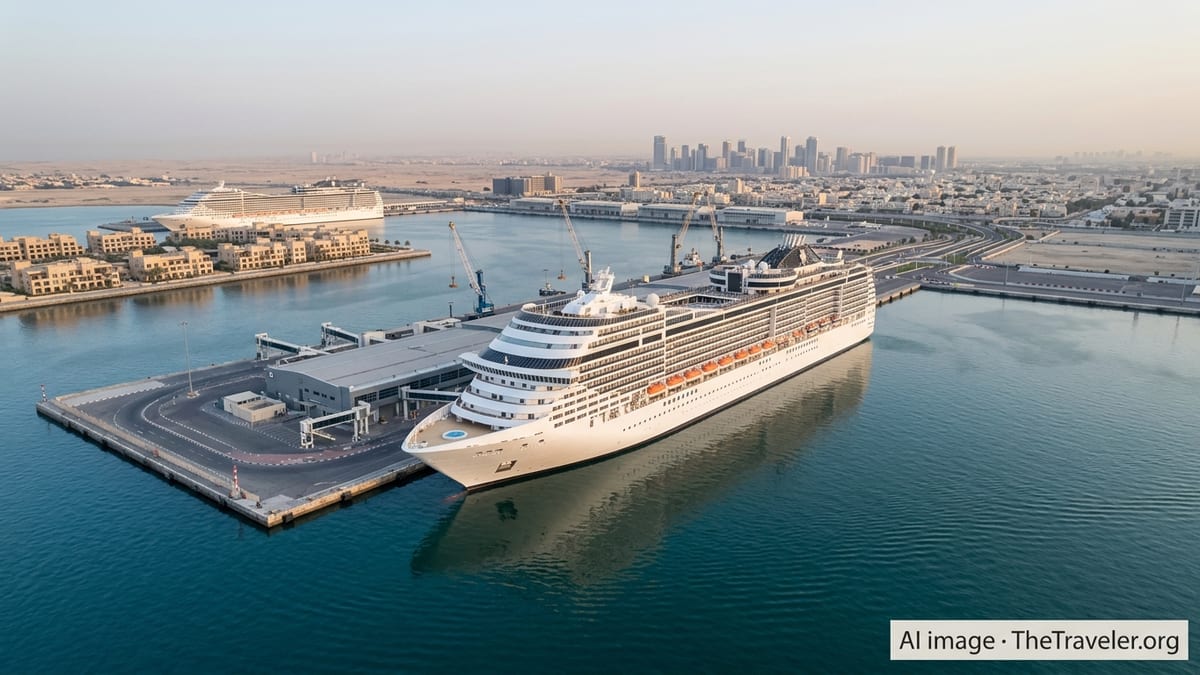
Ships Trapped in UAE and Qatar as Key Waterway Seizes Up
Publicly available tracking data and regional reports show that at least two TUI Cruises vessels, Mein Schiff 4 and Mein Schiff 5, remain unable to leave their Gulf bases. Mein Schiff 4 is berthed in Abu Dhabi, while Mein Schiff 5 is alongside in Doha, mirroring a wider paralysis affecting multiple international cruise brands in the region.
The shutdown stems from the 2026 Strait of Hormuz crisis, in which heightened military activity, missile strikes and maritime security alerts have effectively rendered the narrow shipping lane impassable for most commercial passenger traffic. Security advisories issued in early March describe a sharp reduction in vessel movements through the strait, with owners advised to avoid transits due to elevated risk.
Although ports such as Dubai, Abu Dhabi and Doha technically remain operational, the inability of large cruise ships to safely exit the Gulf without crossing the Strait of Hormuz has turned terminals into temporary parking lots. Several vessels that were scheduled to reposition to Europe for the spring and summer season have been forced to stay in place, complicating global deployment plans.
The disruption comes at a critical moment for the Gulf’s growing cruise tourism sector. In recent years, winter itineraries based from the UAE and Qatar had become a key pillar of regional tourism strategies, attracting European and Asian passengers seeking warm-weather voyages between November and March.
TUI Cancels Gulf Itineraries and Halts Season Plans
According to recent trade and travel industry coverage, TUI Cruises has formally cancelled its current Gulf itineraries and suspended remaining voyages that would have required transiting the Strait of Hormuz. The company’s winter program had included sailings that combined UAE ports with calls in Oman and other regional destinations, with ships due to return to Europe in late March and April.
Instead, Mein Schiff 4 and Mein Schiff 5 are now effectively laid up in Abu Dhabi and Doha, with publicly available schedules and port reports indicating no confirmed departure dates. Travel-focused outlets describe the cancellations as part of a wider wave of itinerary withdrawals across the Arabian Gulf as cruise lines reassess risk and await clarity on when the vital waterway might reopen to regular traffic.
TUI had previously adjusted deployment in nearby regions due to security concerns, including cancelling Red Sea itineraries for Mein Schiff 4 in an earlier phase of the broader Middle East crisis. The latest Strait of Hormuz shutdown extends those challenges further east, eliminating a key winter homeport region that had been marketed heavily to German-speaking and European guests.
Passengers booked on affected Gulf cruises are being offered refunds and rebooking options on alternative itineraries, according to consumer-facing updates and media coverage. However, industry analysts suggest that rerouting capacity at short notice in the busy spring and summer period will be complex, particularly for ships designed and staffed around a specific seasonal program.
Stranded Passengers Highlight Wider Travel Disruption
The cruise standstill is unfolding against a backdrop of broader transport disruption linked to the conflict. Aviation advisories and regional media reports indicate that airspace closures and heavily reduced flight schedules have complicated efforts to move cruise guests and crew in and out of major Gulf hubs, notably Dubai and Doha.
Travel publications describe thousands of passengers initially stranded on board or in hotels as lines worked to arrange repatriation via limited available routes. Some ships disembarked guests in Dubai in early March once it became clear that onward cruising was impossible, while others have remained alongside with skeleton operations as companies coordinate logistics and crew deployments.
The combination of a blocked maritime chokepoint and constrained air connectivity has underlined the vulnerability of cruise operations in politically sensitive regions. Commentators note that while cruise lines routinely adjust itineraries for storms or isolated incidents, a near-total closure of a major global shipping artery is a far more disruptive scenario.
For travelers, the episode has become another reminder of how quickly complex, multi-leg trips involving flights and cruises can be upended by geopolitical events. Coverage in travel media highlights a surge of questions around insurance coverage, rebooking rights and the flexibility of future bookings in regions perceived as higher risk.
Global Cruise Networks Scramble to Redeploy Capacity
The Strait of Hormuz crisis is not only a regional setback but also a scheduling shock that reverberates through global cruise networks. Ships that were due to reposition from the Gulf to the Mediterranean or Northern Europe now face uncertain timelines, leaving operators to improvise alternative deployment plans on short notice.
Industry reports indicate that some lines are considering extended layups in Gulf ports until safe passage is restored, while others explore the possibility of moving ships via alternative routes once regional advisories are relaxed. However, rerouting around the Arabian Peninsula to reach the Red Sea and Suez would still expose vessels to other active risk zones, making long detours less attractive.
The disruption also feeds into a broader pattern of itinerary reshaping that began with earlier crises in the Red Sea and Eastern Mediterranean. Several brands had already withdrawn or reduced programs in those waters, shifting capacity toward Europe’s Atlantic coasts, the Caribbean and other comparatively stable regions. The latest escalation in the Strait of Hormuz further narrows the map of viable warm-weather itineraries for the northern winter.
Analysts quoted in cruise and shipping publications suggest that operators may accelerate diversification away from choke points such as Hormuz and the Bab el Mandeb Strait, favoring regions with multiple routing options and stronger risk mitigation infrastructure. Such a shift would likely influence ship design, fuel planning and port investment decisions in the coming years.
Economic Fallout for Gulf Tourism and Ports
The halt in cruise traffic is expected to have a meaningful economic impact on Gulf destinations that have invested heavily in terminals, marketing and related infrastructure. Reports from regional business outlets point to the loss of spending by thousands of cruise visitors who would normally transit through Dubai, Abu Dhabi, Doha and nearby ports during the winter and early spring months.
Local tour operators, guides, transport providers and retail businesses near cruise terminals are among those most immediately affected. For ports, the absence of large passenger ships removes a high-visibility revenue stream just as many authorities were working to position their cities as marquee cruise gateways between Europe and Asia.
At the same time, container and energy shipping disruptions linked to the Strait of Hormuz crisis are adding pressure to Gulf economies, raising logistics costs and complicating import flows. While some cargo can be diverted to alternative ports on the Arabian Sea, the closure of a central corridor increases voyage times and insurance costs, which can ultimately filter through to consumer prices.
For now, observers expect cruise lines, tourism boards and port authorities to focus on crisis management and short-term mitigation, including support for affected workers and businesses. The speed and stability of any eventual reopening of the Strait of Hormuz will be a central factor in determining how quickly Gulf cruise tourism can recover and whether operators such as TUI will be willing to commit ships to the region in future seasons.