

More news on this day
Passengers across Europe are confronting another bruising month of air travel disruption in April 2026, as weather damage, labour unrest and conflict-linked airspace closures combine to strand travellers at some of the continent’s busiest hubs.
Get the latest news straight to your inbox!
Storm Damage Keeps Schedules Fragile at Major Airports
Operational data from flight compensation and tracking services indicates that severe weather sweeping Western and Northern Europe at the turn of March into April continues to ripple through airline schedules, with nearly 500 flights disrupted across major hubs including Frankfurt, Munich, Madrid, London Heathrow and Oslo in the first days of the month. While runways and terminals remain open, the lingering effects of high winds and earlier ground stoppages are limiting capacity and narrowing the margin for recovery when fresh problems arise.
Frankfurt and London, already stretched by heavy transfer traffic, have been especially vulnerable to these knock-on effects. Each cancellation at a hub removes an aircraft and crew from subsequent rotations, which then cascades into further schedule gaps at outstations across the continent. For connecting passengers, even modest weather delays are translating into missed onward flights and unexpected overnight stays.
Travel advisors and consumer platforms are reporting that passengers whose trips involve multiple European connections are among the hardest hit. Tight connection windows designed for normal conditions have become risky as airlines work through backlogs, with aircraft and crew still out of position from the late March storms.
European aviation analysts note that the pattern follows a familiar post-disruption script: once bad weather punches a hole in the schedule, the system can take days to rebalance. With Easter holiday demand still elevated in early April, seats on alternative flights are scarce, leaving many travellers effectively stuck at the first point of failure in their itinerary.
Strikes in Germany and Italy Trigger Fresh Groundings
On top of weather-related fragility, April has brought a new round of labour action affecting key aviation markets. In Germany, reports from specialist travel outlets describe how a Lufthansa cabin crew walkout at Frankfurt on 10 April led to the cancellation of around 580 flights, representing roughly three quarters of the airline’s scheduled departures at the country’s primary hub. Estimates suggest that tens of thousands of passengers saw their plans collapse in a single day, with many unable to secure same-day alternatives.
Because Lufthansa uses Frankfurt and Munich as central connection points, the strike’s impact quickly spread beyond Germany. Aircraft that were due to operate onward sectors to other European cities never left their stands, leaving return legs from destinations such as Paris, Amsterdam and Rome without inbound aircraft. Travellers who had already flown the first segment of their journey found themselves stranded mid-itinerary, often in airports far from home.
Italy has faced its own turmoil. Coverage from aviation-focused publications describes a nationwide air traffic control walkout on 10 April that triggered more than 450 flight cancellations across Rome, Milan and other Italian gateways. The strike window officially lasted four hours, but the disruption stretched across the day as morning arrivals bunched together and afternoon departures struggled to depart on time once restrictions lifted.
At Rome Fiumicino and Milan Malpensa, passengers reported long queues at customer service desks as carriers attempted to rebook disrupted travellers. Minimum service rules kept some protected flights operating, but many leisure and business itineraries scheduled through the middle of the day were abandoned, creating fresh clusters of stranded travellers just as German hubs were attempting to recover from their own cancellations.
Middle East Conflict Sends Shockwaves Through European Networks
The flight chaos in Europe this April is also being shaped by events far beyond the continent’s borders. Ongoing conflict in the Middle East has led to extensive airspace closures over countries including Iran and Iraq, interrupting traditional corridors between Europe, the Gulf and South Asia. Coverage from international media and industry briefings indicates that hundreds of flights have been cancelled or rerouted since late February, with the knock-on effects still evident in April schedules.
Airports such as London Heathrow, Paris Charles de Gaulle, Frankfurt and Amsterdam have been central to emergency rerouting and repatriation efforts. As long-haul flights are diverted or consolidated, aircraft and crews that would normally feed European short-haul networks are tied up on lengthy detours, causing further cancellations on intra-European routes. Travellers who began their journeys in Asia or the Gulf are finding that, even if they reach Europe, their onward connections within the region may no longer exist.
Jet fuel supply concerns are adding another layer of uncertainty. Recent European coverage has highlighted warnings from airport associations and airline groups about potential fuel shortages if oil shipments through the Strait of Hormuz remain constrained. While large-scale fuel-related cancellations have not yet materialised in April, carriers are already trimming some frequencies and building additional buffers into schedules, which reduces available capacity for rebooking stranded passengers from other disrupted flights.
For travellers, the result is a complex web of indirect consequences. A cancellation rooted in airspace closures or fuel logistics on a long-haul sector can eventually strand passengers trying to complete a short hop between two European cities, particularly when their journey relies on a single through-ticket with limited alternative options.
Amsterdam, London and Other Hubs Buckle Under Combined Pressures
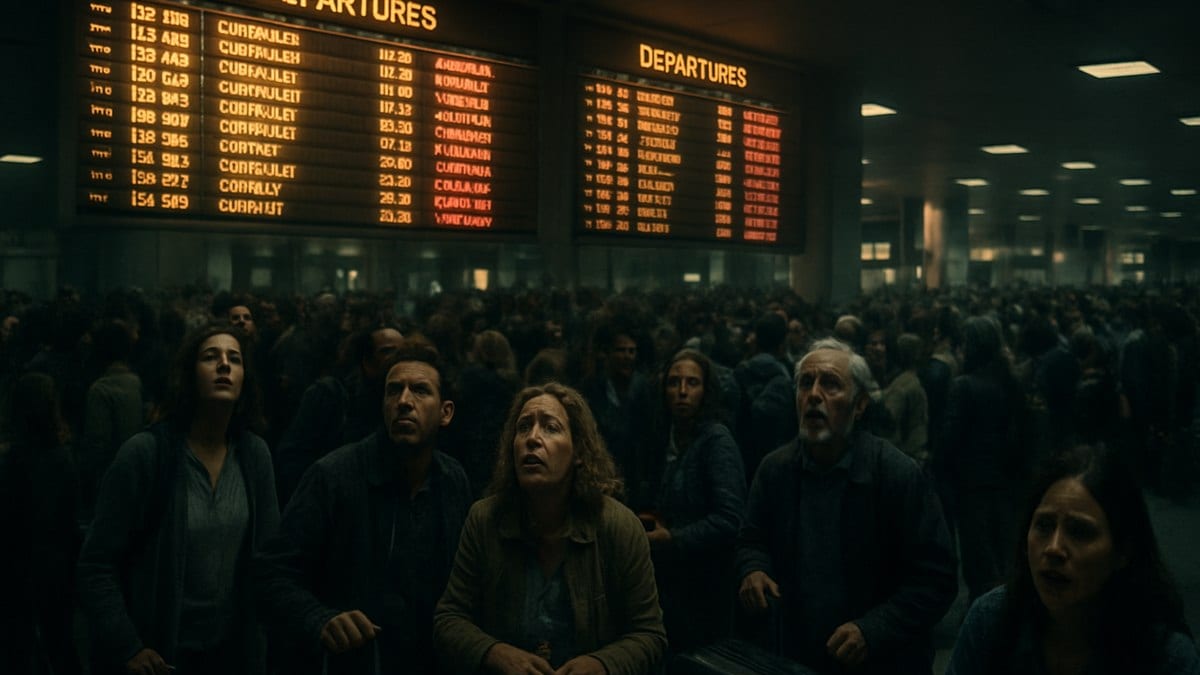
Several of Europe’s busiest airports have emerged as pressure points where the different strands of disruption converge. Reporting from regional outlets on 11 April describes more than 100 flights cancelled across Amsterdam Schiphol and other major airports in a single day as airlines including Lufthansa, Air France, easyJet and KLM cited operational disruption and airspace congestion. Passenger images shared with local media show crowded departure halls and densely packed rebooking counters.
Data compiled by travel industry publications for the first half of April indicates that Heathrow, Charles de Gaulle, Frankfurt and Schiphol have faced repeated waves of delays and cancellations linked to storms, strikes and long-haul network upheaval. When one hub experiences a sudden cut in capacity, the others often struggle to absorb diverted aircraft and displaced passengers, leading to rolling queues and missed connections across the region.
Smaller but strategically located airports such as Copenhagen and Milan Malpensa have also felt the strain. Even modest numbers of cancellations and delays at these secondary hubs can cause outsized disruption because they often serve as the final connection point for travellers heading to regional cities that see only a few daily flights. If one of those limited services is cancelled, passengers may have to wait many hours, or even an extra day, to reach their destination.
European passenger advocacy groups are warning that April’s events highlight persistent system weaknesses exposed in earlier crises. Despite investments in digital rebooking tools and contingency planning since the pandemic, many travellers are still finding that, when multiple disruptions collide, there are insufficient spare seats, staff and information channels to manage the surge of stranded customers efficiently.
Travellers Brace for a Prolonged Period of Uncertainty
Industry forecasts suggest that the turbulence seen in early April may not ease quickly. Weather agencies are tracking additional Atlantic storm systems capable of disrupting Western European airspace, while unions in several countries have signalled that further industrial action remains possible if ongoing pay and staffing disputes are not resolved. At the same time, geopolitical and fuel supply risks tied to the Middle East conflict show few signs of rapid improvement.
European consumer organisations and travel advisors are therefore urging passengers to approach upcoming trips with a heightened level of risk awareness. Long connecting itineraries routed through multiple hubs are particularly vulnerable. Publicly available guidance stresses the importance of checking flight status repeatedly in the 24 hours before departure, allowing extra time at airports already experiencing backlogs and preparing contingency plans in case overnight accommodation becomes necessary.
For airlines and airports, April 2026 is becoming another test of resilience in an era where weather extremes, labour disputes and geopolitical shocks often collide. With hubs from Frankfurt to Rome and Amsterdam to London still working through backlogs, travellers across the continent are facing the prospect of further days and weeks in which a routine journey can quickly turn into an unplanned stay in a crowded terminal.