

More news on this day
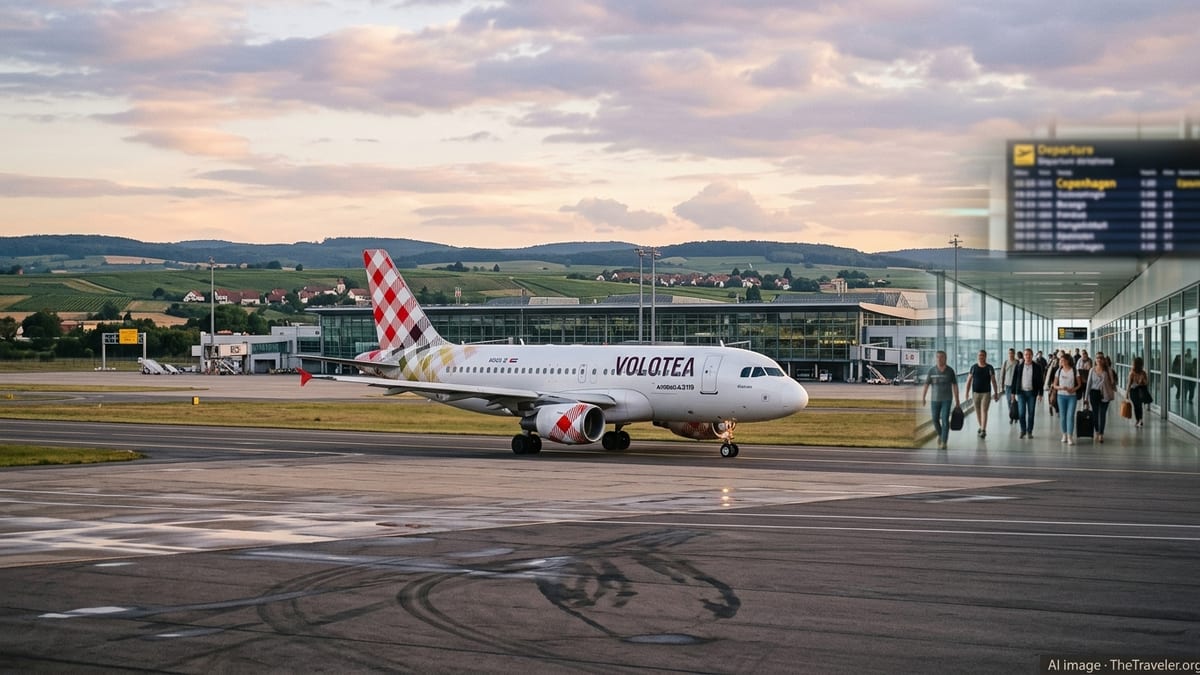
Tourism and business links between the French city of Strasbourg and the Danish capital Copenhagen are set to tighten, as a newly designated public service air route operated by low-cost carrier Volotea begins to take shape within the European Union’s growing network of subsidised regional connections.
Get the latest news straight to your inbox!
A New Public Service Route on the European Map
According to documents published in the Official Journal of the European Union, France has imposed a public service obligation on scheduled air services between Strasbourg and Copenhagen, formally recognising the route as essential for regional connectivity and economic development. The measure follows an order dated 15 October 2025, which sets out the conditions under which carriers may operate the link with possible public support if commercial viability cannot be guaranteed.
Publicly available information shows that Volotea, already the leading airline at Strasbourg Airport by number of destinations, has been expanding its role on other public service routes such as Strasbourg to Munich. Industry reports indicate that this experience with delegated public service contracts positions the carrier as a natural contender to operate the Strasbourg–Copenhagen service under the new framework.
While detailed operational schedules for the Strasbourg–Copenhagen route have yet to be widely circulated, the PSO designation signals that regular, year-round connectivity between the two cities is intended, with minimum service levels and capacity likely to be specified by national authorities. For tourism stakeholders, the move points to a more predictable flow of visitors and a stronger basis for long-term planning.
The Strasbourg–Copenhagen link also fits within the wider European policy objective of safeguarding air access for regions where rail or road alternatives are limited in terms of journey time, particularly for cross-border itineraries. In this sense, the route is expected to serve not only leisure travellers, but also institutional, corporate and academic passengers moving between two important northern European hubs.
What the Route Means for Tourism in Strasbourg and Copenhagen
For Strasbourg, often described as a European capital due to the presence of the European Parliament and several international institutions, the new route brings easier access from Scandinavia at a time when the city is broadening its appeal beyond institutional travel. Direct flights from Copenhagen have the potential to attract more city-break visitors drawn by Strasbourg’s half-timbered old town, festive markets and wine routes, who previously might have relied on longer connections via Paris, Frankfurt or Amsterdam.
Copenhagen, already a well-established city-break favorite, could see a rise in inbound visitors from France’s Grand Est region and neighboring Germany and Switzerland, for whom Strasbourg is a convenient departure point. Travel industry observers note that Scandinavia remains a growth market for urban and culinary tourism, design-focused experiences and cycling-friendly city stays, all of which Copenhagen offers in abundance.
Tour operators and destination marketing bodies are likely to explore themed itineraries combining the two cities, including twin-city weekends, institutional visits and cultural exchanges. With Strasbourg’s Alsatian villages and wine country within easy reach, and Copenhagen’s access to coastal landscapes and nearby Swedish cities across the Øresund Bridge, the new route could underpin multi-destination trips that link northern and central Europe in a single journey.
The route is also expected to benefit the meetings and events sector. Both cities host international conferences, and the presence of a PSO-backed air link may influence organisers who weigh accessibility heavily when selecting venues. Increased frequency during peak congress and holiday periods would further strengthen this appeal.
How Public Service Obligations Shape Air Connectivity
Under EU rules, member states may impose public service obligations on air routes considered vital for a region’s economic and social cohesion, particularly where market forces alone do not guarantee sufficient service. In practice, this can lead to a tender procedure in which airlines bid to operate the route, sometimes with financial compensation for possible losses, in exchange for meeting specific frequency, capacity and pricing conditions.
The Strasbourg–Copenhagen decision places the route alongside other PSO connections involving Strasbourg, such as Strasbourg–Amsterdam and Strasbourg–Munich, which have been listed in European Commission transport documentation. Together, these links illustrate how public policy is being used to maintain air access from the Grand Est region to key northern European hubs.
Volotea has already taken the lead on the Strasbourg–Munich public service route, with announcements detailing a two-year contract and twice-weekly operations using Airbus A320 aircraft. Industry coverage highlights that this arrangement expands Volotea’s Strasbourg network to more than two dozen destinations across several countries, reinforcing its position as a cornerstone carrier for the airport.
Observers point out that the same model could apply to Strasbourg–Copenhagen, with authorities defining minimum service levels and airlines responding through a competitive tender. The outcome is designed to balance commercial realities with the broader public interest of secure, year-round air connectivity for regions that might otherwise face reduced links.
Practical Considerations for Travellers
For passengers, one of the main advantages of a PSO-backed route is the expectation of continuity and regularity in the schedule, which can be particularly important for business travellers and frequent visitors. When an airline is selected under a public service contract, authorities typically specify a minimum number of weekly flights, seasonal coverage and sometimes maximum fare levels on certain booking classes.
Although final timetables and exact launch dates for the Strasbourg–Copenhagen route will depend on the outcome of contractual and operational processes, travellers can anticipate options that are more convenient than current one-stop itineraries via major hubs. Direct flights should reduce total journey times and eliminate the uncertainty associated with tight connections, especially in peak travel seasons.
Travel planning platforms and airline booking systems are expected to integrate the new route once schedules are confirmed, allowing passengers to combine Strasbourg–Copenhagen flights with wider European networks. For example, connections through Copenhagen could open up smoother itineraries from eastern Denmark and parts of Sweden toward Strasbourg and the Upper Rhine region, while Strasbourg’s links to southern Europe could become more accessible from Scandinavia.
Passengers are advised to pay attention to luggage allowances, ancillary fees and ticket flexibility policies, which can vary significantly between carriers even on subsidised routes. While PSO contracts focus on connectivity, standard low-cost carrier conditions on extras and change fees are likely to apply unless promotional or negotiated fares are introduced.
Environmental and Regional Development Dimensions
The launch of a new international route in Europe invariably raises questions about environmental impact, especially as many travellers and policymakers seek to limit short-haul flying where viable rail alternatives exist. In the case of Strasbourg–Copenhagen, reports and traveller guides indicate that overland journeys typically involve multiple connections and long travel times, making air service a more competitive option for many itineraries.
Volotea has highlighted separate initiatives relating to sustainable aviation fuel use on selected routes in France and Germany, signalling an interest in reducing lifecycle emissions where possible. While there is no specific confirmation yet regarding sustainable fuel usage on the Strasbourg–Copenhagen service, the airline’s broader strategy will be closely watched by travellers who factor environmental credentials into their choice of carrier.
From a regional development perspective, the new route underlines the importance of Strasbourg as a gateway for eastern France and the Upper Rhine, and of Copenhagen as a key entry point to Scandinavia. Tourism boards and local authorities on both ends of the route are expected to monitor passenger numbers, overnight stays and visitor spending to assess the impact of enhanced air connectivity.
Should the Strasbourg–Copenhagen route achieve sustained demand, analysts suggest it may support additional investment in tourism infrastructure, from hotel capacity to conference facilities and local transport upgrades. Equally, the PSO framework ensures that performance and public value will be evaluated periodically, shaping decisions on renewals or adjustments to the service in the years ahead.