

More news on this day
Thousands of commuters and visitors in Germany are facing severe disruption as strikes and lingering winter weather combine to cripple urban transport in major cities including Berlin, Hamburg, Munich, Cologne, Nuremberg and Frankfurt, leaving passengers stranded on platforms, packed into replacement buses and scrambling for alternative routes.
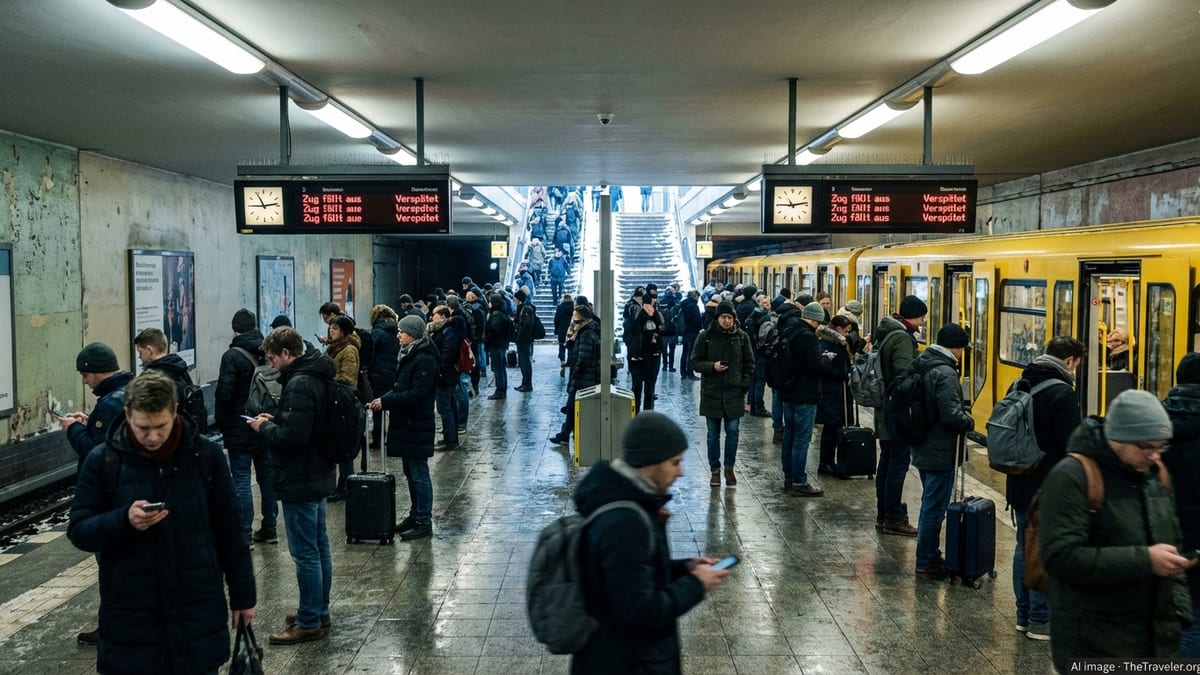
Nationwide Strikes Hit U-Bahn, Trams and City Buses
Public transport workers across Germany began a coordinated 48-hour strike on Friday, February 27, sharply reducing or completely halting local rail, tram and bus services in all 16 federal states. The walkout, called by the powerful Verdi union, targets city-run systems rather than the national rail operator, but its impact is being felt most acutely in dense urban networks that rely on high-frequency underground and suburban lines.
In Berlin, large parts of the U-Bahn and tram network operated by BVG are at a standstill, with only a skeletal emergency timetable in place on a handful of routes. Hamburg’s S-Bahn and U-Bahn connections have been heavily thinned out, forcing commuters onto already crowded replacement buses or into traffic jams on key arteries into the city.
Munich, Cologne, Nuremberg and Frankfurt are reporting similar scenes, with early-morning passengers finding shuttered stations, “no service” notices on electronic boards and long queues forming at remaining bus stops. Transport authorities in several cities are urging people to work from home where possible and to avoid non-essential journeys during the strike window.
The industrial action is the latest escalation in a collective bargaining dispute affecting around 100,000 municipal transport workers. Unions argue that mounting staff shortages, unsocial working hours and rising living costs have pushed systems to breaking point and say they will not rule out further strikes if talks fail.
Berlin, Hamburg and Munich Networks Under Intense Pressure
Germany’s three largest metropolitan rail systems are under particular strain as the strike coincides with ongoing infrastructure problems and the after-effects of a harsh winter. In Berlin, where U-Bahn, tram and bus services form the backbone of daily mobility, suspended lines have led to severe overcrowding on remaining S-Bahn routes and long-distance Deutsche Bahn trains that continue to operate.
Hamburg, which had already seen repeated weather-related disruptions this winter, is experiencing bottlenecks around key interchanges as commuters shift to S-Bahn and regional trains that are not directly targeted by the walkout. With roadworks and temporary highway closures further constricting access to the city, local authorities are warning of knock-on congestion throughout the weekend.
Munich, still dealing with public anger after recent snow-related chaos that stranded air passengers overnight at the city’s airport, is witnessing packed platforms and significant delays on suburban rail as riders avoid shuttered tram and U-Bahn lines. City officials there say park-and-ride car parks are full much earlier than usual, while taxi and ride-hailing services are reporting surging demand and longer waiting times.
Tourists in these cities, many of whom rely on integrated tickets that normally allow seamless transfers between buses, trams, U-Bahn and S-Bahn, are being caught out by patchy information and rapidly changing timetables. Hotel concierges and tourism offices report spending much of the day helping guests replan city sightseeing around the reduced services.
Spillover Disruption in Cologne, Nuremberg, Frankfurt and Beyond
The strike’s reach extends far beyond Germany’s largest three cities. In North Rhine-Westphalia, nearly all major urban centres, including Cologne and Düsseldorf, are reporting near-total shutdowns of local buses and trams, with only limited emergency lines running at extended intervals. In Nuremberg, the city’s U-Bahn and tram lines have been severely curtailed, with some corridors seeing no service at all during peak hours.
Frankfurt, a critical hub for both business travel and international tourism, is also feeling the strain. With trams and city buses largely idle, passengers arriving at the main station or the airport are finding it harder than usual to complete the last leg of their journey into the financial district or residential suburbs. Local authorities have warned of significant delays on the roads encircling the city centre as more commuters turn to cars.
Smaller and mid-sized cities are not spared. In places such as Kassel, Magdeburg and cities across Hesse and Saxony-Anhalt, local bus and tram networks are operating on drastically reduced timetables or not at all, cutting off outer districts and complicating access to schools, hospitals and workplaces. Rural districts that rely on feeder buses to connect villages to regional rail lines are seeing services suspended entirely for the duration of the strike.
Although Deutsche Bahn’s S-Bahn and long-distance ICE and IC services are formally outside the scope of the municipal strike, operators acknowledge that these lines are being used far beyond normal capacity, particularly in corridors linking satellite towns with major city centres. Trains that do run are frequently overcrowded, and delays are mounting as boarding and alighting times increase at busy stops.
Weather, Infrastructure Problems and Recent Chaos Compound the Crisis
The current strike is hitting a system already weakened by weeks of winter disruption and infrastructure strain. Heavy snow and ice earlier in the season forced cancellations of long-distance rail services in northern Germany and brought public transport to a standstill in parts of Hamburg and Bremen. In Berlin and other major hubs, a large-scale technical failure recently knocked out escalators and other station equipment, complicating station access for passengers with mobility issues.
On top of these issues, key rail corridors such as the high-speed line between Berlin and Hamburg remain affected by protracted renovation and modernisation work. Deutsche Bahn recently postponed the full reopening of this strategic route after a fresh bout of severe winter weather, raising concerns about the network’s resilience to future cold snaps.
Air travel has provided only limited relief. Munich Airport, for example, is still facing scrutiny after hundreds of passengers were left stuck overnight on grounded aircraft following a snowstorm in February. With air and road networks both showing vulnerabilities, many travellers feel there is little truly reliable alternative when urban rail and bus systems stop running.
Transport analysts say the confluence of labour disputes, ageing infrastructure and more frequent extreme weather events is creating a new kind of systemic risk for Germany’s mobility network. They warn that without accelerated investment and more flexible contingency planning, future shocks are likely to produce similar scenes of stranded passengers and cascading delays.
Passengers Scramble for Alternatives as Union Talks Drag On
For travellers caught up in the disruption, the strike is less about national policy debates and more about the immediate challenge of getting from A to B. Social media channels are full of images of packed platforms, improvised car shares and long queues at taxi ranks in Berlin, Hamburg, Munich and other affected cities. Commuters describe setting off hours earlier than normal or working from home at short notice after trains failed to appear.
Some cities are trying to cushion the blow. In a number of regions, authorities have relaxed parking restrictions near park-and-ride facilities and encouraged employers to adopt remote working where possible. Cycling associations are also reporting increased use of bike lanes, despite cold and occasionally icy conditions, as residents look for any reliable way to move around.
Union leaders have signalled that they are prepared to maintain pressure if employers do not come back to the bargaining table with more substantial offers on working hours, rest periods and pay supplements for night and weekend work. Employer representatives, for their part, warn that sweeping concessions could strain already tight municipal budgets, but acknowledge that staff shortages and high sickness rates are unsustainable.
With negotiations still deadlocked and travel chaos playing out in real time across Germany’s cities, passengers are bracing for further turbulence. Transport operators are advising travellers to check the latest local information before setting out, allow significant extra time for journeys and be prepared for last-minute changes as the disruption continues.